


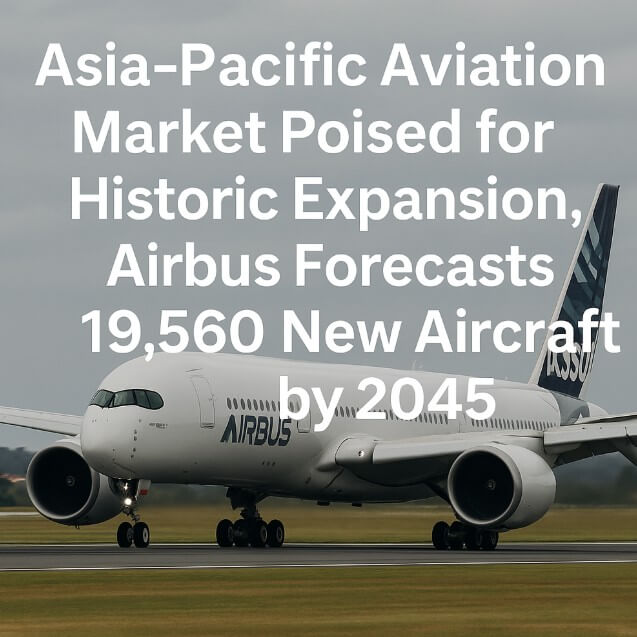
Toulouse — The Asia-Pacific region is on track to lead global aviation growth over the next two decades, with Airbus forecasting demand for 19,560 new aircraft through 2045. The world’s largest aircraft manufacturer projects that India and China will account for the lion’s share of these deliveries, reflecting surging economic development, a rapidly expanding middle class, and unprecedented demand for air travel across key urban centers.
The forecast, presented at the Association of Asia-Pacific Airlines Annual Assembly of Presidents in Bangkok, underscores the region’s pivotal role in shaping the future of global aviation. According to Airbus, airlines across Asia-Pacific are ramping up fleet modernization and expansion to meet the needs of a growing passenger base. Carriers such as Air India (AI) and IndiGo (6E) are at the forefront, placing substantial orders to keep pace with record-breaking travel demand.
“Airbus projects that the Asia Pacific will require 19,560 aircraft over the next two decades, representing 46% of the global forecast for 42,520 new deliveries,” the company stated. “This demand will be fueled by continued passenger growth, rising incomes, and expanded access to air travel.”
India and China Lead Demand Surge
India and China have emerged as central players in the region’s aviation expansion. Both markets are witnessing rapid increases in domestic and international traffic, supported by government investment in airport infrastructure and liberalized air policies. Analysts note that India’s low-cost carriers, particularly IndiGo, are aggressively adding capacity, while China’s “dual circulation” strategy is bolstering internal connectivity and outbound tourism.
According to Airbus, approximately 16,100 of the total aircraft required will be single-aisle jets, accounting for 47% of new global deliveries in that category. The growth is attributed to the rise of low-cost carriers and the proliferation of short-haul routes across the region. “Aircraft replacement and fleet growth are progressing in parallel as airlines optimize operations,” the manufacturer said.
The ongoing wave of fleet renewal aligns with broader efforts to reduce operating costs and improve environmental performance. Airbus highlighted that the region’s sustained demand, coupled with operational efficiency gains and the introduction of new route networks, is “reshaping commercial aviation across Asia.”
Wide-Body Demand Strengthens Long-Haul Ambitions
In addition to narrow-body aircraft, the Asia-Pacific market is expected to generate significant demand for larger models. The Airbus forecast points to roughly 3,500 new wide-body jets by 2045, representing 43% of global demand in the segment.
Airbus emphasized that next-generation wide-body aircraft now offer a 25% improvement in fuel efficiency, an advance that supports both profitability and sustainability objectives. “These efficiency gains are expected to help reduce carbon emissions while enabling airlines to serve long-haul routes more effectively,” the company stated.
Countries including India, China, Australia, and those across Southeast Asia are driving much of this long-haul growth. As international travel recovers and global business ties deepen, long-range connectivity remains a strategic priority for regional carriers.
Anand Stanley, President of Airbus Asia Pacific, described the moment as an inflection point for the region’s aviation sector. “The region is entering a significant growth phase supported by evolving market needs and expanding infrastructure,” he said.
Sustained Growth Drivers
Airbus identified several structural factors underpinning Asia-Pacific’s aviation momentum: robust economic expansion, urbanization, growing disposable income, and the increasing reach of low-cost carriers. These trends, combined with supportive regulatory environments and airport investments, continue to accelerate the sector’s development.
Asia-Pacific passenger traffic is expected to grow 4.4% annually, outpacing the global average of 3.6%, according to the forecast. This expansion is projected to maintain steady pressure on airlines to upgrade and expand their fleets. Airbus also noted that 68% of new aircraft deliveries will support fleet growth, while 32% will replace aging models as operators transition to more efficient designs.
Strategic Importance for Global Aviation
Industry observers view Airbus’s forecast as a reaffirmation of Asia-Pacific’s position at the forefront of global aviation. The combination of youthful populations, economic resilience, and rising intra-regional mobility makes the region an essential growth engine for manufacturers and airlines alike.
In the broader context, Airbus’s projection signals continued momentum in both narrow-body and wide-body categories, bolstered by fleet renewal programs and long-term investment in aviation infrastructure. The company’s 20-year outlook underscores the strategic weight of Asia-Pacific within the global aerospace market.
“Asia Pacific remains one of the most dynamic aviation markets, supported by strong demand in India and China and expanding air connectivity across the region,” Airbus concluded. “The region’s projected requirement for 19,560 new aircraft underscores its strategic importance to global air transport in the decades ahead.”
