


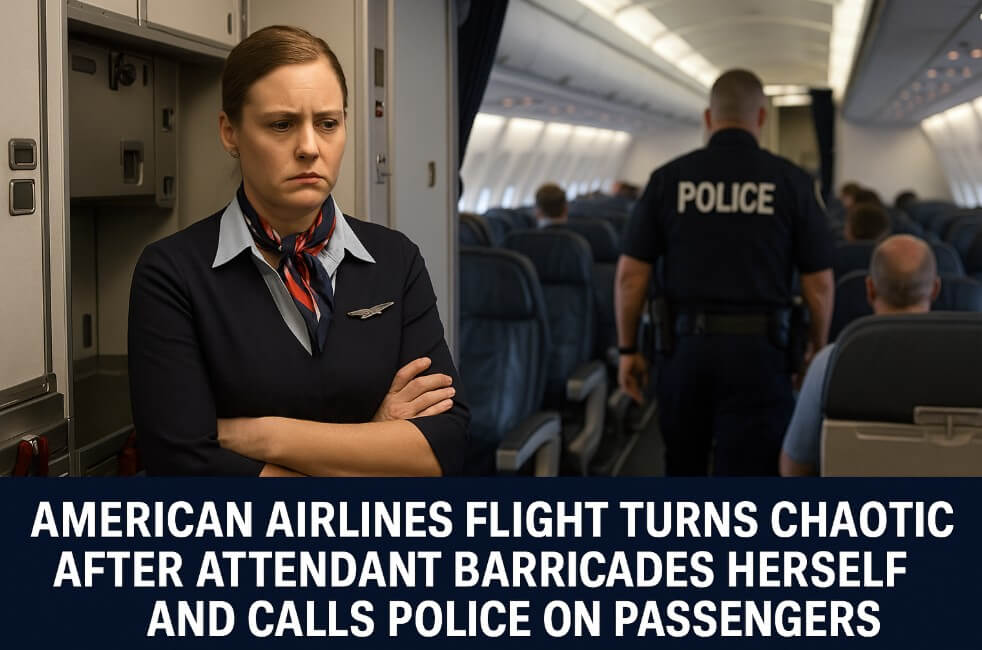
DALLAS — What began as a routine American Airlines flight from Las Vegas to Dallas on October 4, 2025, turned into an extraordinary scene of confusion and disbelief after a flight attendant locked herself in the galley and summoned police to confront several first-class passengers. The incident has since triggered an internal investigation by the airline and raised broader questions about crew conduct and training.
A Routine Flight Turns Tense
Flight AA3286, an Airbus A321 service from Las Vegas (LAS) to Dallas/Fort Worth (DFW), started on an unusual note. According to passengers, the pilot made a pointed announcement before departure warning that “no rudeness toward flight attendants would be tolerated.” The tone, travelers said, struck them as defensive and set an uneasy mood in the cabin.
Once airborne, passengers in the forward cabin reportedly waited more than an hour for service while those in economy had already been served. When a first-class passenger got up to request a drink, the lead flight attendant allegedly scolded him, then began serving drinks one at a time while repeatedly apologizing for issues no one had mentioned.
Tensions escalated when the attendant accused a seated passenger of reporting her to the captain — an accusation the traveler denied. Witnesses said the attendant then told the captain that the passengers were “mean,” “belligerent,” “probably drunk,” and “not first class.”
Barricade and Police Involvement
After those exchanges, the flight attendant reportedly declared that she would “call the union” and have “officers meet the plane.” She then locked herself inside the front galley and refused to complete service duties. Other members of the cabin crew were forced to step in to serve passengers for the remainder of the flight.
As the aircraft approached Dallas/Fort Worth, the situation intensified. Over the public address system, the attendant read out as many as ten passenger names and announced that police would be meeting them upon arrival.
Law enforcement officers were waiting at the gate when the plane landed. However, after interviewing passengers and crew, officers reportedly found no evidence of wrongdoing. According to accounts from those onboard, the officers laughed upon hearing passengers’ explanations and advised airline staff not to involve police in such disputes again.
Airline Confirms Investigation
American Airlines confirmed that the incident occurred and that an internal review is underway.
“Our goal is to provide a positive travel experience for all our customers. Our team has been in touch with several customers from this flight to learn more about their experience and address their concerns,” a company spokesperson said.
Some passengers have reportedly been offered compensation, though one declined. The airline has not disputed the key elements of the reports, signaling acknowledgment of the episode’s seriousness.
Broader Concerns Over Training and Culture
The unusual confrontation has reignited scrutiny of American Airlines’ service culture and conflict management. While most flight attendants are praised for professionalism, frequent travelers have increasingly cited inconsistent service and friction in premium cabins.
Industry observers note that other airlines have faced similar issues in the past and taken decisive steps to address them. Following the widely publicized “David Dao” incident, for example, United Airlines implemented de-escalation training and revamped its service policies.
American Airlines, by contrast, has struggled to maintain consistent standards, even after the pandemic highlighted gaps in service delivery and employee morale. Analysts suggest that management has not yet bridged the gap between increased compensation and customer experience improvements.
Despite the airline’s recent record-setting flight attendant contract, there have been few visible gains in onboard conduct or morale. Experts argue that leadership accountability and cultural clarity remain the missing ingredients.
Leadership and Accountability Questions
Delta Air Lines and Southwest Airlines are often cited as examples of airlines that maintain stronger service cultures. Delta emphasizes internal branding and pride in service, while Southwest is known for effective hiring and culture management despite a heavily unionized workforce.
American Airlines once touted that becoming one of its flight attendants was “harder than getting into Harvard,” highlighting its selectivity and high application volume. Yet incidents like this have led aviation analysts to question whether the airline’s problems lie not with its employees but with how leadership sets — and enforces — expectations.
“The issue isn’t the people—it’s the culture and the leadership,” one analyst said. “If crew members don’t have clear guidance and consistent accountability, even a great workforce can flounder.”
As American Airlines continues its investigation, industry experts say the outcome will be closely watched as a test of the carrier’s ability to manage customer relations and crew discipline in an era when travelers expect professionalism and calm, not confrontation, at 35,000 feet.
