


A Global Grounding With No Precedent
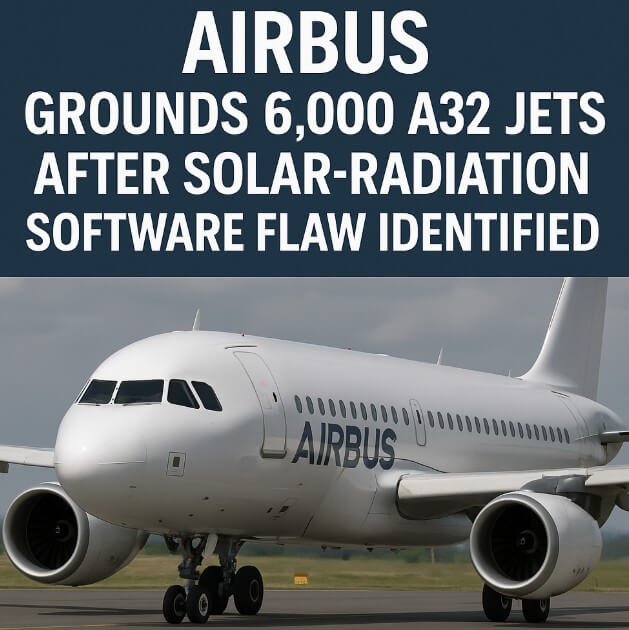
Airbus has grounded 6,000 aircraft across its A320 family after identifying a software vulnerability that can be triggered by intense solar radiation. The order, issued from its Toulouse headquarters, affects more than half of the world’s active A320 fleet—marking the largest grounding in the company’s 55-year history.
The global halt follows a severe October 2025 incident involving a JetBlue (B6) A320 operating from Cancun (CUN) to Newark (EWR). Mid-flight, the jet abruptly entered a nose-down pitch due to corrupted flight-control data. The crew diverted safely to Tampa (TPA), but the event prompted investigators to trace the failure to the aircraft’s ELAC 2 flight-control computer.
Regulators Move Swiftly
With the threat confirmed, the European Union Aviation Safety Agency (EASA) issued an emergency directive grounding all aircraft running the affected configuration until operators apply the required software fixes. Airlines across North America, Europe, Asia, and Latin America have since reported widespread disruptions as they work to comply.
Major U.S. carriers—American Airlines (AA), Delta (DL), United (UA), and JetBlue (B6)—are all experiencing delays and cancellations during an already busy travel season. In India, IndiGo (6E) and Air India (AI) warned passengers of schedule adjustments at key hubs such as Delhi (DEL) and Mumbai (BOM). Japan’s ANA (NH) canceled dozens of domestic flights, while Colombia’s Avianca (AV) temporarily suspended ticket sales after determining that most of its A320 fleet required immediate updates.
What Caused the Radiation-Linked Failure
The A320 family was an early pioneer of digital fly-by-wire technology, replacing mechanical controls with electronic systems that rely on stable, high-integrity data streams. ELAC, the component at the center of the investigation, manages aileron and elevator movements—key inputs for stable flight.
Solar storms occasionally send charged particles into Earth’s upper atmosphere, increasing radiation levels at cruising altitudes. These particles can disrupt electronic signals, leading to corrupted data. In the JetBlue event, such interference caused the ELAC system to trigger an uncommanded pitch movement.
Thales, the manufacturer of the ELAC hardware, noted that the affected behavior stems from software outside its scope, stating that it remains fully compliant with Airbus certification requirements.
The Fix: Short Downtimes for Some, Long Waits for Others
Airbus has announced a two-track solution based on aircraft age and onboard equipment.
Around 4,000 aircraft will receive a software rollback fix. This update can be installed within hours, meaning many airlines can complete repairs during overnight maintenance windows.
The remaining 1,000 older jets require hardware replacements. Because of global supply-chain bottlenecks and already stretched maintenance hangars, some of these aircraft are expected to face extended grounding periods.
Some carriers have already moved quickly. EasyJet (U2) reported completing updates early and anticipates normal operations resuming soon. Air Canada (AC) stated that only a small number of its A320s were using the vulnerable software.
Industrywide Strain Intensifies
The sudden grounding adds stress to an aviation sector already challenged by long maintenance backlogs and shortages of spare parts. Several Airbus models remain sidelined due to unrelated engine issues, and the new A320 directive compounds existing logistical pressures.
The timing is particularly notable: Airbus recently celebrated a major milestone when the A320 family surpassed the Boeing 737 as the most-delivered aircraft in aviation history. The mass grounding now forces manufacturers, regulators, and airlines to coordinate one of the largest technical interventions ever attempted on a commercial fleet.
Despite the disruption, Airbus emphasized that safety remains its top priority and expressed regret for the operational impact on airlines and passengers.
Stay tuned with us. Further, follow us on social media for the latest updates.
