


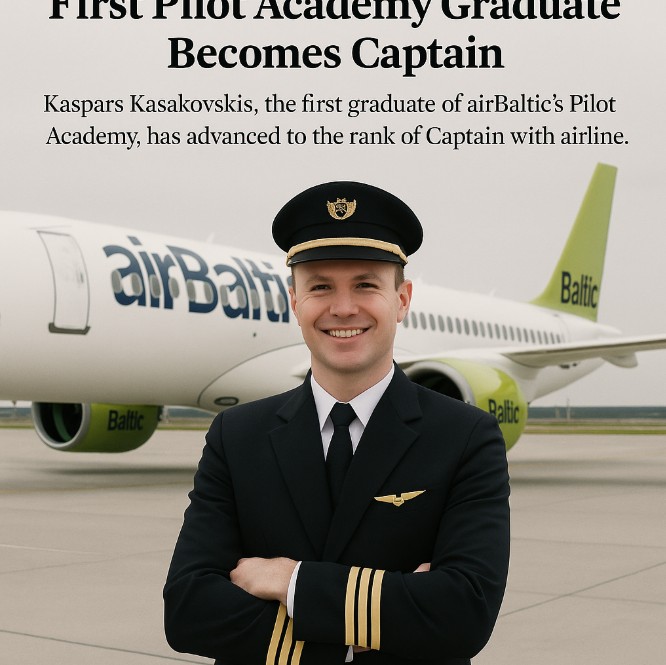
RIGA, Latvia — airBaltic, the flag carrier of Latvia, has reached a milestone in its pilot training program as the first graduate of its Pilot Academy has advanced to the rank of Captain, underscoring the airline’s investment in developing in-house aviation talent.
Kaspars Kasakovskis, who joined the academy in 2018 as part of its inaugural class of 12 cadets, has successfully completed his upgrade to Captain, becoming the first alumnus to achieve the position. The promotion marks a symbolic step for the Riga-based airline, which has made pilot training a cornerstone of its growth strategy.
Leadership Applauds Training Success
AirBaltic executives praised the achievement as a reflection of the academy’s effectiveness in creating a pipeline of skilled pilots.
“Kaspars’ accomplishment is a proud moment for him and a landmark for airBaltic and our Pilot Academy,” said Pauls Cālītis, Interim CEO of airBaltic. “It showcases the strength of our training program and the clear career path we’ve created—from cadet to Captain.”
Cālītis added that the milestone reflects not only the determination of Kasakovskis but also the broader commitment of the airline’s training team. “Kaspars’ journey reflects the dedication and passion of our entire team. Every academy graduate carries the future of airBaltic, and Kaspars is a shining example of what’s possible.”
Vilmantas Vaclovas Mažonas, CEO of airBaltic Training, echoed the sentiment, emphasizing the long-term vision behind the program. “Since launching the Pilot Academy, we’ve built a modern, high-quality program for aspiring pilots,” he said. “Our academy has earned international recognition, evidenced by strong demand from students and the success of our graduates. Kaspars’ promotion to Captain underscores the lasting value our academy brings to students and the aviation industry as a whole.”
Building a Pipeline of Pilots
The airBaltic Pilot Academy currently hosts 140 active students, drawing primarily from the Baltic region but also attracting aspiring aviators from across Europe, including Denmark, Germany, France, Finland, Spain, and Italy. The program has also made strides toward gender diversity, with women making up more than 10% of the student body.
Since its inception, 138 graduates have joined airBaltic as employees. Most serve as First Officers, while others have advanced into instructor roles, reflecting a steady progression from the classroom to the cockpit.
The academy is preparing for its largest graduating class yet, with more than 20 students set to complete their studies at the start of the new academic year. The expansion signals strong demand for the program and the airline’s capacity to integrate graduates into its operations.
Financial Accessibility and Advanced Training
Students enrolling in the academy cover initial training costs—€25,000 for ATPL theory studies and 45 flight hours—but those who pass airBaltic’s pilot assessment and join the airline gain access to financing for the remainder of their training through a loan structure. The model is designed to make the program accessible while ensuring students are aligned with the airline’s hiring needs.
In addition to academic coursework and flight training, the academy leverages advanced simulation technology. More than a year ago, airBaltic introduced its second Airbus A220 full-flight simulator, a move aimed at boosting training capabilities and ensuring pilots gain experience with the same aircraft type the airline operates. The equipment not only supports student development but also enhances ongoing training for airBaltic’s growing fleet of Airbus A220-300s.
A Strategic Investment in Talent
Founded in 1995, airBaltic has built a reputation as a fast-growing regional carrier with one of Europe’s youngest fleets. Today, the airline operates 50 Airbus A220-300 aircraft and employs more than 2,800 people.
Kasakovskis’ achievement marks a milestone not only for his personal career but also for the company’s broader strategy of investing in its workforce. By fostering a direct path from student pilot to Captain, airBaltic is positioning itself to meet future demand for flight crews while strengthening loyalty among its recruits.
The accomplishment highlights the airline’s focus on self-sufficiency in pilot training at a time when the aviation industry faces global shortages of qualified flight personnel.
For Kasakovskis, who began as one of just a dozen cadets five years ago, the promotion is a culmination of years of training, dedication, and persistence. For airBaltic, it represents validation that its academy is not only producing pilots but also shaping leaders for the airline’s future.
