


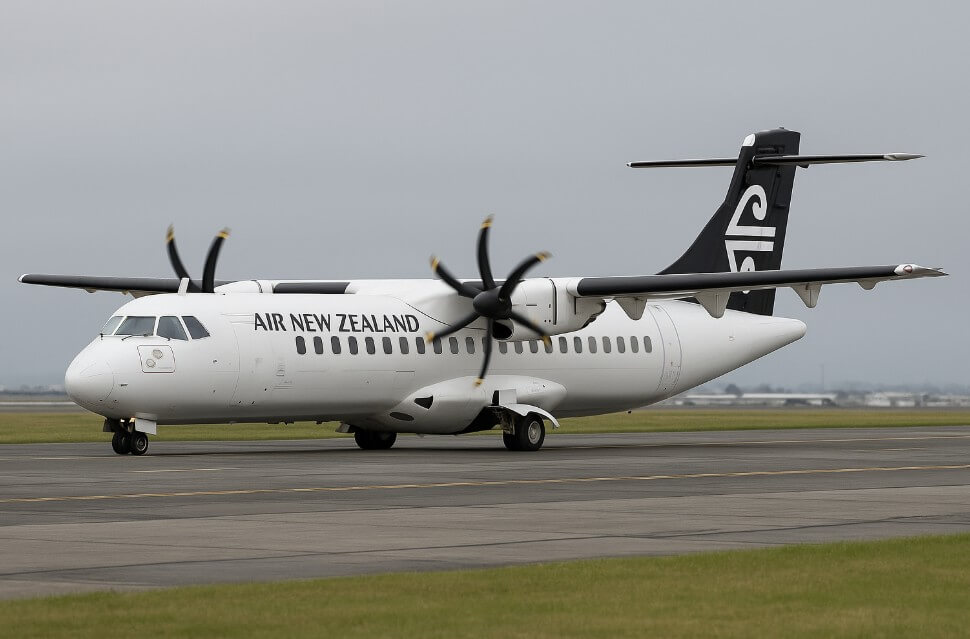
AUCKLAND, New Zealand — An Air New Zealand regional flight bound for Taupō was forced to return to Auckland on Tuesday afternoon after pilots detected a potential technical issue in flight, prompting a precautionary turn-back and engineering inspection.
Flight NZ5095, an ATR turboprop, departed Auckland around 4:55 p.m. for what was scheduled to be a 50-minute journey. But as the aircraft neared the central North Island, pilots received a system indication that required further review and decided to return to Auckland as a safety measure. The plane landed without incident at approximately 5:35 p.m., according to data from flight-tracking service Flightradar24.
“No emergency was declared, and the flight landed safely,” the airline confirmed in a statement. Upon arrival, the aircraft was met by engineering teams who carried out a full inspection before determining next steps for maintenance and return to service.
Air New Zealand Chief Operating Officer Alex Marren said all affected passengers were rebooked on the next available flight. “We want to thank our customers for their patience as we work to get them safely to their destination,” she said. The airline added that passengers were provided with assistance and alternative travel arrangements following the aircraft’s return.
The company did not specify the exact nature of the system alert but said the decision to return was consistent with its operational safety procedures. “Safety remains our highest priority,” the airline noted, emphasizing that flight crews are trained to respond conservatively whenever onboard systems raise anomalies.
Pattern of Precautionary Returns
The Auckland-Taupō incident is the second in recent weeks in which Air New Zealand aircraft have turned back due to technical concerns. Earlier this month, a long-haul flight from Los Angeles to Auckland was also forced to return after pilots identified an electrical fault shortly after takeoff.
On October 5, 2025, Flight NZ3, a Boeing 777-300ER operating from Los Angeles International Airport, experienced simultaneous issues with the air-conditioning and in-flight entertainment systems. The crew traced the disruptions to an electrical fault affecting the aircraft’s power distribution and, after consulting engineers on the ground, elected to return to LAX as a precaution.
According to reports cited by New Zealand’s public broadcaster RNZ, passengers experienced rising cabin temperatures and a temporary loss of entertainment functions during the initial climb. The aircraft—registered ZK-OKS, powered by two GE90 engines, and aged 11 years—landed safely back in Los Angeles without further complications.
Air New Zealand confirmed that ground staff provided support to passengers and rebooked them on alternate services to Auckland. Engineers subsequently began an extensive inspection of the 777 to isolate and repair the fault before clearing it for future operations.
Airline Response and Safety Protocol
Chief Operating Officer Alex Marren said the measures taken in both instances reflect the airline’s strict adherence to safety protocols. “All actions taken were consistent with standard safety procedures,” she said, adding that passenger safety “remains the airline’s top priority.” She emphasized that although the technical malfunctions did not present immediate safety threats, returning to base was the prudent course of action.
Aviation analysts note that precautionary returns, while disruptive, are a sign of mature safety culture in commercial aviation. Aircraft systems are designed to flag even minor irregularities, and standard procedure requires pilots to err on the side of caution when the cause cannot be confirmed in flight.
For Air New Zealand, which operates more than 3,000 domestic and international flights weekly, such diversions remain rare. The airline has consistently ranked among the world’s safest carriers, with rigorous maintenance schedules and close coordination between flight crews and engineering teams.
The aircraft involved in Tuesday’s incident remained under review by Air New Zealand engineers in Auckland late into the evening. As of press time, no indication had been given as to when the ATR would reenter service.
