


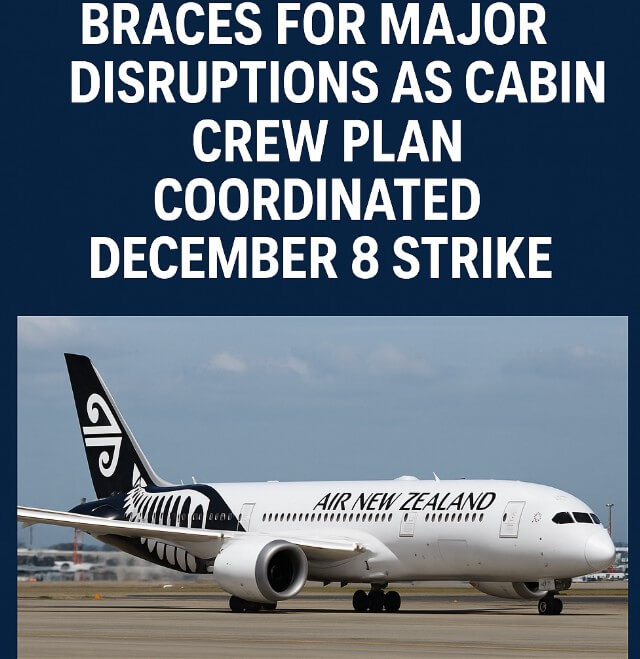
Historic Joint Action Raises Stakes for Airline
WELLINGTON—Air New Zealand is preparing for what could become one of the most disruptive labor actions in its recent history, as two major cabin crew unions move toward a coordinated strike on December 8, 2025. The unprecedented joint action, announced after months of stalled negotiations, threatens to halt most of the carrier’s regional, domestic, and international services for a full day.
The planned walkout marks the first time all three of Air New Zealand’s cabin crew groups—regional turboprop crews, domestic jet crews, and long-haul international crews—have aligned industrial action on the same date. With the unions representing roughly 80% of cabin crew employees, operational leaders across the airline are now preparing for widespread impacts at Auckland Airport and other major hubs.
Unions Present a United Front
The two unions involved—E tū and the Flight Attendants Association of New Zealand—have historically been rivals, often negotiating separate contracts under the airline’s split-by-fleet bargaining structure. Their decision to join forces underscores what both describe as deepening frustration over staff workloads, fatigue, and the erosion of long-established employment conditions.
Members say management is seeking productivity concessions in exchange for pay increases that merely keep pace with inflation. Union representatives argue that the proposal fails to acknowledge growing pressure on crews as schedules intensify. “Members have stated that management is seeking productivity concessions in exchange for only an inflation-level pay increase, a proposal they argue is neither fair nor sustainable,” the unions said in their strike notice.
Strike Timetable Designed for Maximum Impact
The planned strike is structured to cause maximum disruption. Regional cabin crew intend to stop work from 5 a.m. to 11 p.m. on December 8, while domestic and international crews will strike from 12:01 a.m. to 11:59 p.m., effectively covering every major flight wave. Aviation analysts say this timing makes it extremely difficult for Air New Zealand to maintain even a skeleton schedule.
The airline may attempt to operate limited services using non-union employees or managers with crew training, though it has not confirmed how many flights could realistically be staffed.
Airline Works to Calm Passengers Amid Uncertainty
Air New Zealand has publicly acknowledged the seriousness of the situation. The airline “has acknowledged the seriousness of the strike notice, emphasizing that it respects employees’ right to take industrial action,” and is working to minimize customer disruption. Leaders have not yet published a revised December 8 schedule and are urging passengers to monitor updates as planning evolves.
The dispute comes at a time when the airline is already grappling with significant operational pressures. A global shortage of Pratt & Whitney PW1100G engine parts has forced extended inspection cycles for the carrier’s fleet of Airbus A320 and A321neo aircraft. These narrowbody jets form the backbone of Air New Zealand’s short-haul operations, and the delays are expected to stretch another 18 to 24 months.
Technical Issues Add Pressure to Network Stability
Chief executive Nikhil Ravishankar said the dual challenges of labour unrest and technical constraints are weighing heavily on the network. He confirmed that the proposed strike “would place pressure on customer operations,” though talks with unions remain active. Ravishankar noted that “most cabin crew belong to unions and the airline is preparing graded response plans to manage potential service gaps.”
The airline currently records controllable cancellations on about 2 percent of its roughly 170,000 annual flights, compared with an internal benchmark of 1 percent. Engineering bottlenecks, spare-part shortages, and staffing issues continue to complicate efforts to improve reliability. Still, Ravishankar pointed to internal efforts to strengthen resilience, with frontline staff given broader authority to adjust bookings and support customers during irregular operations.
Inflation, Fees, and Operational Costs Shape Strategy
The wider aviation environment has added further strain. Inflation, rising airport charges, and regulated aviation fees have increased cost pressures, prompting questions about the future direction of airfares. Ravishankar reiterated his goal of positioning Air New Zealand as “a globally respected small airline with strong local roots,” even as it navigates mounting challenges.
Despite long-standing tensions between the two cabin crew unions—stemming from disagreements during the pandemic over issues such as representation and allowances—leaders say their joint action reflects shared concerns that can no longer be deferred. Both groups cite increasingly demanding rosters and a decline in working conditions as key motivators for the December strike.
Negotiations Continue as Passengers Await Clarity
Negotiations between the airline and unions are continuing this week in hopes of avoiding mass disruption. Should talks fail, Air New Zealand is preparing reaccommodation plans for affected travelers, though the scale of the strike may severely limit alternatives. Current cabin crew remuneration ranges from about NZ$58,000 to NZ$85,000 annually, with additional allowances based on the nature of flying duties.
For now, the prospect of a nationwide shutdown looms. With a historic joint strike only days away, passengers and airports across New Zealand are bracing for the possibility of widespread delays and cancellations.
Air New Zealand is expected to release further updates as negotiations progress and contingency plans take shape.
