


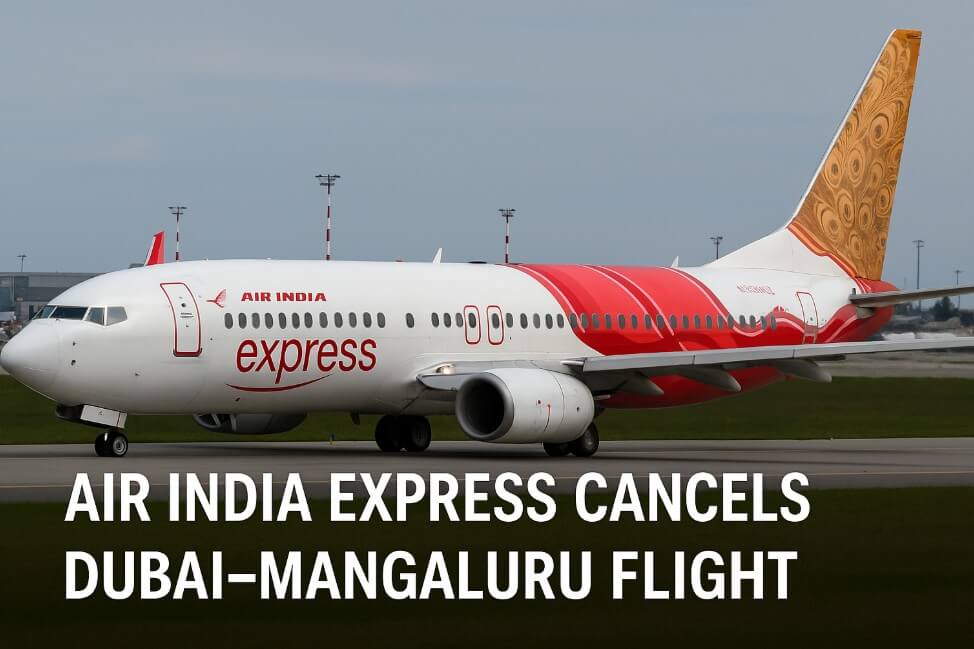
DUBAI — More than a hundred passengers bound for southern India were left stranded late Sunday after Air India Express abruptly canceled its Dubai–Mangaluru flight due to a last-minute technical issue, triggering a chain of delays and an additional flight cancellation the following day.
Flight IX814 was scheduled to depart Dubai International Airport at 11:40 p.m. on November 2, 2025, when a technical fault was detected just before takeoff. The aircraft, which had already begun taxiing, returned to the ramp for inspection. Although the issue was later resolved, the delay pushed the flight crew beyond their permitted duty hours under aviation safety regulations, forcing the airline to cancel the service altogether.
“Safety protocols were followed at every stage,” Air India Express said in an official statement. “The airline emphasized that it prioritized passenger welfare and regulatory compliance over operational convenience.”
Technical Glitch Grounds Flight
Air India Express engineers discovered the problem during pre-departure checks, prompting immediate action. While maintenance teams managed to rectify the fault, aviation rules prevented the same crew from continuing the flight once their shift limit expired. Crew duty-hour limits are strictly enforced across global carriers to ensure pilot alertness and operational safety.
According to airline representatives, a replacement flight, IX824, was arranged the following evening to transport affected travelers to Mangaluru. “Over 110 passengers chose to board the replacement flight,” airline sources said, noting that the disruption also led to the cancellation of Monday’s Dubai–Mangaluru service, IX832, scheduled for 5 p.m. Those passengers were notified early and offered rebooking or refunds, Gulf News reported.
Passenger Support and Compensation
The unexpected cancellation caused significant inconvenience to passengers, many of whom were Indian expatriates returning home to Karnataka and Kerala after work stints in the UAE. The airline’s ground staff and handling team coordinated hotel accommodations, transportation, and meal arrangements for stranded travelers.
“To mitigate inconvenience, affected passengers were provided full-board hotel accommodation in Dubai and given options to either rebook, accept a complimentary reschedule, or receive a full refund,” the airline said. Staff were deployed overnight to assist elderly passengers and families with children, ensuring all travelers received support while awaiting updates.
Air India Express also issued a public apology for the disruption. “The airline acknowledged the inconvenience caused and reaffirmed its commitment to passenger safety and operational transparency,” the statement said. The carrier confirmed that “additional capacity was arranged to ensure all stranded passengers reached Mangaluru as soon as possible.”
Broader Operational Impact
The cancellation added pressure to Air India Express’s Gulf network, where aircraft utilization and scheduling are tightly managed. The Dubai–Mangaluru route is among the airline’s busiest, serving a large expatriate population from India’s coastal regions. A disruption of this kind, though resolved within 24 hours, highlighted the operational fragility faced by budget carriers working across high-traffic international routes.
Aviation analysts noted that while last-minute cancellations can frustrate travelers, adhering to safety and regulatory protocols remains non-negotiable. Industry observers said that the airline’s prompt response — including arranging accommodations and a replacement flight — reflected growing professionalism under the Tata Group’s ownership.
Context and Company Outlook
Air India Express, a low-cost subsidiary of Air India, operates numerous flights linking Gulf destinations with Tier-II and Tier-III Indian cities. The carrier is currently in the midst of a modernization drive following its merger under the Tata Group, which aims to streamline operations across Air India and Air India Express.
As part of this integration, the airline has been expanding its fleet and updating maintenance and crew management systems to enhance reliability. The incident underscores the persistent challenges of balancing operational efficiency with stringent safety standards in international aviation.
Despite the setback, Air India Express reaffirmed its focus on long-term service improvements. The airline reiterated that maintaining safety compliance would continue to take precedence over schedule adherence or cost considerations.
Industry Perspective
Analysts suggest that as the airline industry rebounds post-pandemic, carriers like Air India Express are navigating increased passenger demand, higher fleet utilization, and tighter regulatory oversight. The Dubai–Mangaluru incident, though isolated, illustrates the delicate balance between operational ambition and safety assurance in a highly competitive regional market.
For now, operations on the route have resumed, and the carrier has reiterated its intention to avoid similar disruptions. “Passenger safety will always remain our highest priority,” the airline stated.
