


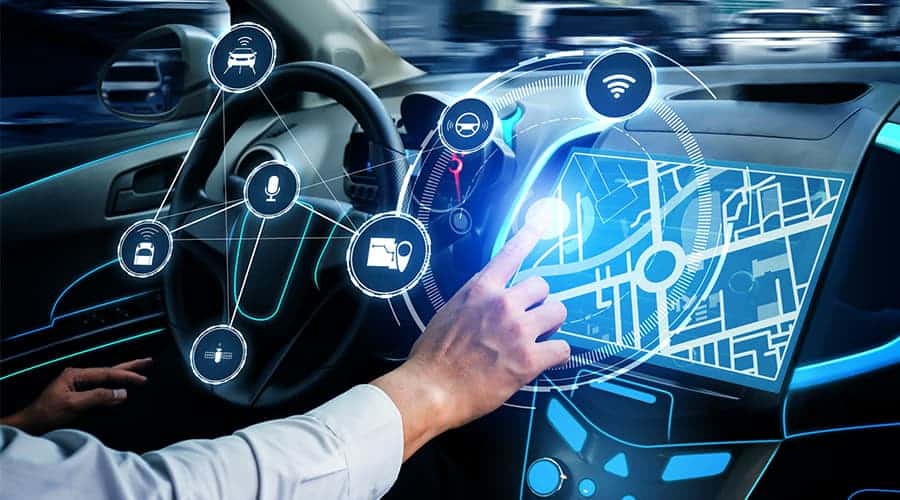
For many years, the concept of self-driving vehicles has captivated legions of drivers. However, artificial intelligence has the potential to have a much broader effect than just self-driving cars. AI enables personalised design, faster production, more cockpit features, and predictive safety measures. Because of these technologies, the automotive business is evolving and improving each year. As AI advances, its influence expands in a variety of ways. Let us examine the effect and impact of AI on our current automotive world and future vehicles.
Beyond Autonomous Vehicles
Autonomous vehicles (AVs) are the most visible implementation of artificial intelligence (AI) in the automotive industry. The key AI technologies related to self-driving are AI chips, computer vision, and machine learning (ML). However, AI is essential throughout the entire value chain. The upstream (tier-1, 2, and 3 suppliers and automakers) advantages range from computer vision and smart robots to data science and ML, while downstream (sales and the increasingly important aftermarket) benefits include everything from conversational platforms and context-aware systems to enhanced customer data analysis.
More importantly, AI helps to close the feedback loop between the upstream and the downstream by incorporating pre- and post-sale vehicle data into predictive modelling, allowing output to be more closely tied to demand. Thus, automakers can actively respond to their market competitors and real-world events, mitigating disasters such as the pandemic and the automotive chip bottleneck.
Automakers and suppliers are finally recognising that they need the assistance of custom automotive software companies and are rightfully wary of losing valuable opportunities. Developing artificial intelligence skills is now critical to automakers’ future profitability and survival.
AI-Powered Cockpits
Many of us spend more time in our cars than we’d like to admit. While cars used to be more practical and barebones, drivers now expect a fully modern in-vehicle experience regardless of the car’s price range. And modern vehicles are all about having a fabulous and feature-rich cockpit. The majority of these are powered by artificial intelligence.
Since the introduction of cellular modems in high-end cars, automotive software engineering services have been exploring new methods to integrate technology and artificial intelligence to redefine every element of a car’s cockpit. Personalisation, driver behaviour monitoring (e.g., distracted driving, moving eyes off the road), in-car virtual assistant services, and intelligent driving support are among the new features made possible with AI.
Creating the perfect digital cockpit is not only essential for vehicle manufacturers from a functional standpoint; it is also to create a favourable reflection of the company itself. Most automakers are now attempting to develop their automotive software and applications to control the user experience of drivers behind the wheel. The aim is to make the vehicle intuitive and interactive, not just personalisation. Every new vehicle contains far more AI than most drivers are aware of – and the effect is profound.
Smart Transportation
Everyone is impacted by the spread of smart infrastructure and transportation made possible with AI. Major shifts have occurred as a result of this emerging technology, allowing next-generation transit networks and infrastructure to operate in smarter and more environmentally-friendly ways.
Transportation networks will strive to become safer, more efficient, pedestrian-friendly, commuter-friendly, and ecological over the next decade or so. How will artificial intelligence achieve such a feat? There are a couple ways it can do that. For example, an AI-enhanced infrastructure can power an AI software model that will create road quality models based on sensor data. Each model will be a highly detailed 3D HD map of a specific area, which can be easily studied, controlled, and improved.
Digital Twins
A digital twin is a virtual simulation of an asset, plant, or supply chain created using IoT sensors, real-time analytics, and machine learning. The use of data science and machine learning in digital twins creates allows for early detection and prevention of problems that cause inefficiencies. Furthermore, when the physical world is altered as a result of such insights, new information is generated for the twin to assimilate and refine.
The end-to-end data picture given could assist automotive manufacturers in rebalancing supply chains proactively and swiftly in the face of rapidly changing situations. As a result, the output can be transformed from a reactive and siloed process to a holistic, iterative, and agile one. AI can thus allow automakers to operate in a much closer relationship with real-world events, which is precisely what is required to survive and adjust to future crises.
Smart Cities Overlap
The application of artificial intelligence in automotive production will increasingly overlap with the development of sustainable smart cities. 5G connectivity will serve as the foundation for low-latency communication from vehicle-to-vehicle (V2V) and, ultimately, vehicle-to-everything (V2X), enabling a wide range of AI use cases.
From a sustainability standpoint, AI will benefit road demand prediction and centralised traffic control, increasing travel efficiency and lowering vehicle energy usage. Further AI adoption by mobility providers will occur in fleet management and real-time car routing, and via the enablement of ambient commerce in infotainment systems with a smart infrastructure interface.
AI development is critical to the possible success of Level 4 and 5 AVs, which will be closely scrutinised by regulatory authorities before being adopted by the general public. To face this pressing issue, key technologies such as AI chips, computer vision, LiDAR, and edge computing power are being rapidly developed. When scaled up to hundreds of thousands – and ultimately millions – of vehicles, even a low failure rate is no longer acceptable.
Final Words
AI is already here, and we can anticipate wonderful things from it. It has already affected the automotive industry and will continue to have an impact on it for years to come. Machine learning, in particular, provides a glimpse into the future of self-driving vehicles. They can learn to navigate the road better without the need for human intervention or supervision. This implies that we may soon have vehicles that are safer than humans because they cannot be distracted or intoxicated while driving.
Autonomous vehicles have the potential to transform our lives, including how we get around town and even journey across continents or oceans. So, while some kinks still need to be worked out, there are plenty of reasons to be excited about what this thriving technology has in store for you.
