


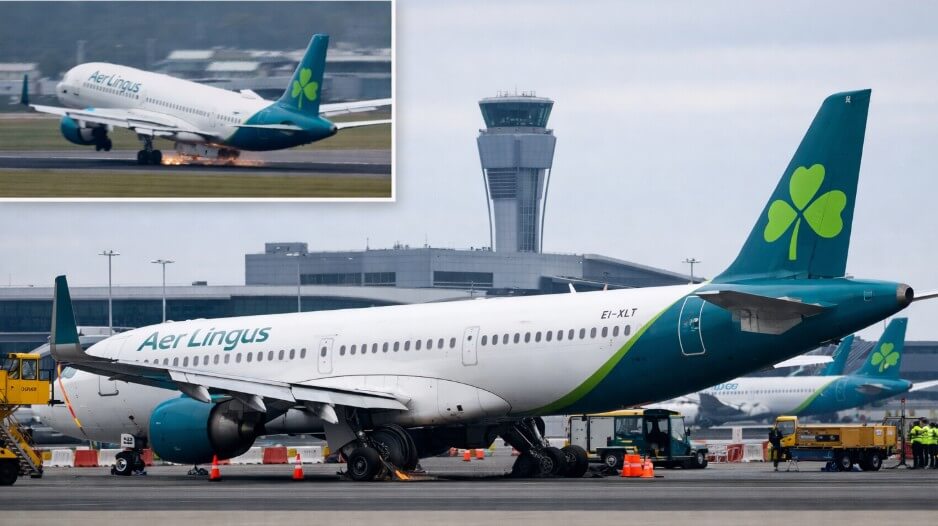
Severe Touchdown Triggers Extensive Damage Review
Aer Lingus is managing a significant operational setback after one of its newest Airbus A321XLR aircraft sustained serious damage during a hard landing at Dublin Airport, forcing the aircraft into prolonged downtime and setting the stage for multi-million-dollar repair costs.
The incident involved Airbus A321XLR aircraft registered EI-XLT, which was operating a routine flight from London Heathrow to Dublin. During landing, the aircraft experienced an unusually high touchdown force that exceeded normal operational thresholds. Subsequent inspections determined that the damage was severe enough to require a full landing gear replacement, grounding the aircraft indefinitely.
Initial assessments indicate that the landing gear on EI-XLT cannot be economically repaired and must be fully replaced.
High-G Impact Recorded During Windy Conditions
The hard landing occurred amid strong winds at Dublin Airport, conditions that routinely add complexity to aircraft landings. Video footage captured by plane spotters shows the aircraft making firm runway contact and visibly bouncing upon touchdown, an early indication of abnormal landing forces.
Post-flight data reportedly showed a landing force of 3.3G. This figure is well above standard operational norms. Typical commercial aircraft landings register between 1.1G and 1.4G, while most aircraft structures are certified to withstand approximately 2G without sustaining damage. Any landing beyond those limits is automatically classified as severe and triggers mandatory, in-depth inspections.
According to Simple Flying, the magnitude of the force placed extreme stress on the aircraft’s landing gear assembly, resulting in damage that exceeded repairable thresholds under standard maintenance guidelines.
Landing Gear Replacement Drives Multi-Million-Dollar Costs
Landing gear replacement represents one of the most complex and costly maintenance procedures for a commercial aircraft. The Airbus A321XLR is equipped with reinforced landing gear to support its higher maximum takeoff weight and extended range, a design feature that further increases both cost and labor time when replacement is required.
Factoring in specialized tooling, engineering labor, component sourcing, and regulatory certification checks, the total repair bill is expected to reach several million dollars. Beyond direct maintenance expenses, Aer Lingus also faces indirect financial impacts, including lost revenue from having a long-range aircraft unavailable during peak operational periods.
Each additional day the aircraft remains grounded compounds the cost, particularly as the A321XLR plays a critical role in the airline’s long-haul scheduling strategy.
Aircraft Background and Fleet Implications
EI-XLT was delivered to Aer Lingus in December 2024, making it one of the airline’s first two A321XLR aircraft. At less than a year old, the aircraft had primarily been operating transatlantic services to the U.S. East Coast, in addition to select European routes.
Flight tracking data shows that EI-XLT has remained on the ground at Dublin Airport since December 13. Aer Lingus currently operates five A321XLR aircraft, with a total commitment for six, making the temporary loss of a single unit operationally significant.
The A321XLR in Aer Lingus configuration seats up to 184 passengers across two cabins, including 16 fully lie-flat business class seats and 168 economy seats. The aircraft also features Airbus’ Airspace cabin, which offers increased overhead storage and enhanced passenger comfort for long-duration flights.
Strategic Importance of the A321XLR Program
The Airbus A321XLR is central to Aer Lingus’ long-term transatlantic growth strategy. With a published range of up to 4,700 nautical miles, the aircraft enables the airline to operate thinner long-haul routes that would not be economically viable with widebody aircraft.
Aer Lingus has used the type to launch services to U.S. cities such as Indianapolis and Nashville, later expanding operations to Boston, New York, and Washington, with Pittsburgh planned next. Some of these routes approach ten hours in duration, redefining narrowbody long-haul operations.
The extended grounding of EI-XLT adds pressure to the remaining A321XLR fleet and highlights how a single severe landing can have far-reaching operational and financial consequences for airlines relying on small, highly specialized aircraft subfleets.
