


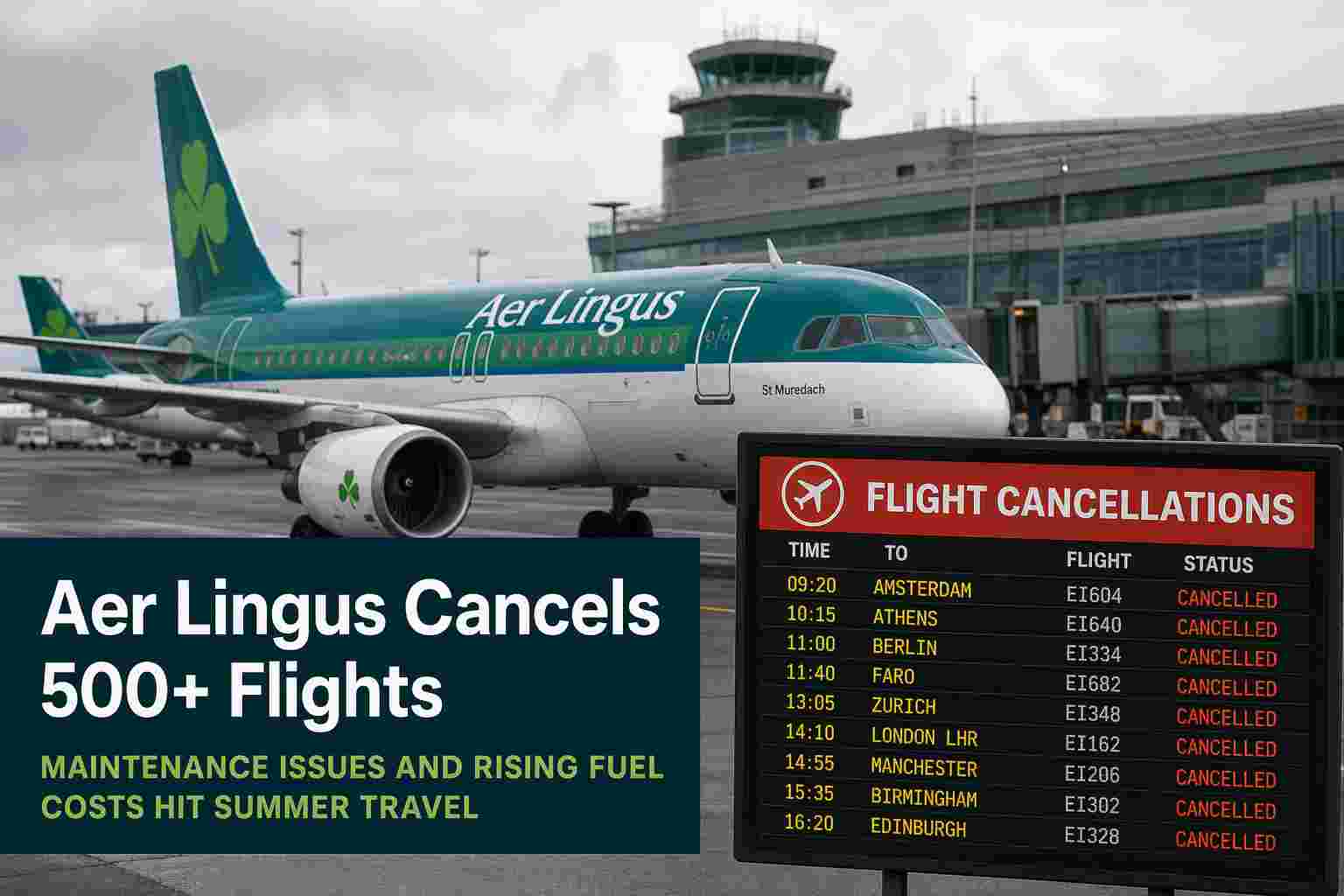
Maintenance Issues and Industry Pressures Force Schedule Cuts
DUBLIN — Aer Lingus has cancelled more than 500 flights from its summer schedule, signaling mounting pressure on European carriers as operational constraints and fuel market volatility collide ahead of peak travel season.
The airline confirmed that the cancellations are tied to mandatory aircraft maintenance requirements, affecting roughly 2% of its overall schedule. While the carrier emphasized that most passengers have been rebooked onto alternative same-day services, the scale of the cuts underscores growing strain within the aviation sector.
The reductions were first reported by the Sunday Independent and later acknowledged by the airline, which characterized the changes as limited but necessary to maintain safety and operational integrity.
European and UK Routes Disrupted
Key Destinations Impacted
The cancellations span both short-haul European and UK routes, including flights departing from Dublin Airport to cities such as Amsterdam, Athens, Berlin, Faro, and Zurich. Services to major UK hubs—including London Heathrow, Manchester, Birmingham, and Edinburgh—have also been affected.
Passengers on these routes have largely been reassigned to alternative flights, though the adjustments may still create ripple effects during one of the busiest travel periods of the year.
Aer Lingus reiterated that the “vast majority of customers” have been accommodated on same-day services, aiming to minimize disruption despite the schedule reductions.
Fuel Market Turmoil Adds Pressure
Rising Costs Challenge Airline Economics
The flight cuts come amid broader turbulence in global energy markets, with jet fuel prices surging due to geopolitical tensions. Fuel typically represents between 20% and 40% of an airline’s operating costs, making price swings particularly impactful.
The situation has been exacerbated by the closure of the Strait of Hormuz, a critical shipping route for fuel exports from the Gulf region. The disruption—linked to escalating tensions involving Iran, the United States, and Israel—has persisted for more than six weeks, tightening supply and driving up costs.
The International Energy Agency warned that Europe may have only about six weeks of jet fuel reserves remaining, intensifying concerns across the aviation industry.
The agency noted that the الأزمة has “thrown a proverbial wrench into the inner workings of the aviation fuel markets,” highlighting the fragility of supply chains under geopolitical stress.
Airlines Scaling Back Unprofitable Routes
Travel journalist Simon Calder said the cancellations reflect a broader trend across Europe.
“Airlines trimming some of their summer services is becoming widespread across Europe, because the doubling of the cost of fuel means some routes are no longer profitable,” he said.
Government and Industry Push Back on Fuel Concerns
Irish Officials Emphasize Supply Stability
Ireland’s Minister for Transport, Darragh O’Brien, sought to reassure the public about fuel availability.
Speaking on RTÉ’s This Week, he stated that Ireland maintains a robust aviation fuel supply, with approximately 70 days of reserves. He also noted that the country sources jet fuel primarily from the United States, insulating it somewhat from Middle Eastern disruptions.
He added that airlines ultimately make operational decisions independently of government policy.
Pilot Shortages Highlighted as Key Factor
However, industry representatives point to internal staffing challenges as a major contributor to the cancellations.
Irish Airline Pilots’ Association President Mark Tighe said that while geopolitical tensions remain a concern, Aer Lingus has faced similar disruptions in previous years due to pilot shortages.
“Pilots are frequently contacted on their days off and asked to work,” Tighe said, noting that staffing constraints have prevented the airline from granting all pilots their full contractual annual leave this year.
He also pushed back on the idea that fuel costs are the primary driver behind the cancellations, stating that Aer Lingus hedges its fuel purchases—unlike some U.S. competitors—reducing its exposure to short-term price spikes.
A Summer Season Under Strain
The convergence of maintenance requirements, staffing shortages, and volatile fuel markets paints a challenging picture for airlines heading into the summer travel surge.
While Aer Lingus maintains that its schedule adjustments are limited in scope, the broader context suggests a fragile operating environment where even small disruptions can cascade into larger network impacts.
With geopolitical tensions unresolved and industry costs rising, airlines across Europe may continue to reassess capacity in the months ahead—raising the likelihood of further schedule changes as the peak season unfolds.
