


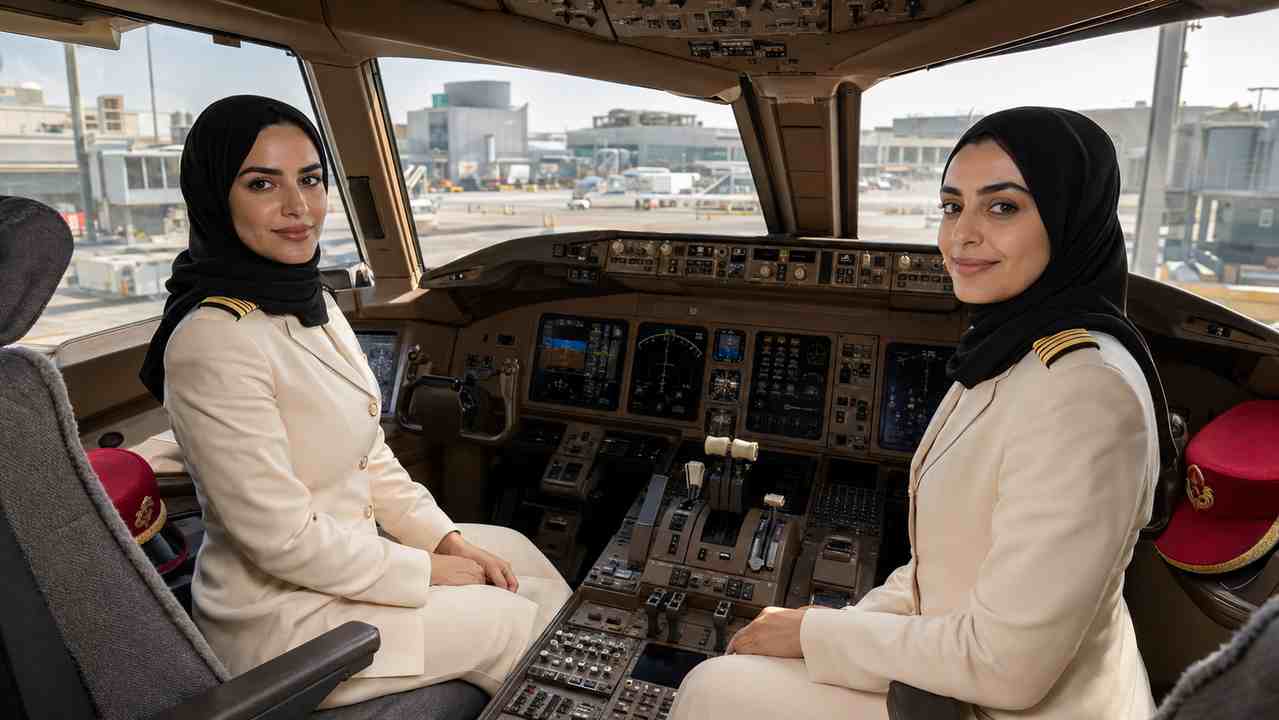
Emirates has promoted Hanan Mohammed Jawad and Bakhita Al Mheiri to captain, making them the first Emirati women to hold the position at the Dubai-based international airline. Both pilots now command Boeing 777 aircraft from Emirates’ main hub at Dubai International Airport.
The promotions mark a significant workforce milestone for Emirates and represent the culmination of nearly two decades of training, operational experience and professional development. Jawad and Al Mheiri began their careers through the carrier’s National Cadet Pilot Programme before progressing through the ranks of one of the world’s largest international airlines.
Two Careers Lead to the Boeing 777 Captain’s Seat
Jawad joined Emirates as a cadet pilot in 2008 and has since accumulated 9,253 flight hours. Al Mheiri entered the same program in 2011, beginning a 15-year career that eventually led to command of the airline’s widebody aircraft.
Although their professional journeys developed on separate timelines, both pilots completed the extensive technical training, flight evaluations and operational requirements necessary to receive the fourth stripe associated with the rank of captain.
The promotion substantially expands their responsibilities. In addition to operating the aircraft, captains lead the flight crew, oversee critical decisions and maintain safety standards throughout each journey.
For Jawad, command involves recognizing the trust placed in the flight crew by passengers and colleagues. Al Mheiri similarly considers safety the guiding principle behind every operational decision, while emphasizing that effective leadership also requires communication, attentive listening and an understanding of the people working throughout the operation.
Mentorship Supports Career Development
Both pilots have highlighted the importance of mentorship in advancing their aviation careers.
Jawad credits the instructors, first officers and captains who contributed to her professional development. Al Mheiri has also pointed to the support and guidance she received from experienced training captains and senior leaders at Emirates.
Their progression illustrates the long-term nature of pilot development, particularly at an airline operating a large global network. Reaching the captain’s seat requires years of experience across different routes, weather patterns and operating environments.
Captains Take Command of GE90-Powered Boeing 777s
Jawad and Al Mheiri operate Emirates’ GE90-powered Boeing 777 aircraft. The combination is among the most widely recognized in long-haul commercial aviation, and Emirates is the world’s largest operator of the GE90 engine.
According to GE Aerospace, the GE90 is the exclusive powerplant for the Boeing 777-300ER, 777-200LR and 777 Freighter. Emirates relies heavily on the Boeing 777 family to connect Dubai with destinations throughout the Americas, Europe, Asia, Africa and the Middle East.
Operating long-haul aircraft requires pilots to continuously assess changing conditions. Weather, aircraft performance, airport environments and crew composition can vary between flights, even when the route is familiar.
Al Mheiri has noted that pilots must reconsider each situation based on the conditions at the time rather than relying exclusively on previous experience. For both captains, continuous learning remains central to effective command and safe airline operations.
Promotions Highlight Opportunities for Emirati Women
Al Mheiri encountered an additional challenge during her early training because she completed much of her primary and secondary education in Arabic. Conducting aviation training in English required her to build technical expertise while working in a different language, creating a significant learning curve.
That experience later influenced her approach to leadership. Jawad, meanwhile, has emphasized the importance of balancing professional confidence with humility.
Cadet Program Builds National Aviation Talent
Emirates launched its National Cadet Pilot Programme in 1993 to provide Emirati candidates with a structured path into commercial aviation. The initiative has since produced captains, training pilots and senior industry leaders.
The promotions of Jawad and Al Mheiri demonstrate the program’s role in developing homegrown aviation talent while expanding opportunities for women in a traditionally male-dominated profession.
Both captains view the milestone as carrying responsibilities beyond their individual careers. Their achievement could encourage more Emirati women to pursue professional aviation and other technical roles across the sector.
Their longer-term ambition is for women on the flight deck to become increasingly commonplace. By reaching the captain’s seat, Jawad and Al Mheiri have established a new benchmark for future pilots while reinforcing the value of resilience, continuous learning and long-term career development.
