


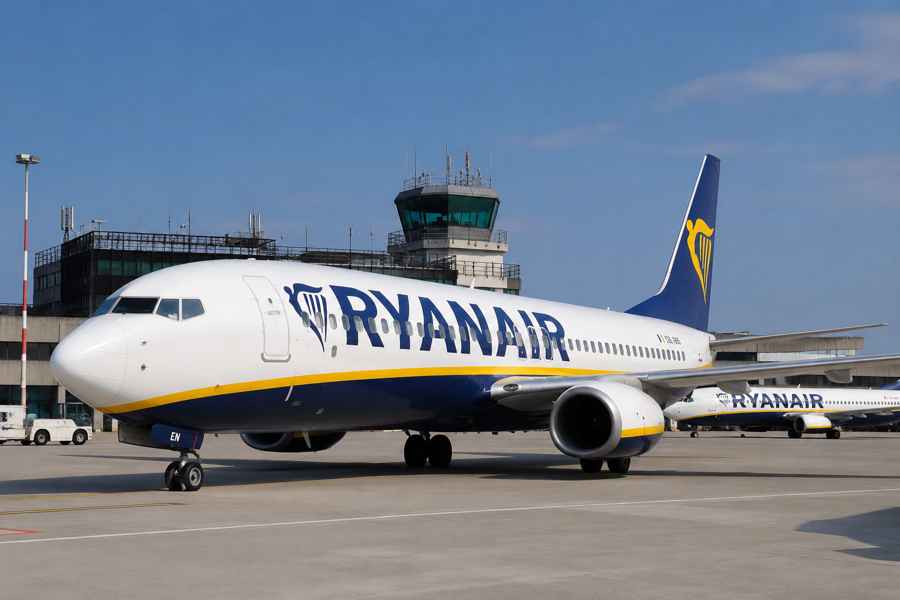
DUBLIN — Ryanair reported a record profit for fiscal year 2026, reinforcing the strength of its ultra-low-cost business model and highlighting a growing contrast with major U.S. airlines that increasingly depend on lucrative credit card partnerships to support profitability.
The Dublin-based carrier generated €2.26 billion in profit after tax before exceptional items for the year ended March 31, 2026, a 40% increase from the €1.61 billion recorded in FY25. The results underscore Ryanair’s ability to generate substantial earnings primarily through its core airline operations rather than through financial partnerships or loyalty-program monetization.
While Ryanair’s success stems from transporting passengers efficiently and at low cost, major U.S. carriers including American Airlines, Delta Air Lines, and United Airlines have increasingly built their financial models around loyalty programs and co-branded credit card agreements with major banks.
Revenue Growth Driven by Passenger Traffic and Ancillary Sales
Ryanair reported total group revenue of €15.54 billion, up 11% year over year. Passenger traffic increased 4% to 208.4 million travelers, while ancillary revenue reached €4.99 billion, equivalent to approximately €24 per passenger.
After accounting for an €85 million provision related to an Italian competition fine, the airline reported net profit after tax of €2.17 billion.
The carrier’s performance reflects a business model built around operating efficiency. Ryanair continues to rely on a single narrowbody fleet centered on the Boeing 737-8200, high aircraft utilization rates, and a fare structure designed to attract price-sensitive travelers before generating additional revenue through optional services.
As noted by travel industry publication Live and Let’s Fly, Ryanair’s approach combines low base fares with ancillary sales that transform inexpensive tickets into profitable journeys.
Seasonal Travel Demand Powers Annual Performance
Strong Summer Offsets Weaker Winter Months
Although Ryanair’s full-year profit reached €2.26 billion, the company’s first-half FY26 earnings were even stronger.
For the six months ended September 30, 2025, Ryanair reported profit of €2.54 billion, representing a 42% increase from the prior year. The September quarter alone generated €1.72 billion in earnings.
The apparent discrepancy between first-half and full-year profits reflects the airline industry’s seasonal nature. Ryanair traditionally experiences losses during the winter season, with the third quarter producing only €115 million in profit and the January-to-March period typically operating at a loss.
Rather than signaling weakness, the seasonal pattern highlights the strength of peak summer travel demand, which continues to drive the carrier’s overall financial performance.
U.S. Airlines Depend More Heavily on Loyalty and Banking Partnerships
American Airlines Benefits from Citi Relationship
American Airlines reported record 2025 revenue of $54.6 billion, yet generated only $111 million in GAAP net income, illustrating the narrow margins facing traditional network carriers.
The airline disclosed $6.2 billion in cash remuneration from co-branded credit cards and other partners during 2025.
American’s loyalty business gained further momentum after Citi became the exclusive U.S. issuer of the AAdvantage credit card portfolio under a new 10-year agreement beginning in 2026. Co-branded card spending increased 8% during 2025, while AAdvantage membership grew 7%.
Although loyalty program accounting involves deferred revenue and other liabilities that make direct comparisons difficult, the scale of partner payments underscores the importance of the airline’s banking relationships.
Delta Expands Its American Express Partnership
Delta Air Lines remains the strongest financial performer among the major U.S. legacy carriers, generating approximately $5 billion in profit on $63.4 billion in operating revenue during 2025.
However, loyalty revenue also plays a significant role in Delta’s financial success.
The airline reported that remuneration from its partnership with American Express rose 11% to $8.2 billion in 2025. Delta also added more than one million new cardholders for the fourth consecutive year and has indicated that annual revenue from the partnership could eventually approach $10 billion.
Today, diversified revenue streams—including premium products, loyalty programs, cargo operations, and partner income—account for roughly 60% of Delta’s total revenue.
United Strengthens MileagePlus Ecosystem
United Airlines reported $3.35 billion in net income on record operating revenue of $59.1 billion in 2025.
The airline’s annual filing showed $3.85 billion in other operating revenue, with growth partly driven by mileage sales to non-airline partners, including spending tied to its JPMorgan Chase credit card relationship.
MileagePlus revenue increased 9% during the year as United continued expanding a loyalty ecosystem that rewards customers not only for flying, but also for credit card usage, spending habits, and elite status participation.
Why Ryanair’s Results Stand Out
Airline Profitability Without a Financial Backstop
The comparison between Ryanair and its U.S. counterparts highlights two distinct approaches to airline profitability.
Ryanair focuses on maintaining low costs, maximizing aircraft utilization, filling seats, and generating ancillary revenue from optional services. Its business model is built around making the flight itself profitable.
By contrast, major U.S. carriers operate more complex networks featuring hubs, premium cabins, airport lounges, and global alliances. These airlines increasingly supplement aviation revenue with loyalty programs that banks are willing to pay billions of dollars to access.
The success of the U.S. model is evident, particularly in Delta’s results. However, loyalty and banking partnerships have evolved from supplementary revenue sources into core financial pillars.
Ryanair operates without that cushion. Its FY26 performance demonstrates that a disciplined low-cost carrier can still generate substantial profits primarily through transporting passengers, making it one of the clearest examples of airline profitability driven by aviation fundamentals rather than financial partnerships.
