


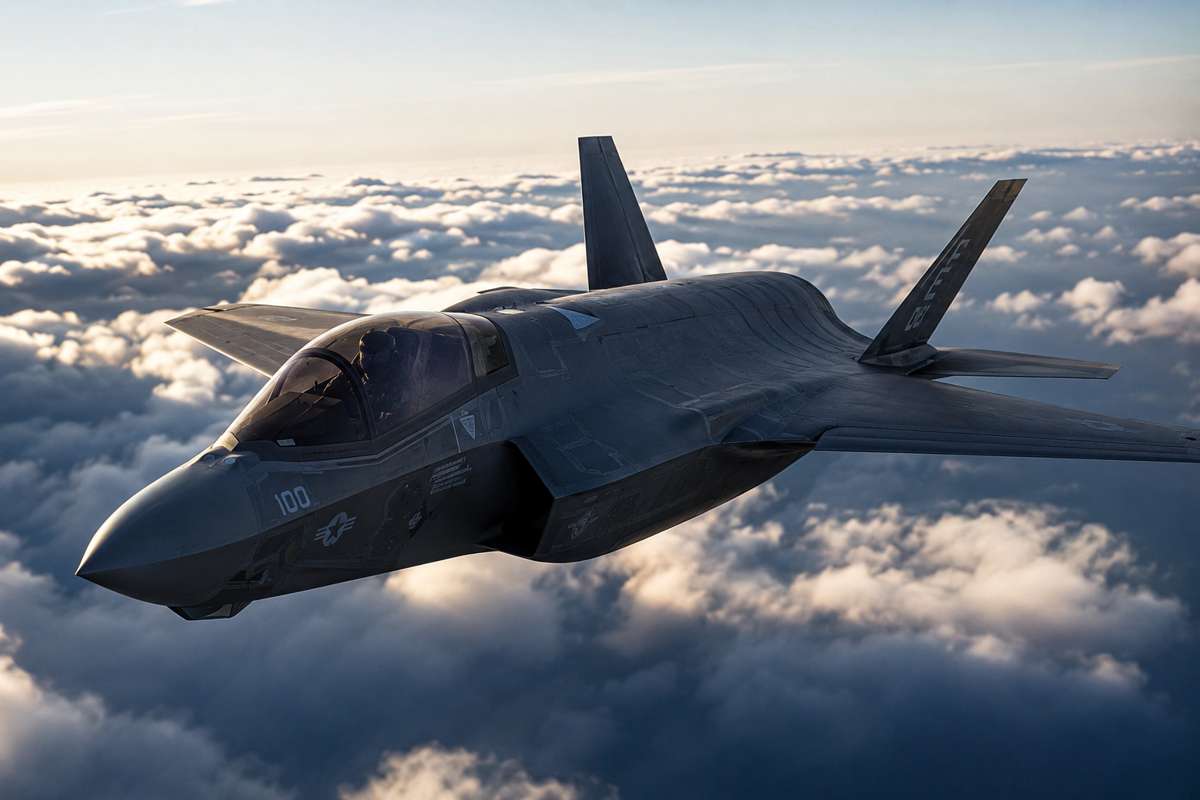
Sixth-Generation Fighter Programs Shift Focus Toward Long-Range Warfare and Advanced Missile Systems
The world’s most advanced stealth fighter programs are increasingly moving away from one of military aviation’s oldest weapons: the internal gun.
As aerospace manufacturers and defense agencies develop sixth-generation combat aircraft, the focus is shifting toward long-range engagement, sensor dominance, and networked warfare rather than traditional close-range dogfighting. Programs such as the Boeing F-47 and the BAE Tempest are being designed around stealth, advanced missile systems, and autonomous support technologies, reducing the importance of onboard cannons that once defined fighter combat.
Modern fighter aircraft already represent the cutting edge of military technology, but future designs are expected to push this transformation even further. Defense planners now view internal guns as systems that consume valuable space and weight that could otherwise support advanced electronics, fuel capacity, or next-generation weapons.
Evolution of Fighter Aircraft Combat Strategy
For decades, guns served as the primary weapon for fighter aircraft. Early jet fighters relied heavily on cannons during air-to-air combat, particularly in close-range engagements where pilots maneuvered aggressively to gain firing positions.
That doctrine began to change during the Cold War as missile technology improved. Aircraft such as the McDonnell Douglas F-4 Phantom II initially entered service without an internal cannon because military planners believed guided missiles would dominate future aerial combat.
Combat experience later challenged that assumption. During conflicts such as the Vietnam War, pilots frequently encountered situations where missiles proved unreliable or enemy aircraft closed into short-range engagements. Those lessons led many air forces to restore guns to their fighter designs as a backup weapon.
Fifth-generation stealth fighters eventually adopted a hybrid approach. Aircraft such as the Lockheed Martin F-22 Raptor and F-35A Lightning II retain internal cannons for emergency dogfighting scenarios and limited ground attack operations.
However, not all variants followed the same path.
Why Some Stealth Fighters No Longer Carry Internal Guns
The F-35B and F-35C variants do not include built-in cannons and instead rely on external gun pods when required for specific missions.
The design differences reflect operational demands and engineering constraints. The F-35B incorporates a vertical lift system that enables short takeoff and vertical landing operations, while the carrier-based F-35C uses reinforced structures designed for aircraft carrier deployments.
Those additional systems occupy critical internal space that would otherwise be available for a gun installation.
Defense manufacturers are also prioritizing stealth performance. Internal space within stealth aircraft is highly valuable because designers seek to minimize radar signatures while maximizing fuel, sensors, and weapons storage. Eliminating an internal gun can provide greater flexibility for mission systems and improve overall aircraft efficiency.
Beyond-Visual-Range Combat Changes Air Warfare
The growing reliance on Beyond-Visual-Range (BVR) combat is one of the main reasons military planners are reconsidering the role of aircraft guns.
Modern fighters now depend heavily on advanced radar systems, sensor fusion, electronic warfare tools, and long-range missile technology. These systems allow pilots to detect, track, and engage hostile aircraft before they become visible to the human eye.
Stealth technology further strengthens this advantage by reducing an aircraft’s detectability. Entering a close-range dogfight can undermine many of those benefits because using a gun requires a fighter to move within short distances of an opponent and align directly with the target.
Military strategists increasingly believe future combat success will depend more on information dominance and long-range precision than on maneuvering for close-range cannon shots.
As a result, defense programs are investing heavily in missile performance, sensor integration, and electronic warfare systems that allow fighters to neutralize threats while remaining outside hostile engagement ranges.
Sixth-Generation Fighters Expand the Concept
Future sixth-generation aircraft are expected to take this operational philosophy even further.
Rather than operating alone, these fighters are being developed as part of broader combat ecosystems that combine crewed aircraft, autonomous drones, advanced data-sharing networks, and potentially directed-energy weapons.
Collaborative Combat Aircraft, commonly described as loyal wingman drones, are expected to play a central role in future missions. These unmanned systems can conduct surveillance, carry additional weapons, and absorb operational risks that would otherwise threaten expensive crewed fighters.
By extending the reach and capabilities of fighter aircraft beyond the limitations of a single airframe, military planners aim to reduce the need for direct close-range combat altogether.
Engineers are also advancing research into directed-energy weapons such as military-grade lasers. These systems could eventually intercept incoming threats or engage enemy targets at the speed of light without relying on traditional ammunition.
Military Planners Remain Cautious
Despite rapid technological progress, defense experts continue to approach the transition cautiously.
History has repeatedly shown that battlefield realities can challenge assumptions about future warfare. Unexpected combat conditions, electronic disruptions, or missile failures could still force pilots into situations where backup weapons become necessary.
While stealth fighter programs continue moving away from internal cannons, many military analysts believe future aircraft will still need flexibility to adapt to unpredictable combat environments.
For now, however, the direction of next-generation air combat is becoming increasingly clear: stealth, networking, autonomous systems, and long-range weapons are taking priority over the traditional fighter gun.
