


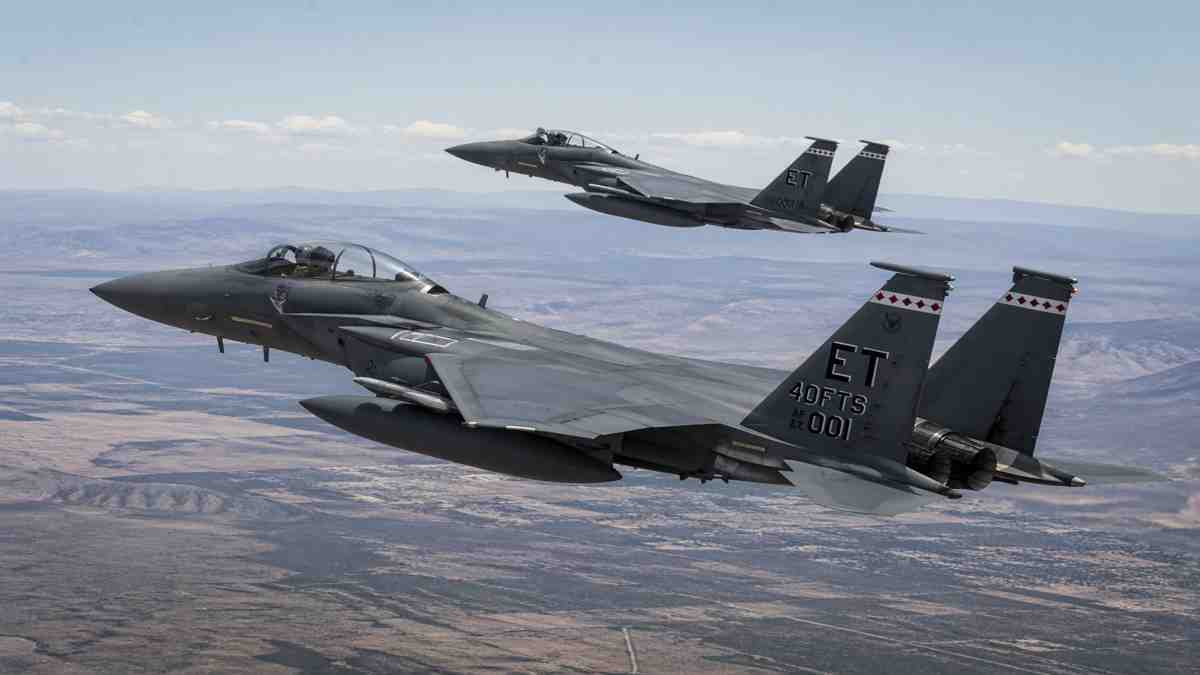
Expanded Procurement Signals Major Shift in USAF Modernization Strategy
WASHINGTON, D.C. — The United States Air Force is significantly expanding its planned acquisition of Boeing’s F-15EX Eagle II fighter jets, more than doubling its previous target in a move aimed at replacing its aging fleet of F-15E Strike Eagles and strengthening combat readiness.
Under the Fiscal Year 2027 budget proposal, the Air Force is seeking funding for 24 additional F-15EX aircraft at a cost of $3 billion. The revised plan raises the total number of jets to 267, up from the previously approved 129. The expansion is part of a broader $1.5 trillion defense budget request put forward by the Trump administration, which would increase Air Force spending by 38 percent to $338.8 billion, according to TWZ.
USAF Massive F-15EX Expansion To Replace Strike Eagle Fleet
The procurement increase is primarily driven by the need to replace the Air Force’s aging fleet of F-15E Strike Eagles. The service currently operates approximately 215 of these aircraft, many of which have been in continuous use for decades across global combat operations.
At least one of the six frontline Strike Eagle squadrons is consistently deployed to the U.S. Central Command region, placing sustained operational strain on the fleet. The oldest jets, particularly those equipped with Pratt & Whitney F100-PW-220 engines, are increasingly showing signs of wear.
To begin addressing this issue, the Air Force has proposed retiring 20 of the oldest F-15Es in FY2027. The expanded F-15EX purchase provides a direct replacement pathway while ensuring continuity in mission capability. It also extends the production life of the F-15EX line, which had previously been expected to wind down sooner.
Parallel Fighter Production and Capability Growth
The Air Force plans to sustain three active fighter production lines simultaneously. Alongside the F-15EX, procurement of the F-35A will continue, while development of the sixth-generation F-47 advances toward future production.
Although the F-35A program remains funded, deliveries have been impacted by delays in the Block 4 upgrade, leaving some aircraft without fully operational radar systems.
Meanwhile, the F-15EX has received strong performance reviews. The Office of the Director, Operational Test & Evaluation noted in its 2025 annual report that the aircraft is operationally effective across air superiority missions, including engagements against surrogate fifth-generation adversaries.
This capability is notable given the increasing prevalence of stealth-enabled threats with advanced avionics systems.
Payload, Longevity, and Strategic Flexibility
The F-15EX’s design emphasizes payload capacity and long-term durability. The aircraft can carry up to 12 AIM-120 missiles, with potential for further expansion through integration of smaller weapons and counter-drone systems.
Its ability to support hypersonic missile deployment over long distances positions it as a critical asset in potential future conflicts, particularly in the Indo-Pacific region.
Boeing has stated the aircraft features a 20,000-hour airframe service life, enabled by structural redesigns and extensive fatigue testing. At typical usage rates, this could allow the aircraft to remain operational for decades, offering cost efficiency over its lifespan.
Air National Guard Leads F-15EX Fielding
Initial deployments of the F-15EX are being led by the Air National Guard, which is prioritizing homeland defense missions. These include intercepting hostile aircraft, countering cruise missile threats, and responding to drone attacks.
The aircraft’s speed, range, payload capacity, and advanced electronic warfare systems make it particularly well-suited for these roles.
Planned basing locations include Portland, Fresno, New Orleans, Kadena Air Base in Japan, and Michigan, where the Air National Guard is transitioning away from A-10 aircraft.
With a total of 267 jets, the Air Force could field up to 13 operational squadrons, each comprising 21 aircraft, with additional units allocated for testing and training.
Eagle II’s Growing Offensive Role
While initially focused on air superiority, the F-15EX is expected to evolve into a multirole platform. As the successor to the F-15E, it will likely assume responsibilities in deep strike and air-to-ground missions.
The aircraft could also inherit nuclear delivery capabilities associated with the F-15E, including deployment of the B61 tactical nuclear bomb.
Additionally, the F-15EX is being considered for use as an “arsenal ship,” carrying large volumes of long-range missiles to support stealth fighters. Its two-seat configuration also makes it a potential control platform for future unmanned Collaborative Combat Aircraft systems.
Beyond replacing the F-15E fleet, the Air Force faces ongoing pressure to retire aging F-16 and A-10 aircraft. Additional F-15EX orders could help offset these retirements, depending on future budget decisions.
Budget Must Clear Congressional Approval
The FY2027 budget proposal remains subject to congressional review, and lawmakers have historically resisted efforts to retire older aircraft without clear replacement plans.
However, the availability of the F-15EX may ease those concerns by ensuring continuity in operational capability.
The program itself has undergone significant fluctuations in recent years, with planned purchases dropping to as low as 80 aircraft in 2023 before rising again to 98, then 129, and now 267.
Each revision reflects growing confidence in the platform as well as the evolving operational demands facing the Air Force’s Combat Air Forces.
