


Near Miss Raises Fresh Questions About U.S. Aviation Safety
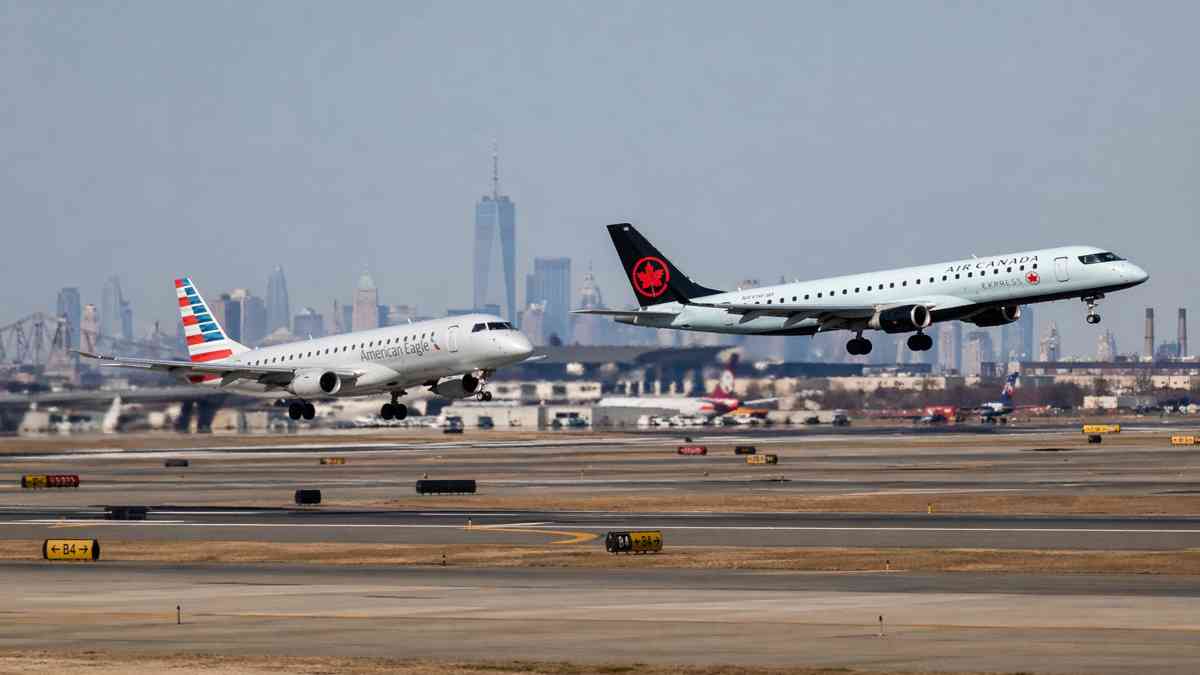
The Federal Aviation Administration has opened an investigation after two regional passenger jets operated for American Airlines and Air Canada came within a dangerously close distance during parallel runway approaches at New York’s John F. Kennedy International Airport, one of the busiest air travel hubs in the United States.
The incident occurred Monday afternoon and involved two Embraer E175 aircraft—Republic Airways Flight 4464 operating for American Airlines and Jazz Aviation Flight 8554 operating for Air Canada. At their closest point, the jets were separated by approximately 350 feet vertically and just 0.62 miles horizontally before onboard safety systems triggered evasive action.
Both aircraft ultimately landed safely, but the near miss underscores mounting concerns about operational risks in an increasingly strained U.S. aviation system.
Sequence of Events During Approach
According to preliminary information, the event unfolded around 2:30 p.m. local time as the Republic Airways jet approached JFK from Indianapolis. During its landing sequence, the aircraft aborted its initial approach and initiated a go-around—a standard aviation safety maneuver in which pilots climb and reposition for another landing attempt.
During this maneuver, the aircraft deviated from its assigned approach path and entered the airspace of a parallel runway.
At the same time, the Jazz Aviation jet, arriving from Toronto Pearson International Airport, had already been cleared to land on that adjacent runway. As the two aircraft converged, onboard Traffic Collision Avoidance Systems (TCAS) in both cockpits issued resolution advisories, prompting immediate corrective actions by both flight crews.
Flight tracking data showed the Republic Airways aircraft made a sharp left turn after the alert, descending approximately 600 feet within seconds as it passed over Long Beach. Meanwhile, the Jazz Aviation aircraft climbed rapidly by nearly 1,000 feet to increase separation.
Both crews followed TCAS instructions and executed go-arounds before successfully landing on subsequent attempts.
Airline and FAA Responses
Republic Airways confirmed that its crew received and complied with the onboard advisory, stating that the pilots followed established procedures and training protocols. Jazz Aviation similarly said its crew responded immediately to cockpit warnings and air traffic control instructions.
The FAA emphasized that the investigation remains in its early stages. Officials are reviewing air traffic control communications, radar data, flight recorder information, and pilot actions to determine the root cause of the incident and whether any procedural or systemic changes are warranted.
Second Near Miss in Days
The JFK incident marks the second close call involving commercial aircraft in the United States within a matter of days, heightening scrutiny on aviation safety practices.
On Saturday, the FAA launched a separate investigation after two Southwest Airlines Boeing 737 aircraft came within approximately 500 feet of each other near Nashville International Airport. In that case, one aircraft executing a precautionary go-around was directed into the path of another departing jet.
Both crews received TCAS advisories and took evasive action, avoiding a collision.
A retired air traffic controller told local media that situational awareness was lost during the Nashville event, pointing to chronic staffing shortages as a contributing factor.
Staffing Shortages Under the Spotlight
The back-to-back incidents have renewed focus on a long-standing issue within the aviation system: a nationwide shortage of air traffic controllers.
The FAA currently operates with approximately 3,500 fewer fully certified controllers than recommended. More than 40% of its 290 terminal facilities are understaffed, and 19 of the 30 largest facilities operate below 85% of target staffing levels. These facilities account for a significant share of nationwide flight delays.
The situation reflects a broader trend. The United States now has about 25% fewer controllers than it did in 1981, despite handling nearly three times the volume of air traffic.
Several factors have contributed to the shortfall, including retirements from earlier hiring waves, disruptions to training programs during government shutdowns, and a lengthy certification process that can take up to five years. A December 2025 report from the Government Accountability Office found that only about 2% of applicants ultimately become certified controllers.
Efforts to Close the Gap
The FAA has stepped up hiring efforts, aiming to bring on at least 8,900 new controllers through 2028. The agency exceeded hiring targets in fiscal years 2024 and 2025 and plans to add more than 2,200 controllers in fiscal 2026.
However, gains have been limited as retirements, attrition, and training washouts continue to offset new hires.
Lawmakers have responded with policy measures, including the FAA Reauthorization Act of 2024, which introduced new hiring authorities and retention incentives. A supplemental funding proposal in Congress would allocate roughly $1.8 billion over five years to expand training capacity and modernize instruction methods.
Broader Pattern of Safety Incidents
The latest near misses add to a growing list of aviation safety concerns in 2026. Last month, a fatal runway collision at LaGuardia Airport involving an Air Canada Express regional jet and a fire truck resulted in the deaths of two pilots and injuries to dozens of passengers and crew.
That incident, along with the recent near misses, has intensified scrutiny from regulators and lawmakers. Congressional hearings earlier this year featured testimony from FAA leadership and union representatives highlighting the operational strain on controllers, including mandatory overtime and fatigue risks.
Outlook Ahead of Busy Travel Season
With the summer travel season approaching and passenger volumes expected to near pre-pandemic levels, aviation analysts warn that system pressures will remain high.
While federal hiring initiatives may yield long-term improvements, experts caution that near-term risks could persist as staffing shortages and operational demands continue to challenge the nation’s air traffic control system.
The FAA’s investigation into the JFK incident is ongoing, and further findings are expected in the coming months.
