


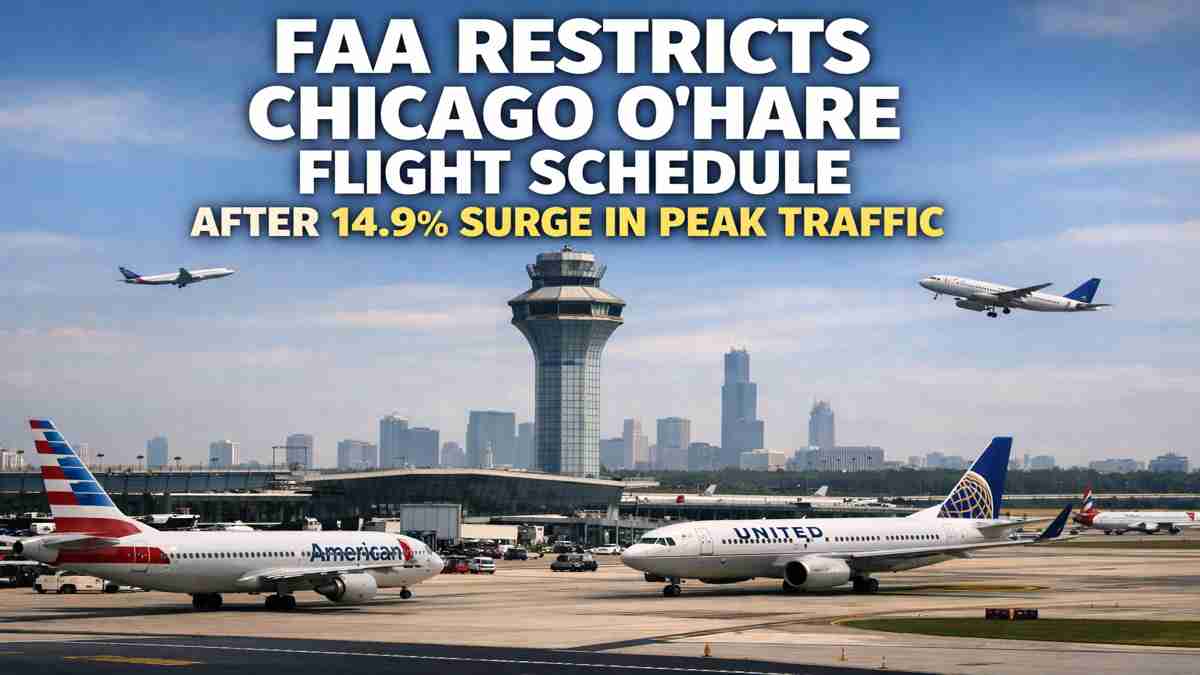
Regulators move to ease congestion after sharp rise in peak operations
CHICAGO — U.S. aviation regulators are imposing new limits on flight operations at Chicago O’Hare International Airport, seeking to curb mounting delays and restore schedule reliability during the busy summer travel season.
The Federal Aviation Administration said it will cap daily operations at one of the nation’s busiest airports after a sharp increase in peak-period scheduling pushed traffic beyond manageable levels. The move follows a surge in demand that has strained infrastructure and complicated air traffic control operations.
Officials said the directive is designed to bring flight volumes back in line with what the airport can realistically handle, particularly as construction projects continue to limit taxiway availability.
Flight caps aim to stabilize operations
Under the order, daily flight activity at O’Hare will be reduced to approximately 2,708 operations, down from peak schedules that had climbed above 3,080 flights. According to the Department of Transportation, that represents a 14.9% increase over the previous summer, a jump that regulators described as unsustainable.
Federal officials have mandated a reduction of roughly 300 flights per day during peak travel periods. The FAA said the adjustment is intended to ease congestion on runways and taxiways, where bottlenecks have contributed to delays that ripple across the national airspace system.
“FAA caps O’Hare operations at 2,708 daily flights after peak schedules surged to 3,080, forcing American Airlines (AA) and United Airlines (UA) to adjust summer capacity.”
Officials noted that the surge created an unrealistic operating environment for controllers already managing construction-related constraints. By scaling back schedules, regulators expect to reduce cascading delays that often disrupt connecting flights across airline networks.
Sean Duffy emphasized that the goal is to improve the passenger experience during the peak summer season. He said the revised schedule should lead to fewer disruptions and more predictable travel outcomes.
Airlines adjust summer schedules
Major carriers with significant operations at O’Hare, including American Airlines and United Airlines, are now revising their summer schedules to comply with the FAA directive.
American Airlines said the move will ultimately enhance operational reliability at the airport, even as it works through the immediate impact of flight reductions. The airline indicated it is reviewing its timetable and expects to cut up to 40 daily arrivals and departures once the cap takes effect.
United Airlines, which operates a major hub at O’Hare, is expected to make more substantial adjustments. Internal estimates suggest the carrier could reduce more than 200 daily flights, though it has not publicly confirmed final figures.
Both airlines said they will notify affected passengers after schedule changes are finalized. They also emphasized efforts to preserve critical connectivity through O’Hare while minimizing disruptions.
Infrastructure strain and performance concerns
Federal officials highlighted that O’Hare already handles the highest number of flights of any airport in the United States. Despite that scale, its on-time performance has lagged behind other major hubs, with delays driven largely by congestion and infrastructure limitations.
Authorities said expansion plans by major carriers contributed to traffic projections that exceeded safe operating capacity. The FAA concluded that aligning schedules with realistic throughput levels is necessary to maintain system stability.
“The Federal Aviation Administration (FAA) said the move aims to stabilize operations and improve on-time performance as demand continues to outpace available airfield capacity.”
The temporary order will take effect May 17 and remain in place through October 24, covering the height of the summer travel season. Regulators expect the reduced schedule to improve predictability for both airlines and passengers.
Outlook for summer travel
The FAA’s intervention underscores the broader challenge facing the aviation industry as travel demand rebounds strongly while infrastructure upgrades lag behind. With O’Hare serving as a critical hub for domestic and international connections, disruptions there can quickly cascade across the national network.
By enforcing capacity limits during peak months, regulators are signaling a more proactive approach to managing congestion at major airports. Whether similar measures will be needed elsewhere may depend on how effectively airlines and airports balance growth with operational constraints in the months ahead.
For travelers, the changes may mean fewer flight options but a greater likelihood of arriving on time — a tradeoff regulators believe is necessary to ensure smoother operations during one of the busiest travel periods of the year.
