


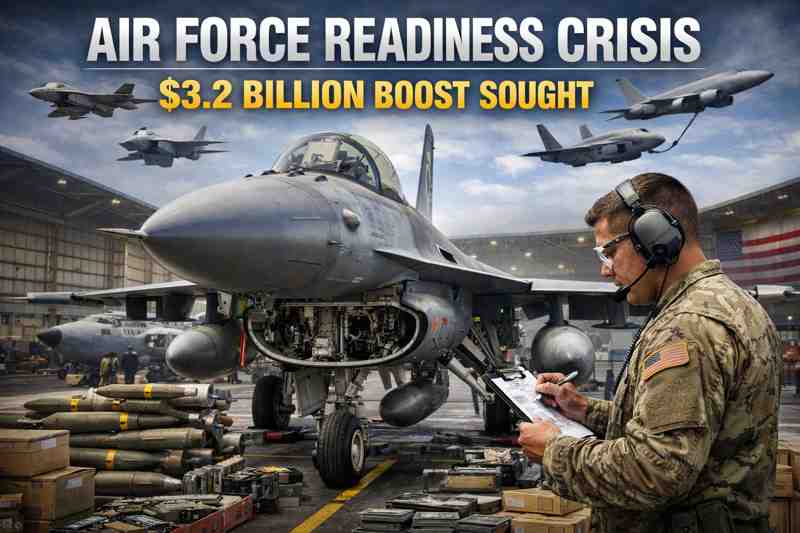
U.S. Air Force Pushes Major Funding Increase Amid Maintenance Shortfalls
WASHINGTON, D.C. — The U.S. Air Force is seeking a $3.2 billion increase in spare parts funding as part of a broader effort to address persistent aircraft readiness challenges, senior officials told lawmakers this week.
Vice Chief of Staff John D. Lamontagne presented the request during a House Armed Services Readiness subcommittee hearing on April 15, outlining how additional resources would help reduce maintenance delays and improve fleet availability.
Although early fiscal 2027 budget documents do not explicitly list the $3.2 billion figure, they propose significant increases in operations and maintenance (O&M) spending, along with additional funding for the Pentagon’s Working Capital Fund. Together, these measures signal a substantial shift toward readiness-focused investments.
The Air Force is aiming to increase O&M funding by $15.4 billion over fiscal 2026 levels—a nearly 20% jump—while allocating more than $4 billion to the Working Capital Fund, which supports supply chain and maintenance operations.
Readiness Becomes Top Strategic Priority
Air Force leadership has made aircraft readiness a central focus over the past year. Both Secretary Troy E. Meink and Chief of Staff Kenneth S. Wilsbach have prioritized improving mission-capable rates since assuming their roles.
The service requested $36.5 billion for readiness in its fiscal 2026 budget, including funding for weapon system sustainment. According to Air & Space Forces reporting, sustainment accounts—particularly those used for spare parts—are expected to receive stronger support in fiscal 2027.
Historically, the Air Force has funded weapons system sustainment at about 85% of required levels. That figure rose slightly to 86% last year but remained insufficient to fully address maintenance needs. The proposed 2027 budget would increase sustainment funding to 93%, bolstered by the additional $3.2 billion request.
“We are redoubling our efforts to invest in our ability to maintain the airplanes,” Lamontagne said. Weapons sustainment accounts will be more richly funded in 2027.
He added that the Air Force is aligning its plans with the White House’s proposed $1.5 trillion federal budget framework for fiscal 2027, using the opportunity to tackle long-standing readiness issues such as spare parts shortages.
Maintenance Bottlenecks and Cannibalization Persist
Despite increased funding, structural challenges remain. One of the most significant issues is the lack of readily available spare parts, which forces maintainers to engage in “cannibalization”—removing components from one aircraft to keep another operational.
Lamontagne detailed the inefficiencies of this process, noting that it can take two hours to remove a part from one aircraft, another two hours to install it in a second aircraft, and an additional two hours to reinstall a replacement part once it becomes available. This cycle consumes valuable labor time and reduces overall fleet efficiency.
Such practices, while necessary in the short term, underscore deeper supply chain constraints that the Air Force hopes to alleviate through increased investment.
Lawmakers Debate Right-to-Repair Barriers
In addition to funding concerns, lawmakers and military leaders are examining regulatory barriers that limit the Air Force’s ability to conduct its own repairs. Intellectual property restrictions often prevent service members from fixing components directly, even when technically feasible.
“We need data that gets down to the component and subcomponent systems so that our Airmen can affect repairs a lot of times,” Lamontagne told lawmakers.
For example, a malfunctioning auxiliary power unit might be repairable, but contractual limitations may require personnel to replace the entire unit instead of fixing it—adding cost and time.
Right-to-repair legislation under consideration would require defense contractors to provide greater access to technical data, enabling competition in maintenance contracts and allowing Air Force personnel to perform more repairs internally.
Representative Pat Harrigan voiced frustration over delays in passing such measures. “This committee wants to give it to you, but for some reason there is some force that is out there that is preventing that from happening,” he said.
“I’m going to start getting very agitated about this this year. We have to deliver right to repair to the services.”
The issue gained bipartisan support during negotiations over the latest National Defense Authorization Act (NDAA), with backing from lawmakers including Elizabeth Warren and Tim Sheehy. However, it ultimately stalled amid opposition from industry groups.
Industry Pushback and Future Outlook
Opponents of right-to-repair provisions, including Aerospace Industries Association President Eric Fanning, argue that mandating broader intellectual property access could have unintended consequences.
In a November opinion piece in The Washington Times, Fanning warned that such requirements could increase costs, slow modernization efforts, and deter innovative companies from working with the Pentagon.
Meanwhile, the Air Force is attempting to mitigate future constraints by designing next-generation systems with more flexible architectures. Programs like Collaborative Combat Aircraft are being developed using government-owned reference designs, enabling easier upgrades and maintenance.
Defense Secretary Pete Hegseth has also directed the Army to identify contracts where intellectual property restrictions hinder maintenance, signaling a broader Pentagon effort to address the issue.
As budget negotiations continue, the Air Force’s push for increased readiness funding—and fewer repair constraints—will remain central to ensuring operational capability in an increasingly complex global security environment.
