


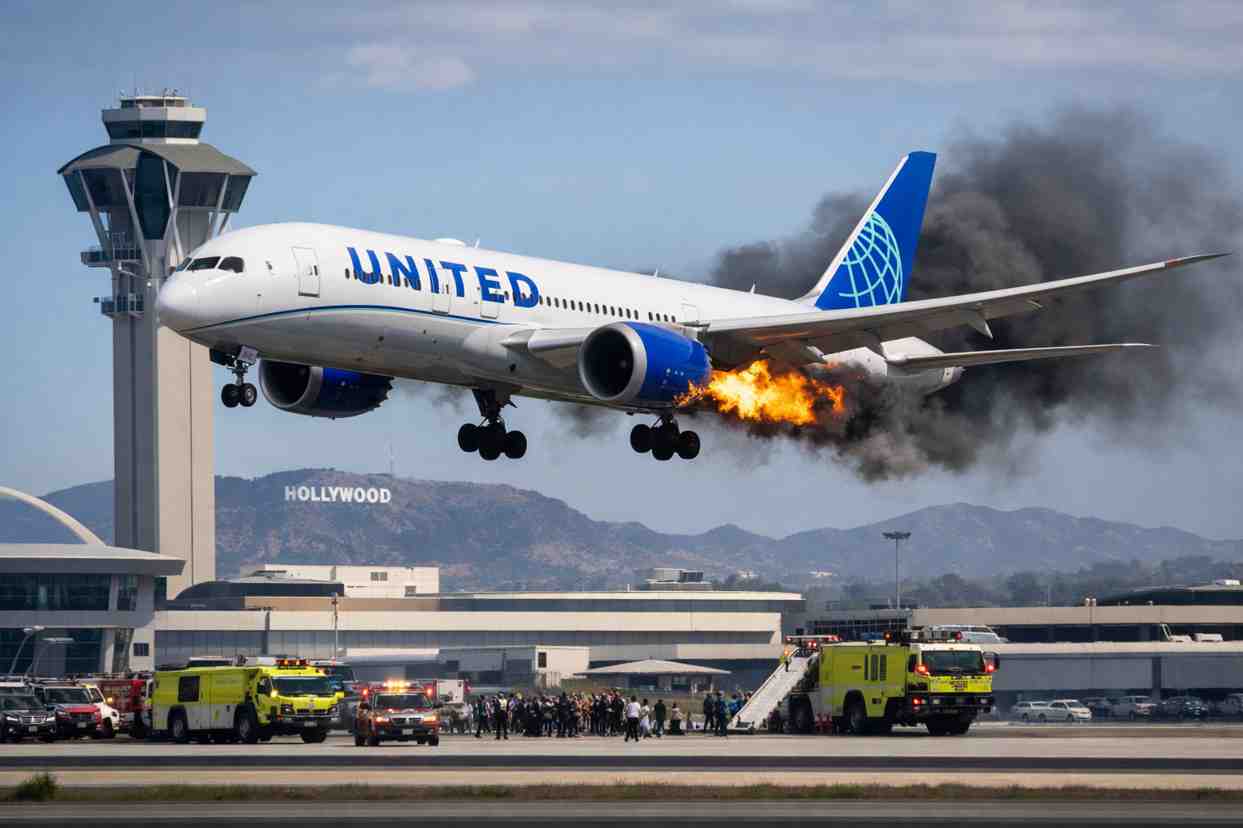
LOS ANGELES — A United Airlines Boeing 787-9 Dreamliner was forced to return to Los Angeles International Airport after an engine fire warning persisted despite multiple onboard suppression attempts, prompting an emergency landing and passenger evacuation, according to preliminary findings from federal investigators.
The incident involved United Airlines Flight UA2127, which had departed Los Angeles International Airport bound for Newark Liberty International Airport when the crew detected signs of a potentially serious malfunction during the aircraft’s climb-out phase.
The aircraft, a Boeing 787-9 powered by two GE Aerospace GEnx-1B76A engines, had climbed to approximately 17,000 feet when pilots reported abnormal vibrations in the flight controls and a drop in left engine N2 speed, according to a preliminary report from the U.S. National Transportation Safety Board.
Shortly thereafter, the aircraft’s Engine Indicating and Crew Alerting System displayed an “L ENGINE FIRE” warning for the left engine, triggering standard emergency procedures.
Crew Conducts Emergency Fire Procedures as Warning Reappears
Fire Suppression Efforts Fail to Fully Extinguish Warning
Flight crew members immediately initiated the engine fire checklist and discharged the first onboard fire suppression bottle in an effort to extinguish the blaze.
According to the NTSB’s preliminary findings, the warning temporarily cleared but returned within approximately 30 seconds, indicating the fire had not been fully suppressed.
Pilots then discharged the aircraft’s second fire bottle and declared an emergency while reversing course toward Los Angeles.
Despite the crew’s actions, repeated fire warnings continued during the aircraft’s return, suggesting the left engine fire remained active long enough to inflict thermal damage.
The Dreamliner continued operating on a single engine as pilots coordinated with air traffic control for priority handling and an expedited approach back to Los Angeles.
Aircraft Lands Safely; Evacuation Ordered as Precaution
No Injuries Reported Among Passengers or Crew
The aircraft landed safely at Los Angeles International Airport on one engine, after which an evacuation was ordered as a precautionary measure.
Emergency slides were deployed and passengers and crew exited the aircraft without reported injuries.
A flight attendant later told investigators that visible flames were observed coming from the left engine after the aircraft had landed, underscoring the seriousness of the event.
The emergency marked a significant operational disruption for United Airlines but ended without casualties, a result investigators credited to crew adherence to emergency procedures and controlled aircraft handling.
Preliminary Inspection Reveals Engine and Thermal Damage
NTSB Continues Investigation Into Root Cause
Post-incident inspections found evidence of sooting and thermal damage concentrated around the left engine’s core module, with damage extending toward the pylon area, according to investigators.
A borescope examination also identified damage to the engine’s high-pressure turbine section, while the thrust reverser sustained only minimal thermal impact.
The NTSB said the investigation remains ongoing and no final determination has been made regarding the cause of the fire.
Investigators are expected to examine engine components, maintenance records, and flight data as part of the broader inquiry.
Safety and Operational Implications
The incident places renewed focus on engine reliability and emergency response protocols aboard long-haul twin-engine aircraft, particularly as carriers continue to rely heavily on Boeing 787 aircraft for transcontinental and international routes.
United Airlines operates one of the largest Boeing 787 fleets in the world, using the aircraft extensively for domestic premium routes and international long-haul service.
While engine shutdowns and inflight fire warnings remain rare in modern commercial aviation, incidents involving repeated fire indications after suppression system activation draw heightened scrutiny from regulators and manufacturers due to the potential implications for engine design, fire containment, and suppression effectiveness.
The affected aircraft will remain out of service pending further inspection and repair.
Neither United Airlines nor GE Aerospace had issued additional public comment beyond the preliminary investigative findings as of publication.
The NTSB’s final report, which could take months to complete, will determine the probable cause of the engine fire and may include safety recommendations for operators, manufacturers, or regulators.
