


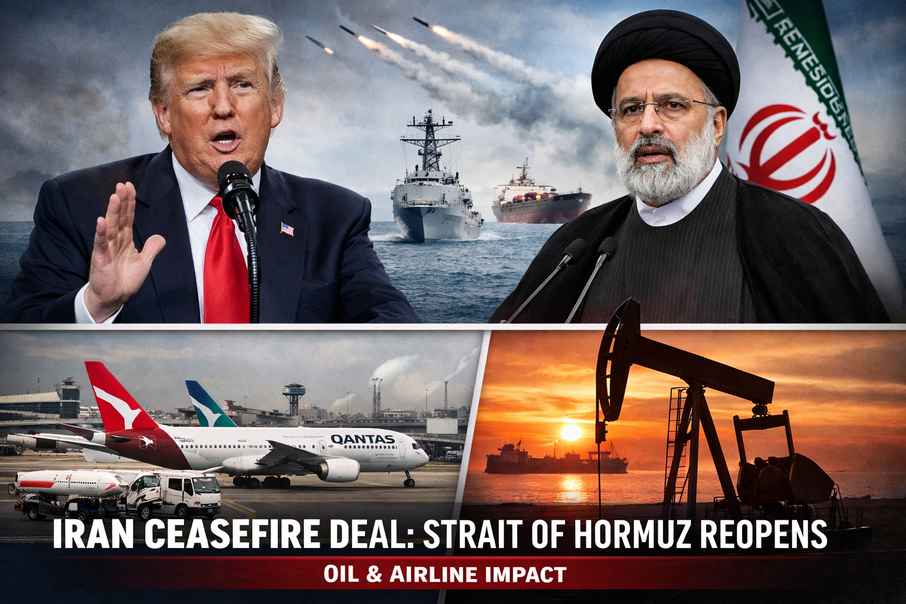
U.S., Iran to Hold Talks in Islamabad as Strait of Hormuz Reopens Under Temporary Deal
President Donald Trump said the United States has agreed to a two-week ceasefire with Iran after Tehran accepted terms to reopen the Strait of Hormuz, stepping back from the brink of a wider regional conflict that had rattled global markets and disrupted energy and aviation supply chains. The agreement was reached late April 7, just hours before Trump’s self-imposed deadline for Iran to restore access to the strategic shipping corridor.
Israel also agreed to the ceasefire and will suspend its strikes, according to a White House official, though questions remain over whether the truce extends to fighting involving Israeli forces in Lebanon.
Trump called the agreement a “big day for world peace” and wrote on Truth Social, “Iran can start the reconstruction process.”
The ceasefire was brokered in part through diplomatic efforts by Pakistani Prime Minister Shehbaz Sharif, who invited U.S. and Iranian delegations to formal talks in Islamabad on Friday. Trump said discussions with Sharif and Pakistan’s military leadership helped secure the framework.
Iranian Foreign Minister Abbas Araqchi confirmed Tehran’s acceptance of the arrangement and said safe passage through the Strait of Hormuz would resume in coordination with Iran’s armed forces.
Last-Minute Diplomacy Pulls Washington and Tehran Back From Escalation
The announcement marked a sharp reversal from Trump’s rhetoric earlier Tuesday, when he warned on social media that “a whole civilization will die tonight” if Iran did not reopen the strait by 8 p.m. ET.
That warning triggered fresh volatility across financial markets and prompted criticism from international leaders, legal experts and the United Nations amid fears the U.S. was preparing strikes on Iranian civilian infrastructure.
Iran reportedly transmitted a 10-point proposal to Washington through Pakistan, which Trump described as a “workable basis on which to negotiate,” adding that “almost all of the various points of past contention have been agreed to.”
Iran’s Supreme National Security Council separately said “nearly all war objectives have been achieved.”
Oil Markets Rally as Strait of Hormuz Reopens
The reopening of the Strait of Hormuz, through which roughly one-fifth of global oil supply passes, immediately eased pressure on energy markets.
International benchmark oil prices fell 13% Tuesday night, while S&P 500 futures pointed to gains of more than 2% at Wednesday’s open.
The waterway had been effectively choked off during the conflict, sending fuel prices sharply higher and raising concerns of a prolonged global economic shock. Iran had also moved toward formalizing tolls for ships transiting the corridor, seeking to preserve leverage over the route even after reopening.
White House Press Secretary Karoline Leavitt framed the ceasefire as a diplomatic and military win for Washington, saying, “The truth is that President Trump and our powerful military got Iran to agree to reopening the Strait of Hormuz, and negotiations will continue.”
Airlines Cheer Relief, but Jet Fuel Prices Remain Elevated
Refinery Damage Expected to Keep Aviation Costs High for Months
Airline stocks surged globally on the ceasefire news, reflecting optimism that oil flows will normalize. Shares of carriers across Asia rallied, including Australia’s Qantas, Hong Kong’s Cathay Pacific, and India’s IndiGo.
But airline executives cautioned that lower crude prices will not quickly resolve jet fuel shortages.
The International Air Transport Association said refinery disruptions across the Middle East will continue constraining supply even after shipping resumes. Jet fuel prices have risen 132.1% over the past year to $209 per barrel, according to IATA, putting pressure on carriers already grappling with route disruptions and higher operating costs. Fuel typically accounts for about 27% of airline expenses.
Willie Walsh, IATA’s director general, said the refining bottleneck means supply normalization will take time.
He said recovery is “not going to happen in weeks.”
Walsh added that the Middle East remains central to global refined petroleum production, saying many underestimate how concentrated refining capacity is in the region.
Higher Airfares Likely as Airlines Pass Through Costs
Walsh said airlines are likely to raise ticket prices to offset sustained fuel costs, calling fare increases inevitable if the elevated pricing environment persists.
Asian jet fuel prices currently stand at $228 per barrel, the highest of any region globally, while North America remains the cheapest market at $192 per barrel—still more than double year-ago levels.
Peace Talks Ahead, but Broader Deal Remains Uncertain
The U.S. and Iran are expected to begin negotiations Friday in Islamabad, with Vice President JD Vance likely to lead the American delegation.
Iran’s broader demands include lifting sanctions, releasing frozen Iranian assets, withdrawing U.S. combat forces from regional bases and compensating Tehran for war-related damages—conditions that would require a dramatic reset in U.S.-Iran relations.
Iran’s Supreme National Security Council suggested the ceasefire could be extended if talks progress favorably.
For now, markets and global businesses are treating the truce as a temporary reprieve rather than a lasting settlement. Missile alerts continued across parts of the Gulf after the ceasefire technically took effect, underscoring the fragility of the agreement.
Still, the pause has eased immediate fears of a wider regional war—and offered some relief to industries battered by weeks of disruption.
