


Transpacific Service Diverted to Osaka Following Oil Level Alert
A long-haul flight operated by Cathay Pacific Airways was forced to make an emergency diversion early Tuesday after a mechanical issue was detected mid-flight over the Pacific Ocean, underscoring the aviation industry’s strict adherence to safety protocols.
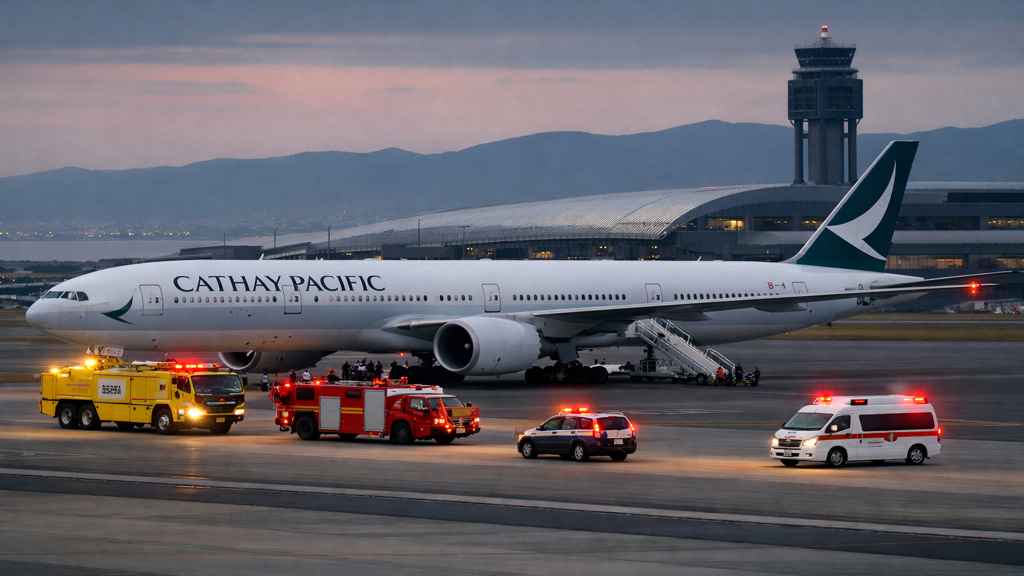
Cathay Pacific flight CX883, traveling from Los Angeles International Airport to Hong Kong International Airport, diverted to Kansai International Airport after the flight crew identified a sudden drop in engine oil levels. The aircraft landed safely at approximately 4:30 a.m. local time on Tuesday, April 7, 2026, with no injuries reported among the 373 passengers and crew on board.
The incident highlights the operational challenges of long-haul aviation and the importance of rapid decision-making when technical anomalies arise mid-flight.
Mid-Flight Detection Prompts Precautionary Diversion
The aircraft departed Los Angeles at 11:37 p.m. local time on Monday, April 6, beginning its scheduled transpacific journey to Hong Kong. While en route, the flight deck crew detected what was described as a “significant and sudden drop in engine oil levels,” prompting immediate evaluation of the situation.
Following established aviation safety procedures, the crew opted to divert to the nearest suitable airport rather than continue the long-haul journey across the Pacific. Kansai International Airport in Osaka was selected due to its capability to handle widebody aircraft and its relative proximity.
The aircraft landed without incident, and all passengers and crew disembarked safely. Cathay Pacific confirmed the outcome and acknowledged the disruption caused to travelers.
Local media reports indicated the diversion caused minor operational disruptions at Kansai International Airport, including at least one delayed departure. Airport authorities coordinated the unscheduled arrival efficiently, ensuring no further complications.
Aircraft Details and Operational Response
Flight CX883 was operated using a Boeing 777-300ER, registered as B-KQO. The aircraft, approximately 12 years old, is powered by two GE90 engines, one of the most widely used engine types for long-haul widebody jets.
Cathay Pacific stated that all procedures followed during the incident aligned with global aviation safety standards, emphasizing that passenger and crew safety remained the airline’s “absolute priority throughout the event.”
The airline issued a formal apology to affected passengers, reinforcing its commitment to safety and operational transparency.
Passengers Rebooked as Investigation Begins
Following the emergency landing, Cathay Pacific moved swiftly to minimize disruption for travelers. All passengers were rebooked on alternative flights departing from Kansai to Hong Kong later the same day.
At the same time, engineering teams were dispatched to inspect the aircraft. The inspection is expected to focus on identifying the root cause of the engine oil level anomaly and determining whether additional maintenance or component replacement is required before the aircraft can return to service.
Such inspections are standard practice after in-flight mechanical alerts and are conducted in accordance with both manufacturer guidelines and regulatory requirements.
Safety Protocols Reinforced in Aviation Industry
Industry experts note that diversions of this nature, while disruptive, are a clear indication that safety systems and crew training are functioning as intended. A drop in engine oil levels can indicate potential engine performance issues, making precautionary landings the safest course of action.
Cathay Pacific reiterated that the decision to divert rather than continue to Hong Kong reflects standard operating procedures across the aviation sector. Airlines are required to prioritize immediate risk mitigation over schedule adherence in the event of any mechanical irregularity.
Regulatory authorities are expected to be notified of the incident as part of mandatory reporting requirements. Further findings from the engineering inspection may also be shared with relevant aviation safety bodies.
Ongoing Updates Expected
While the immediate situation was resolved without injury or major disruption, the incident serves as a reminder of the complexities involved in long-haul aviation operations and the critical importance of real-time monitoring systems.
Cathay Pacific has not yet provided a timeline for when the aircraft will return to service, pending completion of technical assessments.
Further updates are expected as the airline and aviation authorities continue their review of the event.
