


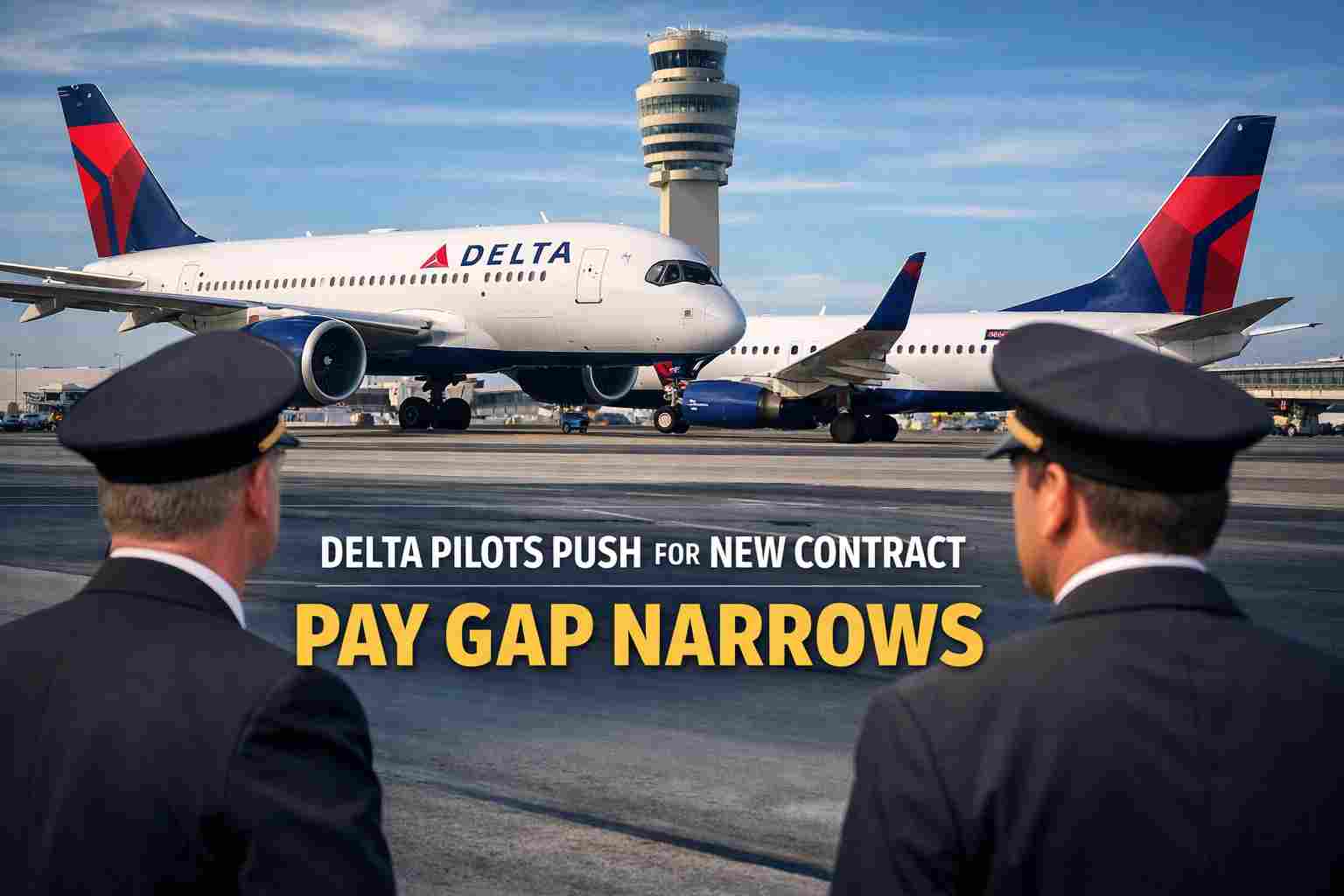
Union Moves Early to Lock in Gains Before 2026 Deadline
ATLANTA — Pilots at Delta Air Lines are accelerating efforts to secure a new labor contract years ahead of its amendable date, seeking to preserve premium compensation as competitive and economic pressures evolve.
Represented by the Air Line Pilots Association (ALPA), Delta pilots have formally submitted their opening proposal and are urging fast-tracked negotiations. The current Pilot Working Agreement becomes amendable on December 31, 2026, but both sides reopened Section 6 negotiations in early 2026.
“With their current deal expiring in late 2026, Delta pilots are racing to lock in a premium pay agreement before market conditions shift.”
The union’s urgency reflects a favorable moment: Delta’s strong profitability, tightening industry pay parity, and a limited window of leverage.
Early Negotiations Aim to Avoid Lengthy Delays
ALPA’s strategy is shaped by the historically slow pace of airline labor negotiations under the Railway Labor Act, which keeps contracts in force until a new agreement is ratified.
“The history of the last Delta contract illustrates just how long this process can take.”
Negotiations for the current agreement began in April 2019 but were disrupted by the COVID-19 pandemic, delaying talks for nearly two years. A deal in principle was reached in December 2022 and ratified in March 2023—nearly four years after talks began.
“From start to finish, the process took nearly four years.”
By starting early this cycle, both Delta and ALPA hope to avoid a similar timeline and reach an agreement before economic uncertainty complicates negotiations.
What the Current Contract Delivered
The 2023 agreement marked a major milestone in pilot compensation across the U.S. airline industry. Delta became the first major carrier to secure a deal providing a 34% pay increase over four years, with an immediate 18% raise followed by annual increases of 4% to 5% through 2026.
“The total cost to Delta came to $7.2 billion over four years.”
The contract also improved retirement contributions and vacation policies, helping Delta set a benchmark that competitors soon followed.
However, Delta’s early lead has since narrowed as rivals such as American Airlines and United Airlines negotiated similar agreements.
Pay Parity Erodes Delta’s Competitive Edge
At the top end of the pay scale, compensation among major U.S. carriers has largely converged. A 12-year captain flying widebody aircraft such as the Airbus A350, Boeing 777, or Boeing 787 now earns $465.13 per hour across Delta, American, and United.
“A 12-year captain flying an Airbus A350, Boeing 777, or Boeing 787 earns $465.13 per hour, while first officers on the same aircraft earn $317.73 per hour, regardless of which of the three carriers they fly for.”
Differences become more pronounced on smaller widebody and narrowbody aircraft, where Delta’s rates increasingly trail competitors.
“Delta’s pay advantage on narrowbodies disappears entirely under these comparisons.”
While Delta pilots still benefit from industry-leading profit-sharing programs, base wage leadership—a key differentiator in past negotiations—has eroded.
Strong Profits Strengthen Union’s Case
Delta’s financial performance has bolstered ALPA’s argument for higher compensation. Since the 2023 agreement, the airline has generated more than $18 billion in pretax income over four years.
“Since that deal was signed, Delta (DL) has reported over $18 billion in pretax income across four years, giving pilots a strong argument that their compensation should reflect the airline’s premium financial performance.”
The union maintains that Delta’s positioning as a premium airline should be reflected in pilot wages and overall compensation.
Timing Seen as Critical to Negotiation Leverage
ALPA is entering negotiations from a position of strength, supported by favorable labor dynamics. Delta expects approximately 506 pilot retirements in 2026 and has resumed hiring, tightening labor supply.
Aircraft expansion plans—including orders for Boeing 787-10s and Boeing 737-10 MAX jets—also create additional leverage around scope and staffing provisions.
“Delta pilots are entering these negotiations from a position of relative strength, but that strength is time-sensitive.”
However, the union’s leverage is constrained by the Railway Labor Act, which makes strikes difficult and requires approval from the National Mediation Board.
Push for a Swift Agreement
Both sides have precedent for reaching a deal ahead of schedule. In 2012, Delta and ALPA finalized an agreement seven months before the amendable date, demonstrating that expedited negotiations are possible.
“A fast negotiation, concluded before economic conditions weaken or profit figures soften, is therefore in both sides’ interest.”
For ALPA, the objective is clear: secure improved terms while Delta’s financial performance remains strong and before competitive dynamics further erode its pay advantage.
“The union’s position is straightforward: Delta operates as a premium airline, generates premium profits, and should therefore pay premium wages.”
With negotiations now underway, the outcome will help determine whether Delta can maintain its reputation as a compensation leader—or continue to converge with its peers.
