


Airline Cuts Capacity but Upgrades Premium Offering on Key Transatlantic Corridor
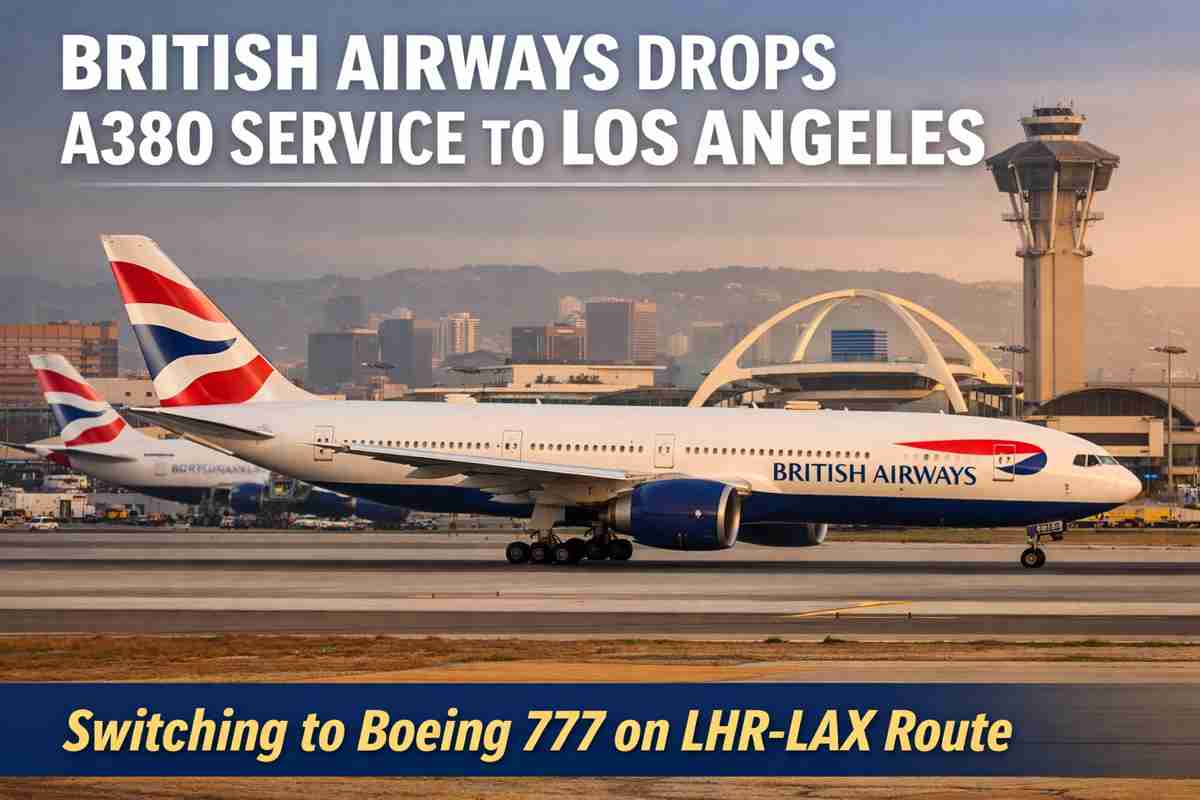
LONDON — British Airways will discontinue all Airbus A380 flights between London Heathrow and Los Angeles starting in winter 2026/2027, marking a significant shift in capacity and fleet deployment on one of the world’s busiest long-haul routes.
The move, first reflected in Cirium Diio schedule updates, represents the first time since September 2013 that the double-decker aircraft will not operate on the Southern California route under normal conditions. Instead, the airline will deploy Boeing 777-300ER aircraft across all three daily frequencies.
Final A380 Departure Set for October 2026
The A380’s last scheduled flight from London Heathrow to Los Angeles will depart on October 24, 2026, the final day of the IATA northern summer season. Beginning October 25, all services will transition to 777-300ER aircraft equipped with the airline’s newer Club Suites business class.
While the shift reduces total daily round-trip seat capacity from 1,962 to 1,536—a 22% decline—British Airways will maintain its three daily departures, preserving schedule flexibility for both business and leisure travelers.
The change is closely tied to the airline’s ongoing A380 retrofit program, which will reduce seating density from 469 to 421 seats while introducing a more premium-heavy configuration. However, the existing A380 cabins still feature older Club World seats, which lag behind competitors’ offerings.
Product Upgrade Prioritized Over Volume
The Boeing 777-300ER replacement is widely viewed as a product upgrade despite the reduction in capacity. The aircraft will feature Club Suites, British Airways’ latest business class product designed to enhance privacy and comfort.
Two of the three daily Los Angeles services already operate with this configuration, making the transition to an all-777 operation more consistent from a passenger experience standpoint.
Industry observers note that the airline appears to be prioritizing yield and product competitiveness over sheer seat volume, particularly on premium-heavy transatlantic routes.
A380 Network Shrinks Further
The Los Angeles change is part of a broader contraction of British Airways’ A380 network. During the winter 2026/2027 season, the aircraft will operate on just four routes from Heathrow: Dubai, Johannesburg, Miami, and San Francisco.
Total A380 departures are expected to fall to 770 for the season, representing a 27% reduction compared to the previous winter schedule. The decline is driven by multiple factors, including the termination of A380 service to Washington Dulles in late 2025, reduced frequencies to Johannesburg, and the complete withdrawal from Los Angeles.
Strong Market Position Maintained
Despite the capacity cut, British Airways retains a dominant position on the London–Los Angeles corridor. The route carried nearly 1.5 million round-trip passengers in 2025, making it one of the busiest transatlantic markets.
British Airways alone transported approximately 574,000 passengers, and together with joint venture partner American Airlines, the two airlines controlled nearly 60% of the market.
Load factors also remain strong. British Airways reported an average seat factor of 84.8% on the route in 2025, outperforming the broader market average of 78.4%. Monthly demand peaked at 90.7% in September and dipped to 74.9% in February, reflecting typical seasonal variation.
Competitive Implications
The reduction in available seats, combined with a more premium-focused cabin, is expected to improve yields and potentially strengthen the airline’s competitive position.
At the same time, the capacity withdrawal could open opportunities for rival carriers such as United Airlines, which currently reports below-average load factors on the route.
Analysts suggest that the shift reflects a broader industry trend toward optimizing profitability through premium products rather than maximizing passenger volume.
Outlook
British Airways’ decision underscores a strategic recalibration of fleet usage and product positioning on high-demand international routes. By aligning aircraft deployment with evolving passenger expectations—particularly in premium cabins—the airline is betting that higher yields will offset reduced capacity.
As the winter 2026/2027 season approaches, the London–Los Angeles route will serve as a key test case for whether this balance between quality and quantity delivers sustained financial and competitive gains.
