


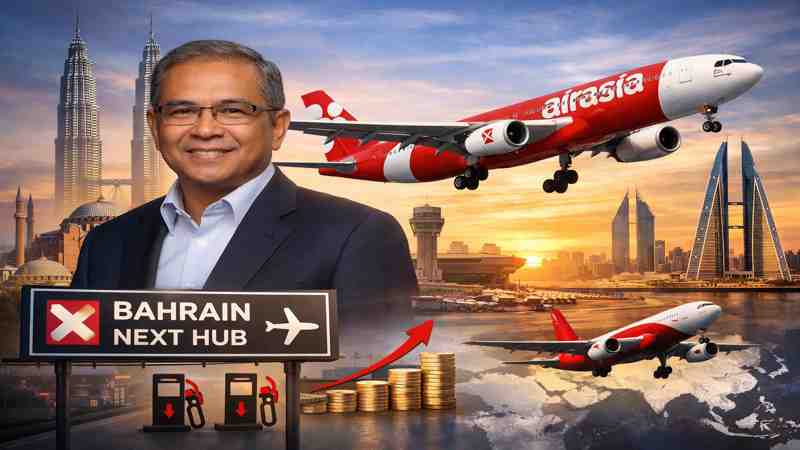
Carrier reshapes strategy amid fuel pressures and global uncertainty
KUALA LUMPUR — AirAsia X is doubling down on network realignment and leadership changes as it navigates rising fuel costs and shifting global travel demand, appointing Tan Sri Jamaludin Ibrahim as Independent Non-Executive Chairman while advancing plans for a new Bahrain hub.
The airline said the leadership transition and route adjustments are central to its strategy to sustain growth and maintain cost competitiveness in an increasingly volatile aviation environment. At the same time, the carrier reaffirmed its commitment to Kuala Lumpur as its primary hub while prioritizing expansion into Central Asia and the Middle East.
AirAsia X Charts Growth Path Under New Leadership
The appointment of Tan Sri Jamaludin follows the consolidation of seven AirAsia airlines into a unified group structure spanning both short-haul and medium-haul operations. The move is designed to streamline operations and strengthen governance as the company enters a new phase of expansion.
AirAsia X said the new chairman brings independent oversight and governance expertise that is critical to guiding the group through current market challenges. The restructuring comes as the airline continues to report steady travel demand across its ASEAN network, even amid macroeconomic uncertainty.
The carrier reiterated its ambition to position Kuala Lumpur as a low-cost carrier megahub, leveraging its Fly-Thru connectivity product through Kuala Lumpur and Bangkok to facilitate seamless regional travel at competitive prices.
Fuel Surge Forces Network Adjustments and Fare Changes
AirAsia X is also responding to a sharp rise in global jet fuel prices, which have climbed to more than double 2025 levels due to geopolitical tensions and supply chain disruptions. The cost pressures have prompted the airline to introduce calibrated fare increases, including a one-off fuel surcharge across its network.
In parallel, the group has shifted capacity toward routes with stronger demand and higher yields. Services to Almaty, Tashkent, and Istanbul have been prioritized as the airline seeks to capture displaced demand from disrupted markets.
The company is also exploring growth opportunities at its domestic hub in Senai, Johor Bahru, as part of a broader effort to diversify its network and reduce reliance on any single market.
Bahrain Hub Strategy Remains on Track for June 2026
A key pillar of AirAsia X’s forward strategy is the development of Bahrain as a strategic hub linking Asia with the Middle East and Europe. The airline confirmed that services to Bahrain are scheduled to commence on June 26, 2026, signaling confidence in medium-term market recovery.
Tony Fernandes, Advisor to AirAsia X, emphasized the importance of the broader Capital A ecosystem in supporting the airline’s resilience. He pointed to the roles of AirAsia MOVE in boosting sales and connectivity, ADE in lowering operational costs, and AirAsia NEXT in leveraging data and technology to drive revenue.
Group CEO Bo Lingam said the gradual reactivation of the airline’s full fleet is expected to improve unit costs, while stronger ASEAN currencies provide a natural hedge against U.S. dollar-denominated expenses.
He added that ongoing negotiations with key partners are aimed at further containing operational costs as the airline adapts to evolving market conditions.
Strategic Balancing Act Ahead
AirAsia X’s latest moves highlight a balancing act between cost management and growth ambitions. By reinforcing its Kuala Lumpur hub, reallocating capacity to high-demand routes, and advancing its Bahrain expansion, the airline is positioning itself to capture new opportunities while mitigating near-term risks.
As global aviation continues to face uncertainty, the success of these initiatives will likely depend on fuel price stabilization, currency trends, and the pace of demand recovery across key markets.
