


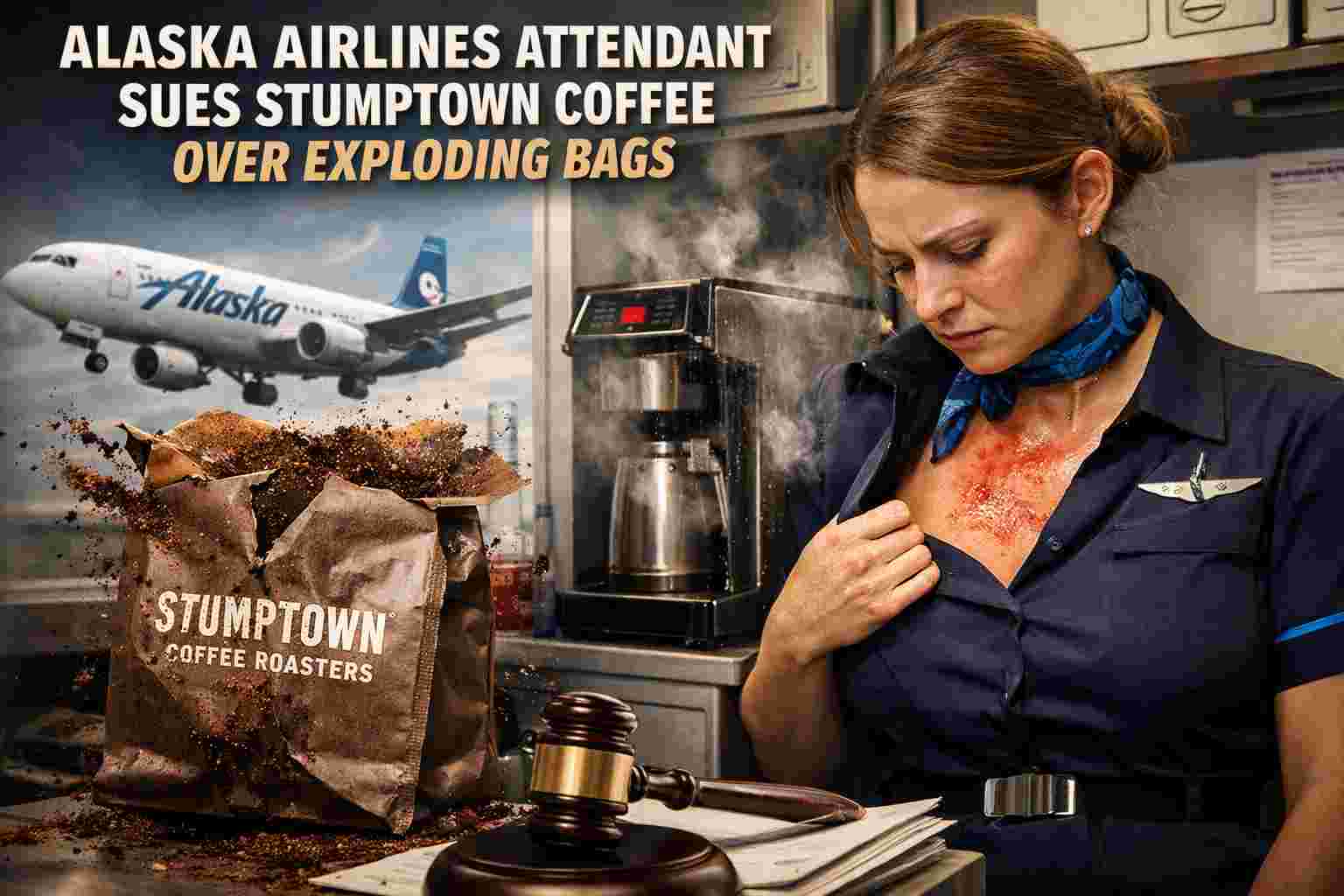
Pregnant crew member alleges defective packaging caused severe burns mid-flight
SEATTLE — A flight attendant for Alaska Airlines has filed a federal lawsuit against Stumptown Coffee Corp., alleging that defective coffee packaging led to a mid-flight equipment failure that caused serious injuries.
The complaint, filed in the U.S. District Court for the Western District of Washington, stems from a 2024 onboard incident in which a galley coffee maker allegedly malfunctioned, spraying scalding liquid and coffee grounds onto crew member Victoria Waldron. According to the lawsuit, Waldron was pregnant at the time and has since suffered permanent burn scarring.
The case raises broader concerns about product safety standards for inflight service equipment and whether vendors adequately test products for aviation-specific conditions.
Allegations Focus on Product Design and Testing Failures
Coffee partnership shift under scrutiny
Stumptown began supplying coffee to Alaska Airlines and its regional affiliate Horizon Air on December 1, 2023, replacing a longstanding partnership with Starbucks. The Portland-based company developed a custom blend marketed for optimal taste at cruising altitude.
However, the lawsuit alleges that while the coffee itself was tested for flavor performance, the packaging used for brewing onboard aircraft was not properly evaluated for safety under pressurized cabin conditions.
Aircraft cabins are typically pressurized to simulate altitudes between 6,000 and 8,000 feet, which can significantly affect how materials behave under heat and pressure. The complaint claims that Stumptown relied on packaging designed for ground-level use, without validating its structural integrity inside airline coffee makers.
The filing further alleges that the packaging differed from previously used products and was not tested for compatibility with Alaska Airlines’ galley equipment.
Prior Incidents Suggest Broader Pattern
Union concerns raised before injury
The lawsuit points to a pattern of similar incidents prior to Waldron’s injury. At least ten burn-related events involving the same coffee packaging were reportedly documented among Alaska Airlines crew members.
According to the complaint, the Association of Flight Attendants raised concerns as early as February 2024. Public reports from crew members described coffee packs bursting during brewing, causing burns.
Despite these warnings, the lawsuit alleges that Stumptown did not issue product recalls, warnings, or design changes. The complaint characterizes this lack of action as a failure to respond to known safety risks.
Details of the April 1 Incident
Equipment failure mid-flight
The incident involving Waldron occurred approximately 30 minutes before landing on a flight from Seattle-Tacoma International Airport to Phoenix Sky Harbor International Airport.
According to the lawsuit, a coffee maker in the aircraft galley failed suddenly, ejecting hot coffee, boiling water, and grounds onto Waldron’s chest and other areas of her body.
The filing states that Waldron experienced immediate pain and feared for both her safety and that of her unborn child. She has since developed permanent scarring, recurring heat-triggered skin reactions, and ongoing emotional distress. The complaint notes that she may require additional medical treatment, including dermatological care and possible surgical intervention.
Legal Claims and Industry Implications
Product liability and damages sought
Waldron’s lawsuit includes claims of product liability, alleging defective design and failure to warn, as well as breach of implied warranty. The complaint argues that safer packaging alternatives were available and that Stumptown failed to adequately test its product under real-world airline conditions.
She is seeking damages for physical pain and suffering, medical expenses, lost wages, and long-term disfigurement. The total monetary amount will be determined at trial.
Notably, Alaska Airlines is not named as a defendant in the case, despite its role in selecting and continuing to use the coffee product after earlier incidents were reported.
Broader Questions for Airline Supply Chains
The lawsuit underscores the complexities of airline supply chains, where products designed for consumer markets must be adapted to unique aviation environments. It also highlights potential gaps in testing protocols for onboard service items subjected to pressurized and high-temperature conditions.
As the case proceeds, it may prompt closer scrutiny of how airlines and suppliers evaluate product safety—and whether current standards are sufficient to protect crew members working in confined, high-risk environments.
