


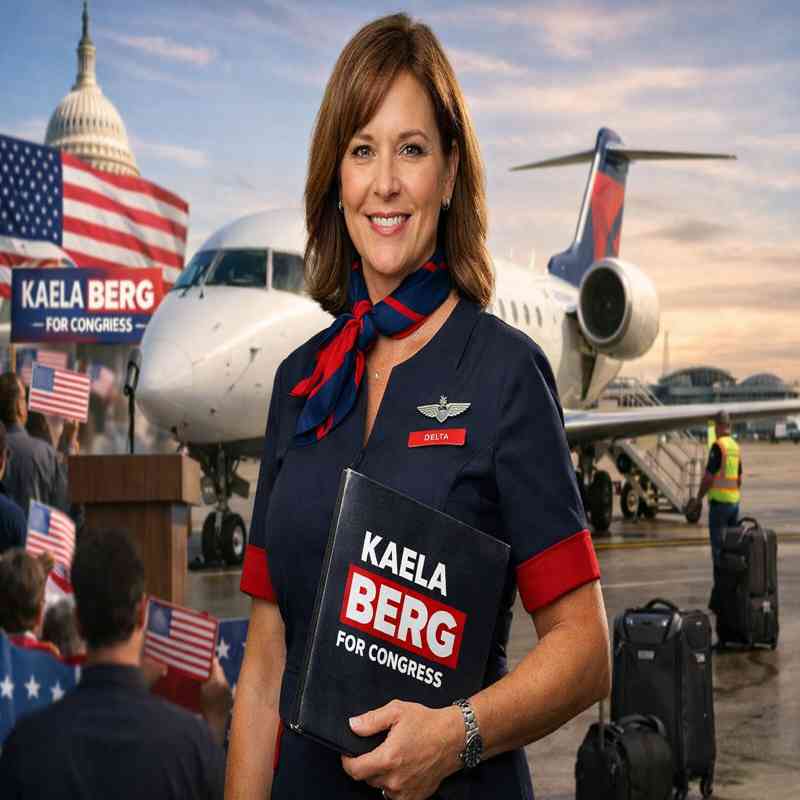
Union-Backed Candidate Balances Flying and Campaign Trail
MINNEAPOLIS — Kaela Berg, a Minnesota state representative and flight attendant for Endeavor Air, is mounting a bid for the U.S. House in the Minneapolis suburbs while continuing to work regular flight shifts, underscoring a campaign built on working-class credentials and lived economic experience.
Berg’s candidacy reflects a broader Democratic effort to elevate blue-collar voices ahead of the August 2026 primary, a strategy highlighted in reporting by The New York Times. Her campaign emphasizes the financial realities faced by everyday Americans, positioning her as a candidate who directly understands the pressures of hourly wage work.
She currently flies regional routes connecting major hubs such as Minneapolis-St. Paul, Detroit, and New York-area airports, earning about $45 per hour and only being compensated for time spent in the air. That pay structure, she has indicated, makes campaigning particularly challenging financially.
Juggling Legislative Duties, Union Advocacy, and Aviation Work
Berg has continued to balance multiple professional roles. During a recent five-day stretch involving 15 flights, she conducted donor outreach and campaign strategy sessions from airport terminals and hotel rooms between shifts.
Her schedule reflects the hybrid nature of her career. While Minnesota’s Legislature operates on a part-time basis, Berg takes unpaid leave during legislative sessions and increases her flying hours during the rest of the year to cover living expenses, including rent for her Minneapolis apartment.
Her professional designation has also evolved. State legislative records listed her as a “flight attendant” through 2021–22, but more recent sessions describe her as an “independent labor consultant.” Despite that shift, she continues to campaign heavily on her identity as a flight attendant and union member.
Labor Roots Shape Policy Platform
Berg, 52, credits her political trajectory to her involvement with the Association of Flight Attendants-CWA, which has formally endorsed her campaign. Her union work included organizing workers and lobbying policymakers, experiences that helped launch her political career.
She previously served as a delegate for Senator Bernie Sanders at the 2016 Democratic National Convention before winning a Minnesota House seat in 2020.
Her platform focuses on cost-of-living concerns, including housing, healthcare, groceries, and utilities. She also supports policies such as taxing higher-income earners, expanding access to education, and protecting abortion rights.
Berg has also backed legislation extending earned sick and safe time protections to flight crews. Her personal financial challenges have informed her messaging; during her initial state campaign, she lived in a friend’s basement during the COVID-19 pandemic due to insufficient income from flying alone.
Beyond economic issues, Berg has taken visible positions on immigration enforcement, including alerting residents to nearby U.S. Immigration and Customs Enforcement activity in her community.
Fundraising Disparities and Polling Challenges
Despite a distinct personal narrative, Berg faces a steep climb in securing her party’s nomination. Campaign finance filings show she ended 2025 with $53,162 in cash after raising $132,117 for the election cycle.
Her competitors have built significantly larger war chests. State Senator Matt Klein reported $328,327 cash on hand, while former mayor and state senator Matt Little reported $390,955, though with existing campaign debt.
A recent party straw poll highlighted the gap in support. Berg received 6.68% of the vote, compared with 43.29% for Little and 20.97% for Klein. No independent public polling has been reported for the race.
The Democratic-Farmer-Labor Party endorsement, expected at its May convention, remains a key milestone. Berg’s campaign is actively working to secure delegate backing, though current indicators suggest a difficult path forward.
Democratic-Leaning District Offers General Election Opportunity
Minnesota’s 2nd Congressional District, which includes the southern suburbs of the Twin Cities, has trended Democratic in recent election cycles. The seat is open following Representative Angie Craig’s decision to run for U.S. Senate.
Recent results show Democratic candidates receiving between 48% and 55.5% of the vote, indicating a modest but consistent advantage for the party.
If Berg were to secure the nomination, the district’s political lean could provide a viable path in the general election.
Financial Realities of Congressional Service
The congressional salary of $174,000 would represent a significant increase from Berg’s current earnings as a flight attendant. However, she has acknowledged that maintaining residences in both Washington, D.C., and Minnesota would offset much of that income.
Berg has stated that financial gain is not her primary motivation, instead framing her candidacy as an extension of her advocacy for working-class Americans.
Her campaign ultimately hinges on whether her personal story and labor-backed platform can overcome financial disadvantages and limited early support within party ranks.
