


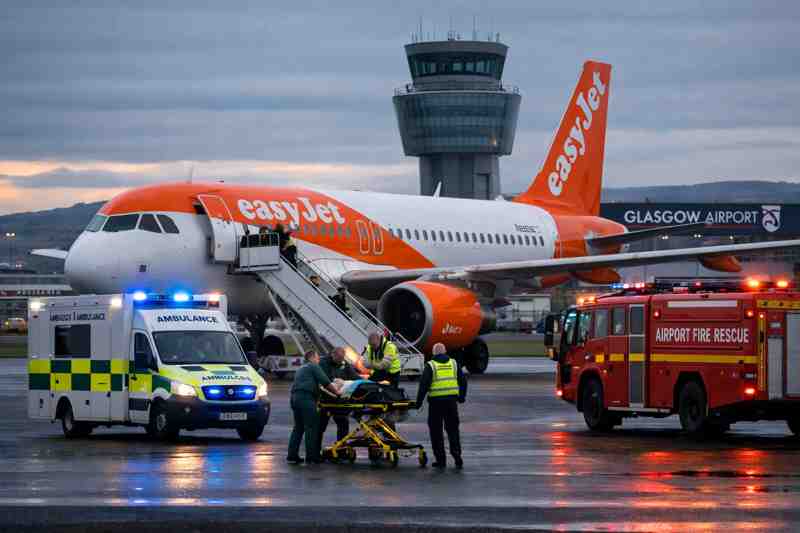
An easyJet flight was forced to return to Glasgow International Airport shortly after takeoff on March 29, 2026, after a cabin crew member required urgent medical assistance, disrupting travel plans for passengers bound for Jersey Airport.
Flight EZY439, operated by an Airbus A319, had departed Glasgow at its scheduled time of 11:50 a.m. local time and was expected to arrive in Jersey at 1:25 p.m. However, within minutes of takeoff, the aircraft turned back, prompting an emergency response upon landing.
The airline initially described the situation as an “extraordinary circumstance,” later clarifying that the diversion was due to a medical emergency involving a member of the cabin crew.
Emergency Landing and Immediate Medical Response
The aircraft landed safely back at Glasgow, where medical teams were on standby to assist. Passengers were not immediately informed of the full nature of the incident, with the airline first citing a “crew welfare issue.”
An easyJet spokesperson confirmed the details of the incident, stating: “Flight EZY439 from Glasgow to Jersey on 29 March returned to Glasgow due to a cabin crew member requiring medical assistance. The flight landed normally in Glasgow and was met by medical services on the ground.”
The airline emphasized that safety protocols were followed and that the situation was handled in line with standard aviation procedures for onboard medical emergencies.
Flight Rescheduling Creates Extended Delays
Following the emergency landing, easyJet initially indicated that passengers would continue their journey later the same day, with a revised departure scheduled for 5:15 p.m. and an expected arrival in Jersey at 6:33 p.m.
However, updated information from Glasgow International Airport showed that the flight was ultimately postponed until the following morning, with a new departure time of 8:35 a.m. on Tuesday.
The delay left passengers facing significant disruption, though the airline said efforts were made to keep travelers informed throughout the process via cabin crew and ground staff.
easyJet stated:
We plan for passengers to continue their journey to Jersey later today and apologise for any inconvenience. The safety and well-being of passengers and crew is always easyJet’s highest priority.”
Regulatory Implications of “Extraordinary Circumstance”
The airline’s classification of the incident as an “extraordinary circumstance” carries implications under UK aviation regulations. Under UK261 rules, such a designation can limit an airline’s financial liability for passenger compensation in cases of delays or cancellations.
Medical emergencies involving crew members are generally considered beyond the airline’s operational control, making them eligible for this classification. As a result, compensation eligibility for affected passengers will depend on how regulators interpret the situation and the total delay duration.
Industry analysts note that while such incidents are relatively uncommon, airlines are required to prioritize safety above all else, including diverting or returning flights when necessary.
Role of Glasgow Airport in Emergency Handling
Glasgow International Airport, Scotland’s second-busiest airport after Edinburgh Airport, played a key role in managing the situation. Ranked ninth in the United Kingdom by passenger traffic, the airport is equipped with full emergency response capabilities, including on-site medical services.
These resources were activated immediately upon the aircraft’s return, ensuring a rapid response to the crew member’s medical needs.
The airport serves as a major hub for domestic and international travel, including easyJet’s regular service to Jersey in the Channel Islands.
Passenger Impact and Next Steps
Passengers aboard Flight EZY439 experienced extended delays and uncertainty as the situation unfolded. While the airline provided updates and rebooking arrangements, the disruption highlights the broader operational challenges airlines face when dealing with in-flight medical incidents.
Travelers affected by the delay may seek compensation depending on the final classification of the event and the total delay incurred, though the “extraordinary circumstance” designation could limit payouts.
For now, the airline has reiterated its commitment to safety and customer care as it works to complete passengers’ journeys and manage the aftermath of the incident.
