


ANA Group Retires AirJapan After Two-Year Hybrid Carrier Experiment
TOKYO — AirJapan, the low-cost long-haul brand of ANA Group, operated its final flights on March 28, 2026, bringing an end to a short-lived but closely watched experiment in hybrid airline service that sought to bridge the gap between premium and budget travel.
The carrier, which launched in February 2024, carried nearly one million passengers across a focused network linking Tokyo with Bangkok, Seoul, and Singapore. Its closure comes as ANA Group continues broader restructuring efforts aimed at optimizing its multi-brand strategy.
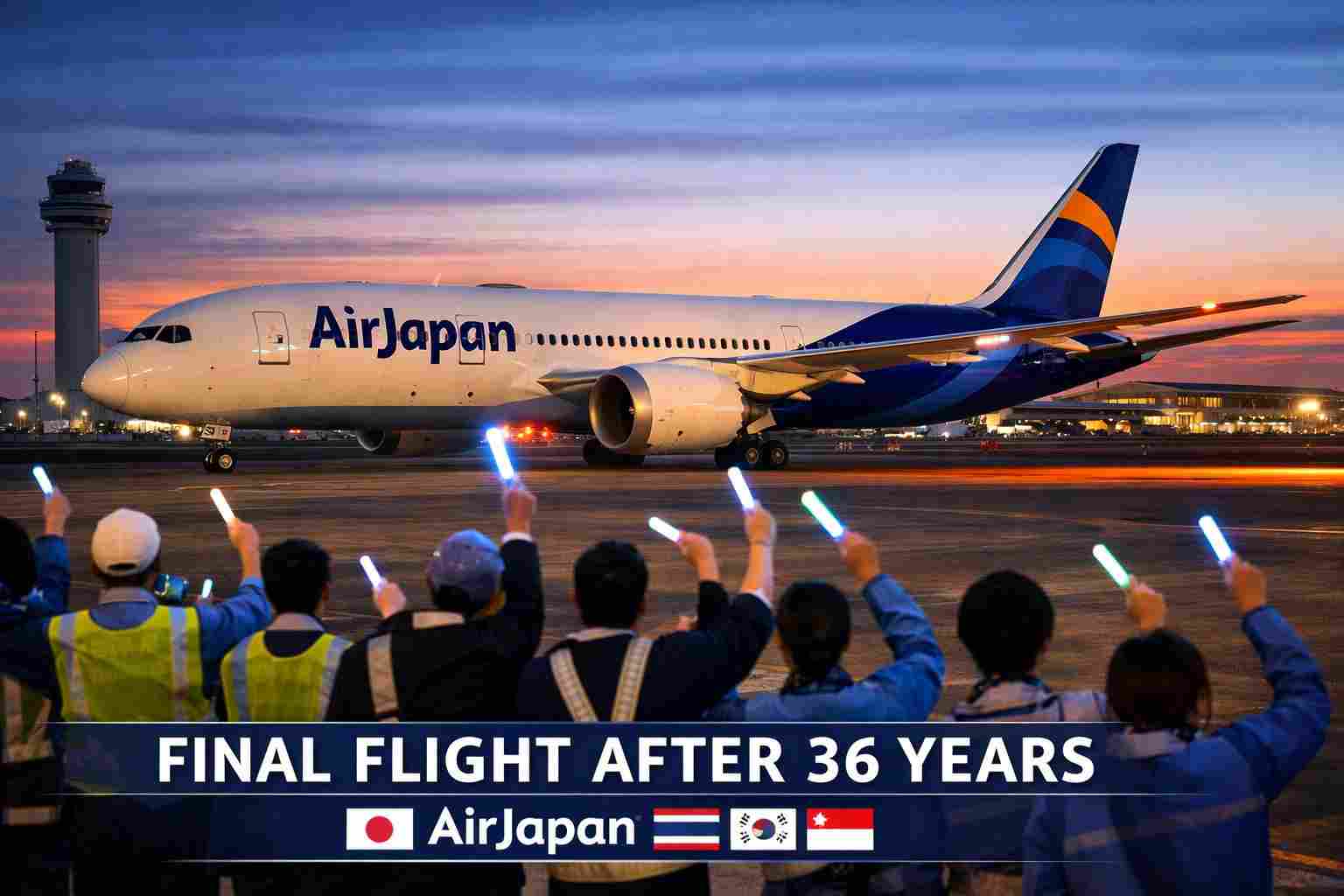
A farewell event at Narita Airport marked the airline’s final departure, with employees and passengers gathering to commemorate the brand’s exit after just over two years in operation.
A Hybrid Strategy in a Competitive Market
AirJapan was introduced as ANA Group’s third airline brand, complementing its full-service flagship All Nippon Airways and low-cost subsidiary Peach Aviation.
Positioned as a “hybrid carrier,” AirJapan aimed to offer Japanese-style hospitality at fares competitive with low-cost airlines, encapsulated in its slogan, “Fly Thoughtful.” The concept was designed to attract both inbound international travelers and cost-conscious Japanese passengers seeking a more personalized flying experience.
The airline began operations on February 9, 2024, with a single route from Tokyo Narita to Bangkok. It later expanded to Seoul Incheon and Singapore Changi, building a lean network concentrated in high-demand Asian markets.
Despite its limited route map, the airline transported more than 968,900 passengers across 4,124 flights during its lifespan, underscoring steady demand for its service model.
Branding, Experience and Cultural Positioning
AirJapan differentiated itself through a strong emphasis on Japanese cultural elements, both in branding and onboard experience. Its visual identity featured indigo and dawn blue tones across aircraft liveries and crew uniforms, while in-flight offerings highlighted Japanese-inspired meals.
The airline also experimented with unique passenger engagement features, including projection mapping experiences and gachapon capsule toy vending machines onboard—an unusual move in commercial aviation aimed at enhancing the travel experience.
These elements were part of a broader strategy to position AirJapan as more than a budget airline, instead offering a culturally immersive journey at competitive prices.
Fleet and Final Day Operations
AirJapan operated a small but efficient fleet of three Boeing 787-8 aircraft, each configured in a high-density, single-class layout with 324 seats.
On its final day of operations, all three aircraft were deployed simultaneously across the airline’s network. Flights operated to Bangkok, Seoul Incheon, and Singapore, marking a coordinated conclusion to the carrier’s services.
The final departure from Tokyo Narita to Bangkok, flight NQ1, carried 298 passengers. Approximately 70 AirJapan staff members gathered on the ramp to send off the aircraft, waving glow sticks as the sun set—an emotional farewell for employees who had helped build the brand.
Passengers on the final flights received commemorative items, including boarding certificates and stickers, while a select group of travelers received special gifts through a lottery system.
Operational Milestones
Over its two-year run, AirJapan achieved notable operational milestones despite its relatively short lifespan. Its Singapore route alone accounted for 1,090 flights and approximately 255,200 passengers.
In total, the airline’s 4,124 flights and nearly one million passengers reflected consistent utilization of its limited fleet and route network, suggesting that the hybrid model resonated with a segment of travelers.
Leadership Reflects on Closure
At the gate prior to the final departure, Naoki Michihiro, General Manager of Flight Operations at Air Japan Inc., addressed both passengers and staff in Thai, Japanese, and English, acknowledging the airline’s diverse customer base.
Michihiro stated that AirJapan had fulfilled two core missions: welcoming international travelers with Japanese hospitality, and offering Japanese travelers a more personal and flexible way to fly abroad.
He confirmed the final flight departed with a full load and expressed confidence that the airline had achieved what it set out to do.
He also emphasized that the knowledge and experience built through AirJapan would serve as an asset for the future development of the ANA Group.
End of a 36-Year Evolution
While the AirJapan brand itself existed for just over two years, its corporate lineage stretches back to 1990, when it was originally founded as World Air Network. Over 36 years, the entity underwent multiple rebrandings before ultimately being retired under its final identity.
The closure highlights the challenges of sustaining niche airline models in an increasingly competitive and cost-sensitive aviation market, even as demand for air travel continues to recover and evolve.
For ANA Group, the end of AirJapan marks not just the conclusion of a brand, but the latest step in refining its long-term strategy across full-service and low-cost segments.
