


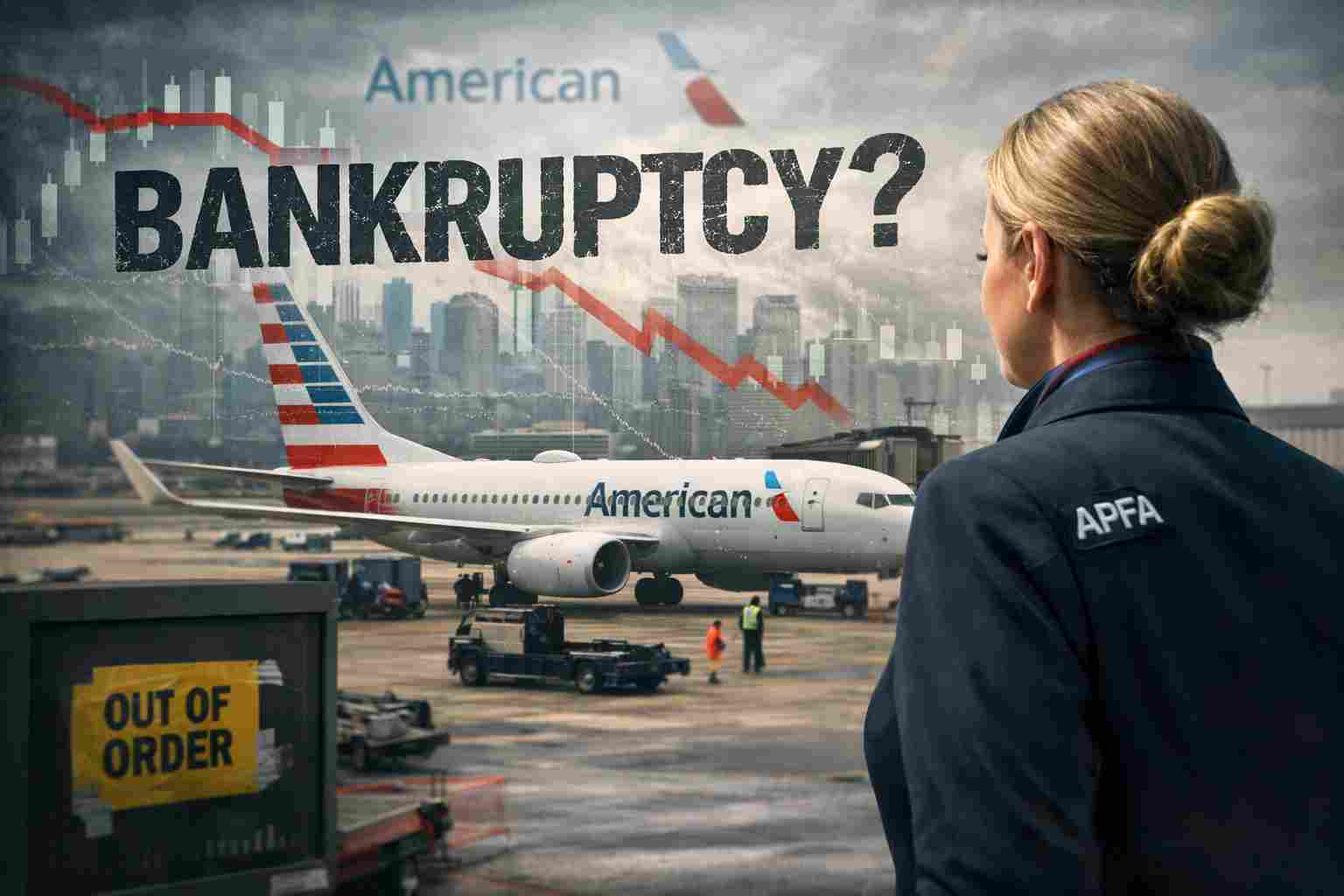
Flight attendants at American Airlines are voicing serious concerns about the carrier’s financial trajectory, with union leadership privately warning that conditions could deteriorate significantly if corrective action is not taken. Internal meeting minutes from the Association of Professional Flight Attendants (APFA) describe the airline’s situation as “dire,” raising fears of a potential bankruptcy scenario reminiscent of the company’s past restructuring.
The concerns surfaced during a February executive board meeting, where APFA National President Julie Hedrick urged members to remain vigilant and continue applying pressure on management. The warning reflects anxiety over protecting labor gains secured in recent negotiations, which could be at risk if financial performance weakens further.
Financial Underperformance Highlights Structural Issues
American Airlines’ recent financial results have intensified these concerns. The carrier reported near break-even performance last year, trailing significantly behind competitors such as United Airlines and Delta Air Lines, which posted $4.3 billion and $6.2 billion in pre-tax earnings, respectively. The disparity underscores deeper structural challenges rather than a temporary downturn.
The airline recently updated its first-quarter 2026 guidance, projecting a 10% year-over-year revenue increase. However, rising fuel costs—driven by global uncertainty—are expected to add more than $400 million in expenses this quarter alone. American now anticipates a per-share loss ranging from 10 to 50 cents.
While the company maintains sufficient liquidity and has reduced debt from pandemic-era highs, analysts suggest that sustained annual losses—potentially reaching $2 billion—could eventually strain its financial stability.
Strategic Decisions Under Scrutiny
Industry observers and union leaders point to a series of long-term strategic decisions that have contributed to American’s current position. Unlike Delta and United, which focused on attracting premium travelers, American pursued a strategy aimed at competing with low-cost carriers such as Spirit Airlines and Frontier Airlines.
This approach included densifying aircraft cabins by reducing premium seating in favor of additional economy rows. CEO Robert Isom previously described the move as a “real success,” though critics argue it weakened the airline’s ability to generate high-margin revenue.
Additional cost-cutting measures, such as removing seatback entertainment screens, contrasted with competitors’ investments in onboard technology and passenger experience enhancements. These differences have further widened the revenue gap between American and its rivals.
Fleet strategy has also played a role. During the pandemic, American retired several aircraft types, including widebody jets that are critical for long-haul international routes. When transatlantic demand rebounded, the airline lacked sufficient capacity to capitalize on the surge, unlike United and Delta, which had secured future aircraft deliveries.
Labor Tensions and Leadership Challenges
Labor relations have grown increasingly strained as financial concerns mount. Both flight attendants and pilots have expressed dissatisfaction with leadership. The APFA issued a no-confidence vote in CEO Robert Isom, while the pilots’ union has pushed for direct engagement with the board regarding the airline’s performance.
Pilots had negotiated profit-sharing provisions into their contracts, but those benefits have yielded minimal returns due to weak profitability. Meanwhile, internal union dynamics are adding complexity, as debates continue over leadership direction and potential affiliation with larger labor organizations.
Hedrick, currently midway through her second term, faces criticism from some members who believe union leadership has been too closely aligned with management.
Bankruptcy Fears Rooted in Past Experience
Despite the heightened rhetoric, no immediate bankruptcy filing appears imminent. American retains sufficient financial flexibility to absorb near-term losses. However, employee concerns are shaped by the airline’s history—particularly its 2011–2013 Chapter 11 restructuring.
During that period, the company used provisions under bankruptcy law to renegotiate labor contracts, resulting in significant concessions from employees. That precedent remains a central concern among union members today.
Experts note that while leadership changes could influence investor confidence and labor relations, they would not address the airline’s core challenges. These include an undersized widebody fleet, limited premium seating, a less competitive onboard product, and eroded customer loyalty.
Outlook Remains Uncertain
As American Airlines navigates rising costs and competitive pressure, the gap between its performance and that of its peers continues to raise questions about long-term strategy and execution.
For employees, the stakes extend beyond financial metrics to job security and contract protections. Union leaders are signaling that without meaningful changes, the risks—while not immediate—could grow over time.
The situation remains fluid, with both management and labor under increasing pressure to chart a sustainable path forward.
