


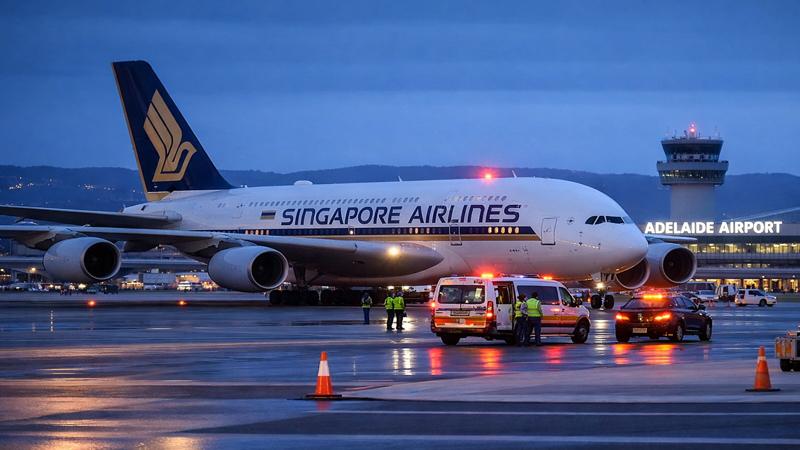
A medical emergency aboard a Singapore Airlines Airbus A380 forced an unscheduled landing in South Australia on Thursday, drawing attention to Adelaide Airport’s role as a critical diversion point for long-haul international flights.
Emergency Diversion Mid-Flight
Flight SQ221, operating from Singapore Changi Airport to Sydney Kingsford Smith Airport, was diverted after a passenger fell ill during the journey. The aircraft departed Singapore at 8:48 p.m. local time on Wednesday and landed at Adelaide Airport shortly after 6:00 a.m. on March 27, 2026.
Emergency services met the aircraft on arrival, with an ambulance crew attending to the affected passenger. Airport officials indicated the flight was expected to continue onward to Sydney later that morning.
While in-flight medical diversions are a routine part of airline operations, the involvement of an Airbus A380 — the world’s largest passenger aircraft — made the incident particularly notable for the region.
Rare A380 Appearance in Adelaide
Adelaide Airport does not typically handle scheduled A380 services, making such landings uncommon outside of emergency situations. The aircraft’s arrival drew attention from residents, including one observer near Gawler who noticed the unusual presence overhead.
“The resident, speaking to ABC Radio Adelaide, said he could hear the aircraft approaching and immediately sensed it was larger than usual.”
“He described seeing four lights flashing in the darkness and noted the sound was distinctly different from that of aircraft that typically fly over that area.”
The Airbus A380’s size and four-engine configuration give it a distinct acoustic footprint, often recognizable even to those without aviation expertise.
Infrastructure Supports Emergency Operations
Despite the rarity of such visits, Adelaide Airport is fully equipped to handle A380 aircraft in diversion scenarios. Its runway length and ground infrastructure meet international requirements for accommodating the aircraft’s approximately 80-meter wingspan and substantial weight.
Airports designated as alternates for wide-body aircraft must maintain specific operational standards, ensuring they can safely manage unexpected arrivals without disrupting broader air traffic operations.
Established Protocols Guide Diversions
The decision to divert is governed by strict aviation protocols designed to prioritize passenger safety while balancing operational constraints. According to the Australian International Pilots Association Vice President and Qantas captain Mark Hofmeyer, pilots rely on defined frameworks when responding to emergencies.
“Speaking after the diversion of Qantas (QF) flight QF82, Captain Hofmeyer said pilots follow a defined set of rules when deciding where to land during an in-flight emergency.”
“He noted that for medical events, there are still airport-specific restrictions in place, unlike certain mechanical crises where a crew may land at the nearest available strip.”
These considerations include proximity, airport capability, and the nature of the emergency, all of which factor into real-time decision-making in the cockpit.
Pattern of A380 Diversions
The SQ221 diversion is part of a broader pattern of A380 aircraft landing in Adelaide due to medical emergencies. In August 2023, a Qantas A380 operating flight QF82 from Singapore to Sydney diverted to Adelaide under similar circumstances.
In another incident, an Emirates A380 flying from Dubai International Airport to Sydney made an unscheduled stop in Adelaide after a passenger experienced chest pains. The aircraft later resumed its journey, while the affected passenger was transported to a local hospital for treatment.
These repeated incidents underscore Adelaide’s strategic importance as a diversion airport along major international routes connecting Southeast Asia and the Middle East with Australia’s east coast.
Strategic Role in Long-Haul Aviation
As global air traffic continues to rebound and long-haul routes remain heavily trafficked, airports like Adelaide play an essential supporting role in ensuring operational resilience. Its ability to accommodate large aircraft such as the Airbus A380 provides airlines with a critical safety net during unforeseen events.
Though rare, such diversions highlight the complexity of modern aviation networks and the infrastructure required to support them — even in cities that do not regularly host the world’s largest passenger jets.
