


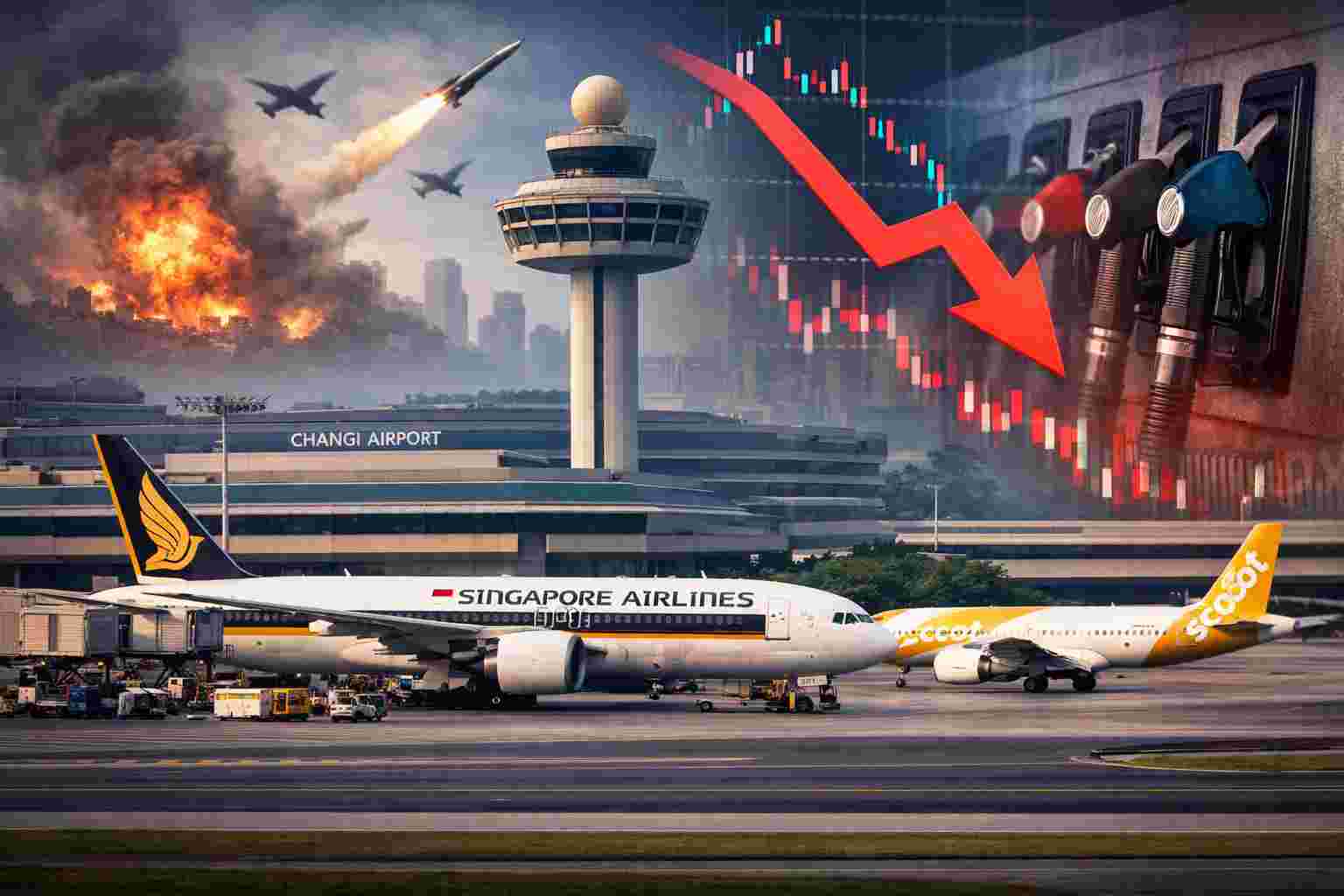
Singapore has delayed the rollout of its sustainable aviation fuel (SAF) levy and adjusted its near-term green aviation targets, as mounting geopolitical tensions in the Middle East continue to strain airline economics and fuel markets.
The decision, announced by the Civil Aviation Authority of Singapore (CAAS), underscores the government’s effort to balance climate commitments with the financial realities facing airlines and passengers. The changes will affect all departures from Singapore Changi Airport, a key global aviation hub and base for Singapore Airlines.
SAF Levy Implementation Pushed to 2027
Singapore had initially planned to introduce the SAF levy on tickets sold from April 2026, covering flights departing in October 2026. Under the revised timeline, the levy will now apply to tickets sold from October 2026 for flights departing from January 2027.
The deferment applies across all outbound flights, including passenger services, cargo operations, and business aviation. Authorities emphasized that while the timeline has shifted, the levy’s structure and pricing remain unchanged.
The CAAS said the delay reflects a cautious response to rising cost pressures in aviation, as geopolitical instability—particularly linked to the Iran conflict—continues to influence global fuel prices and airline operating expenses.
Cost Impact on Travelers and Airlines
Once implemented, the SAF levy will be incorporated into ticket prices, with charges varying by distance and cabin class. Economy passengers traveling within Southeast Asia are expected to pay relatively modest fees, while long-haul routes—especially premium cabin travel to destinations such as the United States—will attract higher surcharges.
For airlines, the delay provides temporary relief from immediate cost pass-through at a time when margins remain under pressure. Carriers worldwide have been contending with elevated fuel costs, supply chain constraints, and uneven demand recovery in certain markets.
Singapore’s decision signals a recognition that imposing additional costs too soon could dampen travel demand or place its aviation hub at a competitive disadvantage.
Sustainability Target Adjusted
Alongside the levy delay, Singapore has also postponed its initial target of achieving a 1 percent SAF uplift by one year. The revision reflects ongoing challenges in sourcing sustainable aviation fuel at scale and at commercially viable prices.
Despite the adjustment, the government reaffirmed its longer-term commitment to sustainability. Singapore continues to target SAF usage of between 3 percent and 5 percent by 2030, contingent on improvements in global supply, cost stability, and broader industry adoption.
Officials noted that SAF remains significantly more expensive than conventional jet fuel and is still produced in limited quantities, necessitating a phased and flexible implementation strategy.
Industry Collaboration Continues
Even as the levy timeline shifts, Singapore’s aviation sector is pressing ahead with efforts to build a scalable SAF ecosystem. A previously announced voluntary SAF procurement trial will continue as planned, involving a range of industry stakeholders.
Participants include Singapore Airlines, its low-cost subsidiary Scoot, Changi Airport Group, and several major financial institutions. The initiative is designed to test procurement mechanisms, cost-sharing models, and operational frameworks needed for wider SAF adoption.
Authorities described the trial as a critical step toward understanding supply chain dynamics and ensuring commercial viability before scaling up SAF usage across the industry.
Temporary Adjustment, Not Policy Reversal
The CAAS emphasized that the delay is a tactical adjustment rather than a retreat from Singapore’s decarbonization goals. Officials reiterated that the country remains committed to reducing aviation emissions while ensuring that policies are implemented in a way that supports economic stability.
By recalibrating its timeline, Singapore joins a growing number of aviation hubs taking a pragmatic approach to sustainability—prioritizing long-term progress while acknowledging near-term market volatility.
As global aviation navigates a complex landscape shaped by geopolitical risk and energy uncertainty, Singapore’s measured approach highlights the challenge of advancing green initiatives without undermining industry resilience.
