


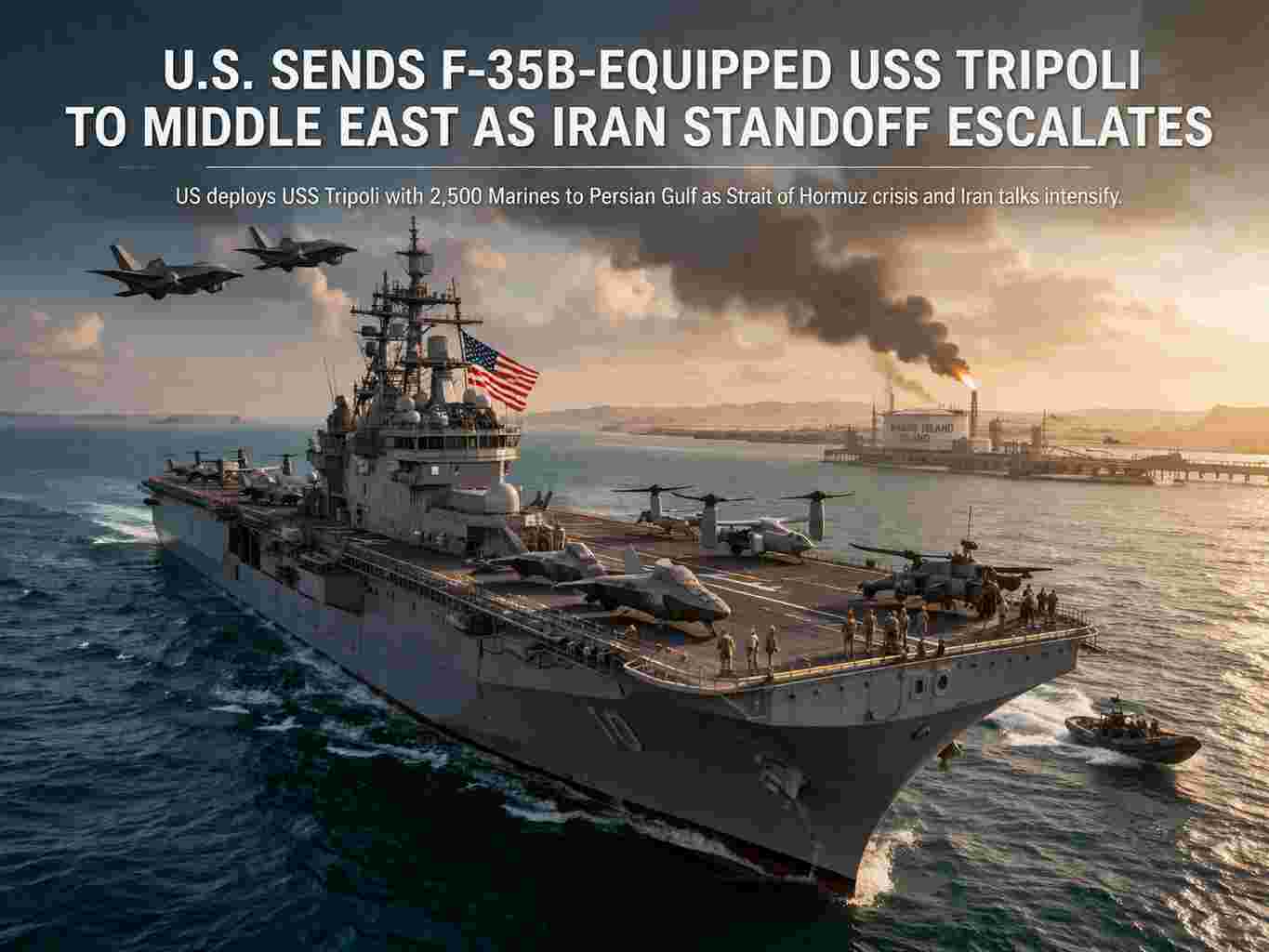
PERSIAN GULF — The United States is accelerating its military posture in the Middle East, dispatching the amphibious assault ship USS Tripoli and thousands of Marines as tensions with Iran escalate alongside renewed diplomatic negotiations. The move reflects a calculated effort to balance deterrence with diplomacy near the Strait of Hormuz, one of the world’s most critical energy corridors.
Strategic Deployment Signals Dual Approach
The USS Tripoli, an America-class amphibious assault ship, is en route from Japan carrying approximately 2,200 to 2,500 Marines. Its deployment comes at a time when Washington is attempting to de-escalate tensions through talks with Tehran while simultaneously reinforcing its military presence in the region.
The vessel is designed to operate as a “lightning carrier,” prioritizing aviation capabilities. Equipped with F-35B stealth fighters, MV-22 Ospreys, and attack helicopters, the ship offers a flexible platform for rapid-response missions without relying on traditional aircraft carriers.
Military planners appear to be positioning assets to respond quickly to developments in the Persian Gulf, even as negotiations continue. Regional logistics hubs, including Dubai International Airport and Hamad International Airport in Doha, remain central to sustaining these operations.
Escalation Rooted in February Conflict
The latest deployment follows a sharp escalation that began in late February 2026, when coordinated strikes triggered a broader regional confrontation. Iran responded with attacks on U.S. and allied positions and took measures that effectively restricted access to the Strait of Hormuz.
This narrow waterway is a vital artery for global oil shipments, and any disruption has immediate consequences for energy markets. The partial closure has already heightened geopolitical risk and raised concerns among global investors and policymakers.
According to Eurasian Times, recent tracking data has shown U.S. naval movements through key maritime routes into the Indian Ocean, suggesting a broader repositioning of forces beyond the USS Tripoli.
Strait of Hormuz Becomes Central Flashpoint
The Strait of Hormuz remains at the center of the crisis. The U.S. administration has identified reopening the passage as a top priority, given its importance to global energy supply chains.
At the same time, Washington has temporarily paused planned strikes on Iranian energy infrastructure for five days to allow diplomatic efforts to progress. The pause indicates a willingness to prioritize negotiations, though officials have made clear that military options remain on the table.
Among those options is the potential targeting or blockade of Kharg Island, Iran’s primary oil export hub. Analysts suggest that controlling or restricting access to the island could exert economic pressure on Tehran while helping restore maritime flow through the strait.
Earlier reports indicate that military infrastructure on Kharg Island has already been targeted, though broader operational decisions are still under review.
Marines Provide Flexible Combat Capability
A key component of the USS Tripoli’s mission is its embarked Marine Expeditionary Unit (MEU), a versatile force capable of conducting amphibious assaults, evacuations, and rapid stabilization operations.
The MEU’s integration with the ship’s aviation assets enhances its ability to carry out surveillance, precision strikes, and troop deployments in contested environments. This flexibility is particularly important in the confined and strategically sensitive waters of the Persian Gulf.
However, defense experts caution that while the MEU is highly capable, it is not designed for prolonged territorial control. Any sustained operation, especially near Iranian territory, would require additional forces and long-term logistical support.
Broader Strategic Implications
The redeployment of USS Tripoli also has ripple effects beyond the Middle East. By shifting amphibious capabilities from the Indo-Pacific, the U.S. may temporarily alter its regional force posture in Asia.
Analysts note that while this shift could affect short-term deterrence dynamics, it is unlikely to significantly change the broader military balance. Still, it underscores the complexity of managing simultaneous global security challenges.
Outlook Remains Uncertain
With diplomatic talks ongoing and military forces repositioning, the situation in the Persian Gulf remains fluid. The coming days will be critical in determining whether negotiations can ease tensions or whether further escalation will occur.
For global markets and energy stakeholders, the stakes are high. Any prolonged disruption in the Strait of Hormuz could have far-reaching economic consequences, reinforcing the importance of both diplomatic resolution and strategic preparedness.
