


Disrupted Departure Raises Questions
LOS ANGELES — Alaska Airlines is under scrutiny following a disrupted international flight in which a pilot’s unusual in-cabin announcement left passengers unsettled and highlighted the importance of clear communication during operational disruptions.
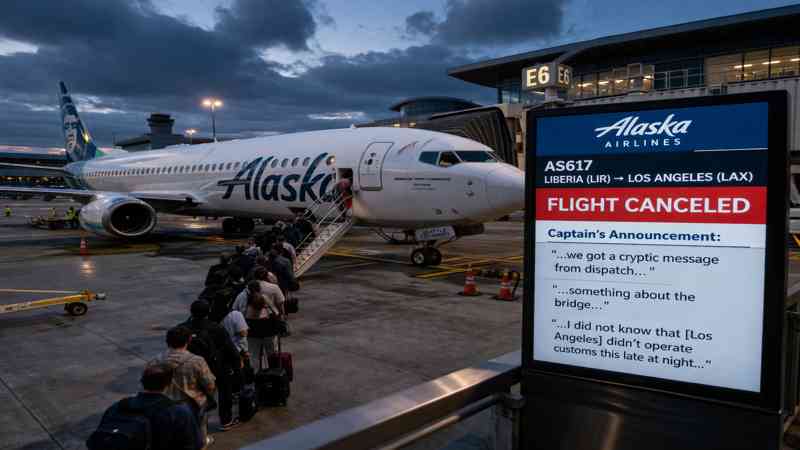
The incident occurred on March 21, 2026, aboard Alaska Airlines flight AS617, scheduled to operate from Liberia, Costa Rica, to Los Angeles. The flight was ultimately canceled after the aircraft pushed back from the gate but returned before takeoff, leaving passengers stranded after boarding.
While cancellations and delays are not uncommon in commercial aviation, the circumstances surrounding this flight — particularly the nature of the captain’s explanation — have drawn attention within the industry and among travelers.
Confusing Cockpit Communication
According to accounts of the incident, the captain made an extended announcement attempting to explain the evolving situation. During the address, the pilot referenced receiving “cryptic messages” from dispatch and expressed confusion over a directive involving “the bridge.”
The captain also acknowledged uncertainty about airport procedures in Los Angeles, noting unfamiliarity with customs services not operating late at night.
The communication stood out not because of the disruption itself, but because of how the information was delivered. Instead of providing clear, structured updates, the remarks conveyed uncertainty and speculation, which contributed to passenger concern.
Aviation observers noted that while transparency is generally encouraged, sharing incomplete or unclear operational details can create confusion rather than reassurance.
Customs Constraints Behind the Cancellation
At the core of the disruption was a logistical issue tied to customs processing hours at Los Angeles International Airport. The flight’s scheduled arrival time was close to the cutoff for customs operations, particularly at terminals handling international arrivals.
Many U.S. international gateways, including Los Angeles, do not maintain 24-hour customs processing. Flights arriving after the cutoff cannot be processed, often forcing airlines to delay or cancel service.
In this case, even a minor delay in departure from Liberia would have pushed the aircraft’s arrival beyond the allowable window. As a result, continuing the flight was deemed impractical.
The late-evening schedule for this route had reportedly been introduced in late 2025, leaving little margin for delays and increasing the likelihood of disruptions under tight operational constraints.
Communication Standards in Focus
The incident has renewed focus on how airlines train pilots and crew to communicate with passengers during irregular operations.
Industry standards emphasize the importance of delivering clear, concise, and verified information. Passengers typically expect straightforward explanations, estimated timelines, and reassurance — particularly when plans change unexpectedly.
In this case, the captain’s unfiltered remarks, including references to internal confusion and comparisons to past extreme events, deviated from those norms. While the intent may have been to provide transparency, the lack of clarity appeared to have the opposite effect.
Experts note that effective communication requires balancing honesty with clarity, ensuring that only confirmed and relevant information is shared with passengers.
Scheduling Pressures and Operational Risk
The disruption also highlights broader challenges in airline scheduling and operational planning. Carriers often design flight schedules to maximize aircraft utilization, sometimes leaving narrow buffers for delays.
Flights scheduled close to operational limits — such as customs hours — carry inherent risks. Even small disruptions can cascade into cancellations if critical deadlines are missed.
The Liberia-to-Los Angeles route illustrates this vulnerability. Although the aircraft was technically ready for departure, the tight timing window meant that any delay could render the flight unviable.
Broader Implications for Airlines
For Alaska Airlines and the broader industry, the incident serves as a reminder that operational reliability depends not only on logistics but also on communication.
Clear, consistent messaging can help manage passenger expectations and reduce frustration during disruptions. Conversely, unclear or speculative communication can erode confidence, even when safety and operational decisions are justified.
As airlines continue to optimize schedules and expand international routes, aligning flight timing with infrastructure constraints — and ensuring disciplined communication from crews — will remain critical to maintaining passenger trust.
