


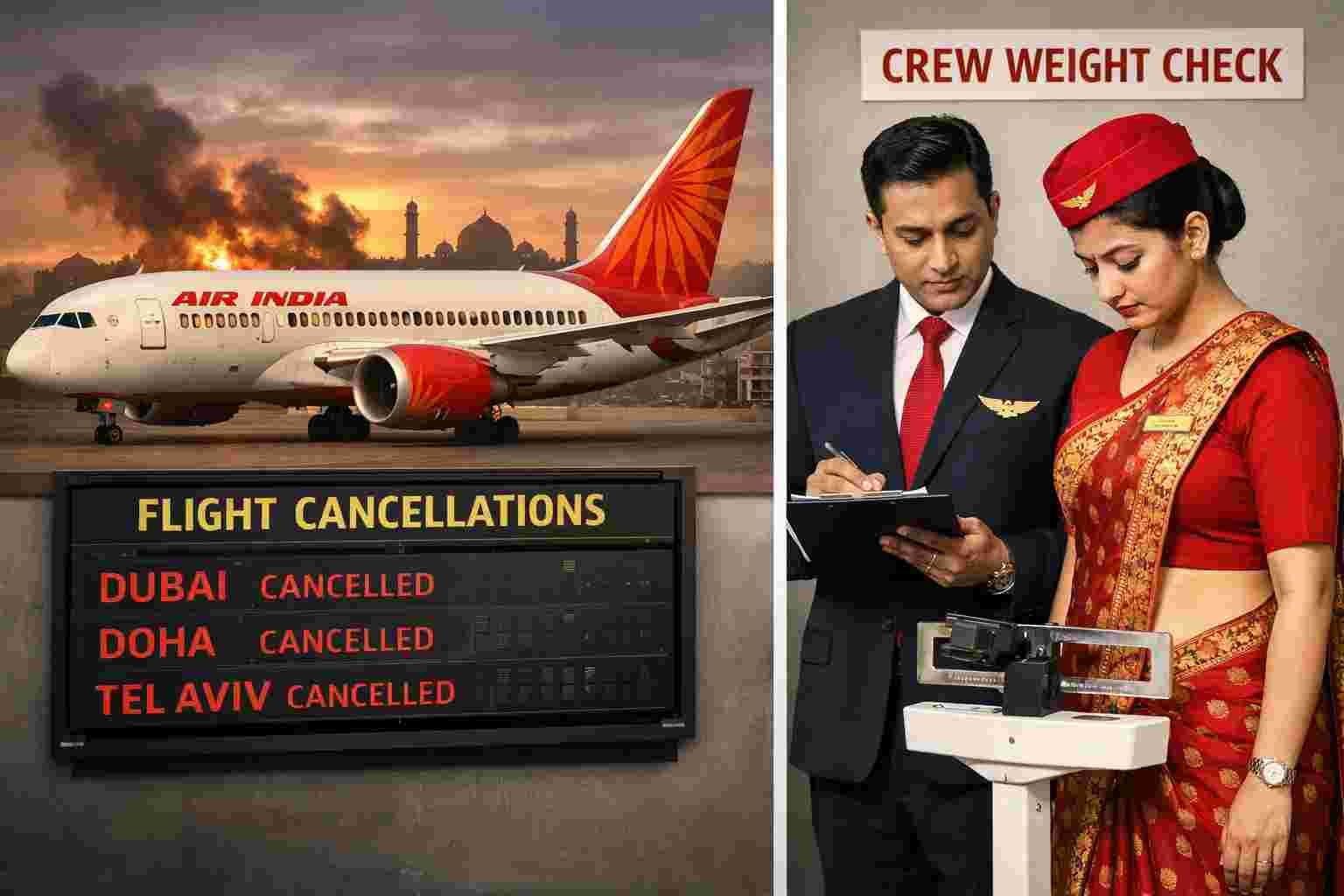
Air India is introducing stricter health and operational measures for its workforce while simultaneously navigating significant external disruptions that have forced the cancellation of thousands of international flights. The developments highlight the airline’s dual challenge of internal restructuring and external geopolitical pressures as it seeks to stabilize operations and improve performance.
New Fitness Policy Targets Cabin Crew Standards
Beginning May 1, Air India will enforce a new health compliance framework linking cabin crew Body Mass Index (BMI) levels to their eligibility for active duty. The move is part of a broader effort to standardize operational readiness across its workforce at its main hub in Delhi.
Under the policy, a BMI range of 18 to 24.9 is considered the ideal benchmark. Crew members falling outside this range will face additional scrutiny. Those categorized as underweight or overweight may continue working only if they pass medical evaluations and functional fitness assessments.
However, the airline has drawn a firm line for higher BMI levels. Employees classified as obese—defined as a BMI of 30 or above—will be immediately removed from active duty and placed on loss of pay until they meet required standards.
The policy also introduces stricter enforcement measures. Crew members who fail to meet fitness requirements or assessment criteria risk being derostered and may face further corrective action if compliance is not achieved within a specified timeframe.
Air India says the initiative is aimed at ensuring that cabin crew remain physically capable of handling safety-critical responsibilities, including emergency procedures and passenger assistance. The airline views this as a foundational step toward implementing more advanced fitness standards in the future.
2,500 Flights Cancelled Amid Middle East Conflict
While tightening internal policies, Air India is also dealing with severe operational disruptions caused by escalating tensions in the Middle East. Over the past three weeks, the airline has cancelled nearly 2,500 flights to West Asia, reducing capacity on affected routes to just 30% of normal levels.
The cancellations stem from safety concerns related to the ongoing Iran conflict, which has led to airspace closures and heightened risks across key aviation corridors. Major hubs such as Dubai, Doha, and Tel Aviv have been impacted, forcing airlines to rapidly adjust schedules.
Air India CEO Campbell Wilson noted that the airline’s heavy reliance on Middle East routes has made it particularly vulnerable to these disruptions. The region serves as a critical transit corridor connecting India to Europe, North America, and beyond.
Rising Fuel Costs Add Financial Strain
Compounding the operational challenges is a sharp increase in jet fuel prices, which have more than doubled in recent weeks due to the conflict. The surge is expected to weigh on Air India’s financial performance in the coming months.
To offset rising costs, the airline has introduced a fuel surcharge on new ticket bookings. However, pricing flexibility remains limited, as higher fares could dampen demand. This creates a delicate balancing act between maintaining profitability and preserving passenger volumes.
Longer Routes Increase Complexity
Airspace restrictions have also forced Air India to reroute flights to Europe, the United Kingdom, and North America. These longer flight paths result in higher fuel consumption and extended travel times, further increasing operational costs.
The airline had already been navigating longer routes due to earlier geopolitical events, and the current situation has intensified those challenges. The cumulative impact is adding pressure on both scheduling efficiency and cost management.
Shifting Demand Offers Partial Relief
Despite disruptions in the Middle East corridor, Air India is seeing pockets of demand growth in Europe and North America. The airline is reallocating capacity to these markets in an attempt to offset losses.
This strategy contrasts with some global carriers that are scaling back operations amid rising costs. Air India’s approach reflects a more aggressive attempt to adapt to shifting demand patterns while maintaining network relevance.
Safety and Stability Remain Top Priorities
Air India has emphasized that safety remains its primary concern as it navigates both internal reforms and external volatility. Teams across flight operations, airport management, and customer service are working to manage disruptions in real time.
The airline also acknowledged the strain on its workforce during this period, particularly those stationed in affected regions. Maintaining operational stability amid rapidly changing conditions remains a key focus.
As Air India continues its transformation under Tata Group ownership, the combination of stricter internal policies and external geopolitical pressures underscores the complexity of rebuilding a global airline in an uncertain environment.
