


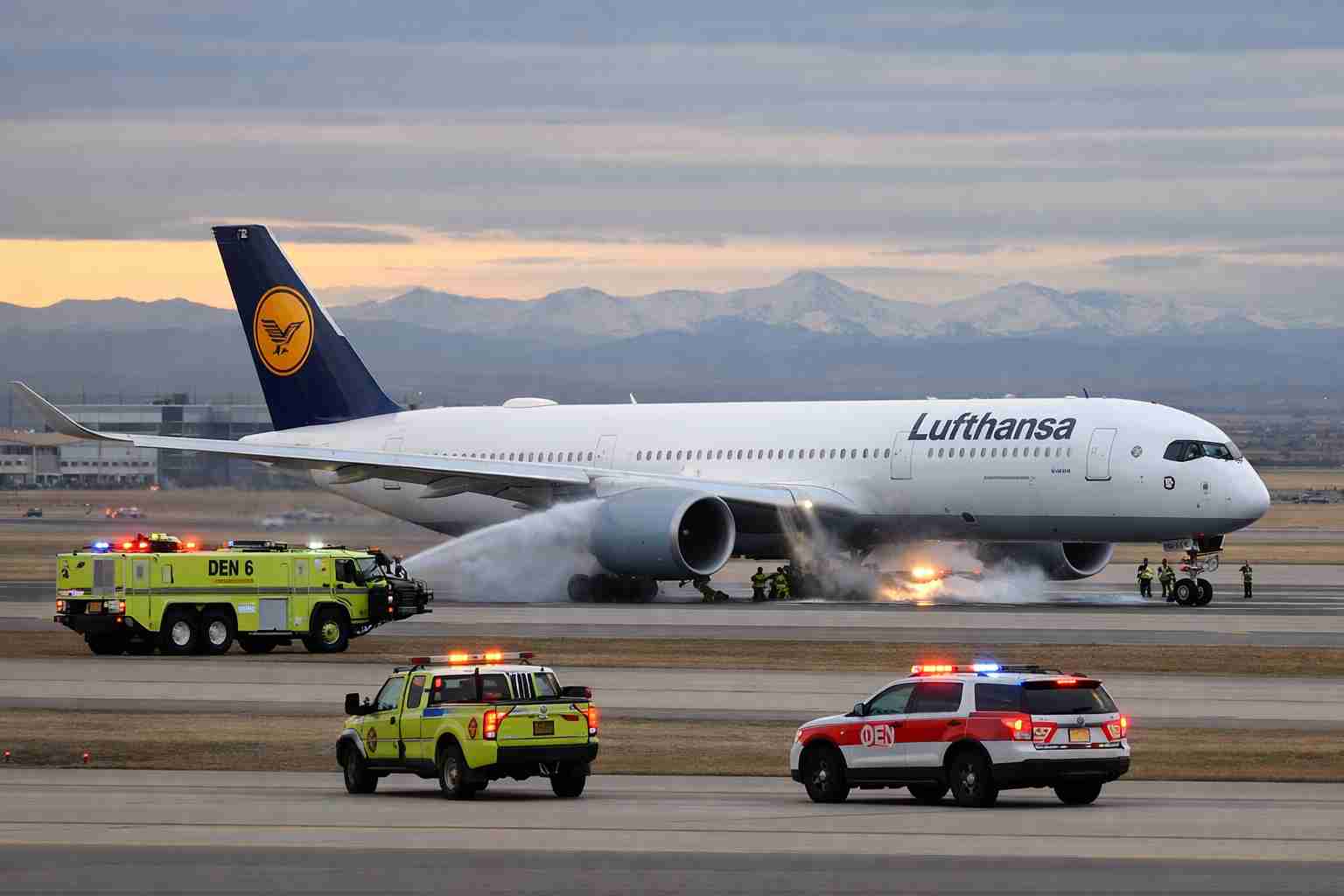
A Lufthansa long-haul flight bound for Munich was forced to abort takeoff at high speed at Denver International Airport, prompting an emergency response and drawing attention to the risks associated with late-stage takeoff decisions.
Flight LH481 had nearly reached liftoff speed when pilots initiated a rejected takeoff at approximately 173 knots. The Airbus A350-900 came to a sudden stop near the end of the runway, a maneuver considered both rare and operationally critical due to the high speeds involved.
Sudden Stop Raises Safety Concerns
Passengers onboard described a routine takeoff roll that quickly turned into a forceful deceleration. Initial reports suggest that strong tailwinds may have exceeded safe operational limits, prompting the pilots to abort the takeoff despite being close to rotation speed.
Such decisions are not taken lightly. Aviation protocols require crews to continue takeoff after a certain speed threshold—known as V1—unless a serious safety issue arises. Aborting near that point increases the physical stress on the aircraft’s braking systems and reduces available stopping distance.
Emergency Response on the Runway
Emergency services responded immediately after the aircraft came to a stop. Fire crews surrounded the plane and applied cooling measures to the landing gear following signs of brake overheating and light smoke.
High-speed rejected takeoffs generate intense friction, which can rapidly increase brake temperatures and pose a risk of fire. As a precaution, airport fire services are routinely deployed in such situations to ensure the aircraft remains safe.
No injuries were reported, and all passengers and crew remained unharmed throughout the incident.
Passengers Delayed for Hours
Following the aborted takeoff, passengers remained onboard for several hours while the aircraft underwent initial safety checks. They were later deplaned using stairs and transported to the terminal via buses.
Accounts from travelers indicate that the aircraft had accelerated normally before the sudden stop. The braking was described as intense, consistent with a high-speed rejection close to liftoff.
The aircraft was subsequently moved to a taxiway, where it remained for further inspection, suggesting that additional technical evaluations were required before it could return to service.
Understanding High-Speed Rejected Takeoffs
Rejected takeoffs at high speed are among the most demanding procedures in aviation. Pilots must make rapid decisions based on aircraft performance, runway conditions, and environmental factors.
Once an aircraft approaches V1 speed, stopping becomes significantly more difficult and potentially hazardous. Brakes can overheat quickly under such conditions, sometimes producing smoke or even leading to fire risks if not managed properly.
Modern aircraft like the Airbus A350 are equipped with advanced monitoring systems that help pilots assess performance in real time. These systems can alert crews if acceleration or other parameters fall outside expected limits, enabling quick and informed decision-making.
Flight Details and Aircraft Background
The aircraft involved in the incident had earlier arrived in Denver as flight LH480 from Munich, completing a journey of approximately 9 hours and 50 minutes. The return flight, LH481, was scheduled to depart shortly after arrival.
The Airbus A350-900, registered as D-AIVD, is a seven-year-old widebody aircraft in Lufthansa’s fleet. It was originally delivered to Philippine Airlines before being transferred to Lufthansa in April 2022. The aircraft carries the name “Duisburg,” following the airline’s naming tradition.
Operational Impact and Ongoing Investigation
The aircraft remained grounded in Denver following the incident, with inspections likely required before it could resume operations. Lufthansa operates multiple weekly flights between Denver and Munich, and adjustments were expected to accommodate affected passengers.
At the time of reporting, Lufthansa had not issued an official statement confirming the cause of the aborted takeoff. However, environmental factors such as tailwinds are strongly suspected.
While no injuries occurred, the incident highlights the complexity and precision required in modern aviation, particularly during critical phases like takeoff, where decisions must be made in seconds and safety remains the top priority.
