


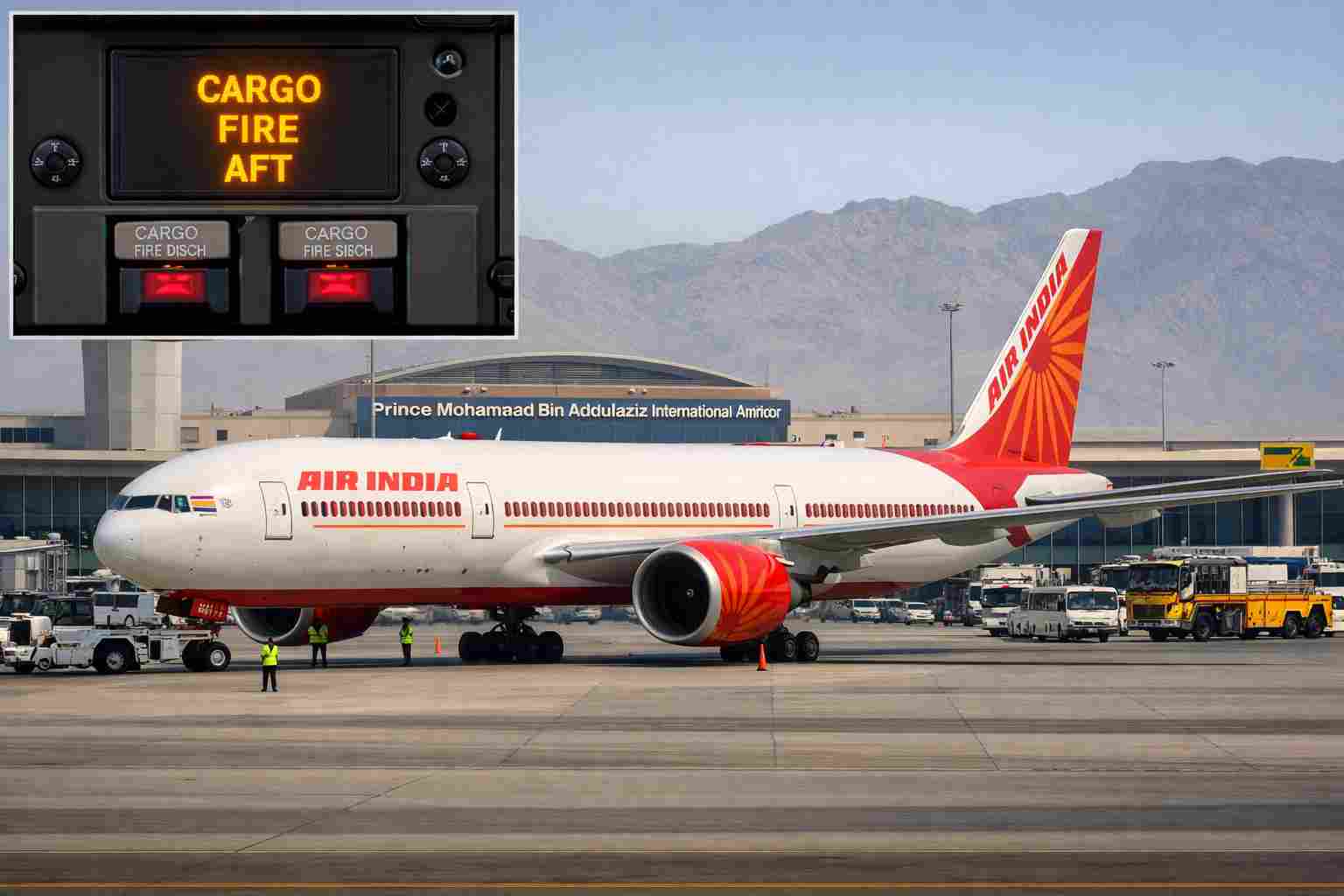
Flight AI116 was en route from John F. Kennedy International Airport in New York to Chhatrapati Shivaji Maharaj International Airport in Mumbai when pilots received an aft cargo fire warning mid-flight. In accordance with global aviation safety protocols, such alerts require immediate assessment and, if necessary, diversion to the nearest suitable airport.
After conducting initial checks, the flight crew opted for a priority landing at Prince Mohammad bin Abdulaziz International Airport in Medina, Saudi Arabia. The aircraft landed safely, and emergency procedures were executed as a precaution.
Inspection Confirms False Alarm
Post-landing inspections were carried out to verify the warning. Air India confirmed that no fire or related hazard was present, indicating the alert was a false alarm.
Such warnings are treated with maximum seriousness in aviation, even when later identified as false alarms. This approach ensures that safety margins are never compromised.
The airline said all passengers and crew remained safe following the incident.
Passenger Support and Operational Response
Air India coordinated with local authorities in Medina to manage the situation on the ground. The airline arranged accommodation and facilitated onward travel for passengers while the aircraft underwent necessary checks.
Efforts were initiated to resume the journey to Mumbai as soon as operationally feasible. Passenger comfort and continuity of travel remained a priority during the disruption.
After being on the ground for more than four and a half hours, the aircraft departed Medina and completed the remainder of the journey without further incident.
Aircraft Details and Flight Resumption
The flight was operated by a Boeing 777-300ER, registered as VT-AER. The 12-year-old aircraft, powered by GE90 engines, is commonly used on long-haul international routes.
Following clearance, the aircraft continued to Mumbai and landed without any additional disruptions, restoring normal operations for the service.
Similar Incident Highlights Operational Challenges
The diversion comes days after another Air India long-haul service faced disruption. Flight AI102, operating from John F. Kennedy International Airport to Indira Gandhi International Airport, was diverted to Shannon Airport on March 15 due to a suspected technical issue.
The aircraft remained grounded in Shannon for more than 34 hours as engineers conducted detailed inspections. Reports indicated that unusual vibrations and noise were detected mid-flight, prompting the crew to divert after nearly six hours of flying.
The extended delay caused inconvenience for passengers, many of whom faced uncertainty regarding onward travel. Air India said it coordinated with local authorities to manage accommodations and comply with immigration procedures during the disruption.
Safety Remains Central to Operations
Despite the operational challenges posed by such incidents, Air India maintained that all decisions were guided by safety considerations.
The recent diversions underscore the complexities of long-haul operations and reinforce the industry-wide principle that precautionary measures—regardless of subsequent findings—are essential to ensuring passenger safety.
