


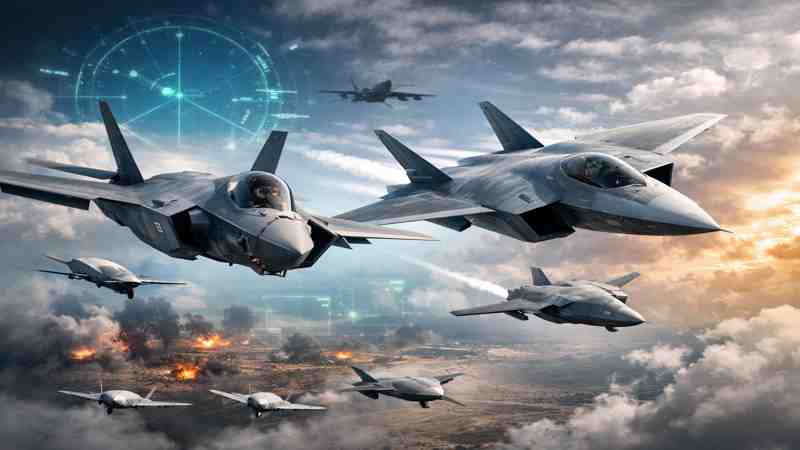
The United States Air Force is accelerating efforts to modernize its combat aviation fleet, combining stealth technology, advanced sensors, and network-driven warfare to maintain air superiority in increasingly contested environments. At the center of this transformation is a dual-track approach: sustaining the current fleet led by the F-35 Lightning II while developing a new generation of fighters designed to operate alongside autonomous systems.
F-35 Remains Backbone of Modern Airpower
The F-35 Lightning II continues to serve as the cornerstone of U.S. air combat capability. Developed under the Joint Strike Fighter program, the aircraft was designed to replace legacy platforms with a versatile, multi-role fighter capable of handling a wide range of missions.
Its defining features include stealth architecture, sensor fusion, and real-time data sharing, allowing pilots to operate effectively in complex and high-threat environments. The aircraft not only executes missions such as air superiority, strike operations, intelligence gathering, and electronic warfare, but also acts as a critical node in networked warfare by sharing battlefield data with allied systems.
Since entering operational service in the mid-2010s, the F-35 has been widely adopted by more than a dozen allied nations, strengthening interoperability and enabling coordinated multinational operations. This global footprint has reinforced joint defense strategies, particularly in regions facing evolving geopolitical tensions.
However, the program has not been without challenges. High procurement and sustainment costs have drawn scrutiny, with lifecycle expenses projected to exceed $1 trillion. Despite these concerns, the platform’s adaptability and ongoing upgrades are expected to keep it operational for decades.
Next-Generation Air Dominance and the F-47
Looking beyond the F-35, the Air Force is investing heavily in its Next Generation Air Dominance (NGAD) program, which aims to deliver a sixth-generation fighter—often referred to as the F-47. This future platform is being designed to operate in highly contested airspace where advanced adversary defenses are present.
Early reports suggest the aircraft will feature significantly improved stealth characteristics, extended range exceeding 1,000 nautical miles, and speeds above Mach 2. These capabilities are intended to provide both survivability and operational reach in future conflicts.
A defining aspect of the NGAD concept is that the F-47 will not operate independently. Instead, it will function as part of a broader system that includes unmanned platforms known as Collaborative Combat Aircraft (CCA). These drones are expected to act as force multipliers, carrying out missions such as surveillance, electronic warfare, and defensive support.
The Air Force plans to deploy hundreds of these unmanned systems, signaling a major shift toward distributed and network-centric warfare. This model reduces risk to human pilots while expanding operational flexibility and mission effectiveness.
Shift Toward Hybrid Air Combat
The evolution of U.S. airpower reflects a broader transition toward hybrid combat models that integrate crewed and uncrewed systems. Military planners view this approach as essential for maintaining a technological and strategic edge against near-peer competitors.
Human pilots continue to play a critical role, particularly in decision-making and adaptability during complex missions. At the same time, advances in autonomous systems are enabling drones to take on increasingly sophisticated roles, including operating in high-risk environments that would be dangerous for manned aircraft.
This integration creates a layered operational strategy in which platforms like the F-35 and future F-47 serve as command hubs, coordinating multiple assets in real time. The result is a more resilient and flexible force capable of responding to dynamic threats.
Long-Term Strategic Implications
The Air Force’s modernization strategy underscores the balance between sustaining current capabilities and investing in future technologies. While the F-35 will remain a key asset for years to come, the introduction of sixth-generation fighters signals a gradual transition toward a new era of air combat.
Advancements in artificial intelligence, propulsion systems, and sensor technology are expected to shape this evolution. At the same time, funding and long-term planning will be critical to ensuring these programs achieve their intended goals.
Ultimately, the Air Force’s newest jets reflect a broader vision of integrated warfare—one that combines advanced aircraft with autonomous systems to secure air dominance well into the future.
