


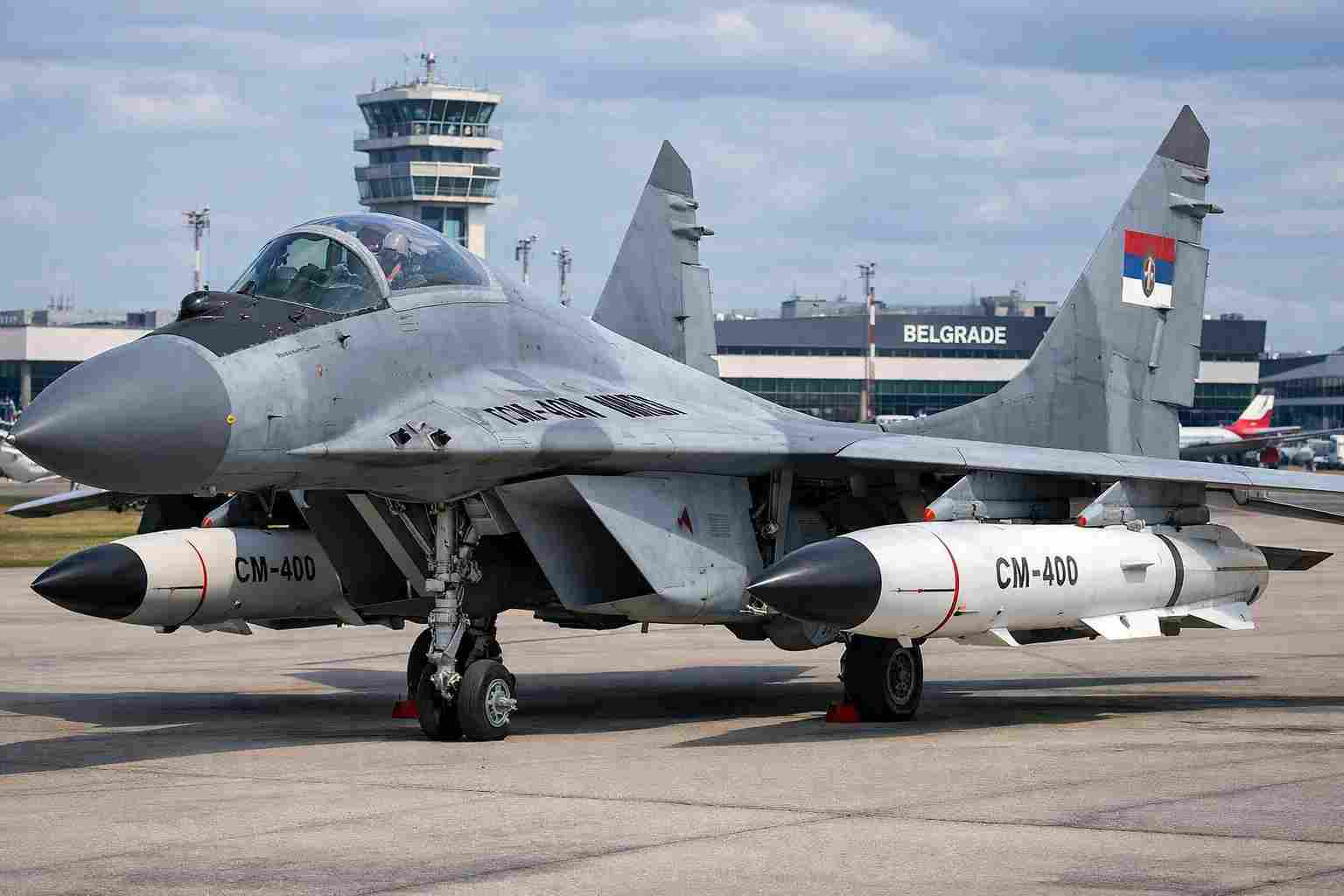
Serbia has reportedly equipped its MiG-29 fighter jets with Chinese-made CM-400 supersonic standoff missiles, marking a significant enhancement to the country’s long-range strike capabilities. Newly surfaced images show the missile mounted on a Serbian Air Force and Air Defense MiG-29 Fulcrum, signaling a notable upgrade to the nation’s aging Soviet-era fighter fleet.
The aircraft involved are part of Serbia’s modernized MiG-29SM+ fleet and operate from Belgrade Nikola Tesla Airport (BEG), the country’s primary aviation hub. The integration of the Chinese missile system highlights Serbia’s evolving defense procurement strategy as it balances partnerships with multiple global suppliers.
Serbia’s MiG-29 Fleet Gains New Strike Capability
A recently released photograph shows a Serbian MiG-29 carrying two CM-400 missiles mounted on its inner wing hardpoints. The integration represents a major leap in offensive capability for the Serbian Air Force, transforming the aircraft from a primarily air-to-air platform into one capable of conducting long-range precision strikes.
The CM-400 missile was developed by China Aerospace Science and Industry Corporation (CASIC) primarily for export customers. Introduced in 2012, the weapon measures roughly 17 feet in length, has a diameter of about 16 inches, and weighs approximately 2,000 pounds depending on the warhead configuration.
Two different warhead types are available. One carries a 330-pound high-explosive payload designed for general strike missions, while the other uses a 440-pound armor-piercing warhead intended for hardened targets. The addition of such weapons provides Serbia with the ability to strike infrastructure or heavily protected facilities from long distances.
CASIC states that the missile can reach speeds of up to Mach 4.5 during its terminal attack phase. Although some descriptions label it as hypersonic, that classification is technically inaccurate because hypersonic speeds begin at Mach 5. Nevertheless, the missile remains among the fastest air-launched export weapons currently available.
Range, Guidance, and Targeting Capabilities
Precise range figures for the CM-400 remain uncertain, but available estimates suggest it can strike targets between roughly 155 and 250 miles away depending on the missile configuration. Such range allows aircraft to launch attacks far beyond the reach of many air defense systems.
The weapon uses an inertial navigation system supported by Global Navigation Satellite System corrections for mid-course guidance. During the terminal phase, different seeker technologies can be employed depending on the mission profile.
For maritime missions, the missile can use infrared or optoelectronic seekers to track ships. For anti-radiation roles, it relies on a passive radar seeker capable of detecting electromagnetic emissions such as radar systems. This versatility enables the missile to target a variety of threats including naval vessels, air defense installations, and other high-value infrastructure.
Reported accuracy levels are also notable. The anti-radiation variant reportedly has a circular error probable between 16 and 33 feet, while the anti-ship version may achieve accuracy of roughly 16 feet or better.
Despite its reputation as an anti-ship weapon, the CM-400 can also be used against land targets. After launch, the missile follows a high ballistic trajectory powered by a solid rocket motor before descending steeply toward the target at high speed.
China’s Flexible Integration System
A key factor enabling the missile’s deployment on Serbian aircraft is China’s Standalone Weapon Fire Control System (SWFCS). This system allows Chinese weapons to be integrated onto non-Chinese aircraft without requiring extensive modifications.
The interface connects wirelessly to a cockpit tablet used by the pilot. The tablet acts as a portable controller that allows aircrews to select and launch compatible Chinese munitions.
Such integration methods have gained attention because they allow relatively quick adaptation of foreign weapons onto existing aircraft fleets. Serbia is also reportedly using the same system to deploy the LS-6 precision-guided munition, a bomb fitted with a guidance and range-extension kit comparable to Western glide bomb systems.
Future of Serbia’s Fighter Fleet
Serbia currently operates a fleet of MiG-29 fighters originally acquired during the Yugoslav era in the 1980s. Several aircraft survived the 1999 NATO air campaign and were later supplemented with additional jets from Russia and Belarus. After modernization, the aircraft are now designated MiG-29SM+, with about 14 believed to remain active in service.
However, the MiG-29’s long-term role in the Serbian Air Force is uncertain. Serbia has already ordered 12 Dassault Rafale multirole fighters from France, which are expected to eventually replace the Soviet-designed aircraft.
Until that transition occurs, the addition of the CM-400 missile significantly enhances the operational relevance of Serbia’s current fighter fleet.
Strategic Implications for the Region
The integration of high-speed standoff missiles provides Serbia with a powerful deep-strike capability rarely seen among smaller European air forces. The weapon’s combination of speed, range, and precision makes it particularly effective against hardened infrastructure, naval targets, and time-sensitive threats such as mobile missile launchers.
Serbia’s decision to incorporate Chinese weapons also reflects shifting global procurement dynamics. Western sanctions following the Ukraine war have complicated access to Russian military equipment, while Serbia has simultaneously expanded cooperation with Western suppliers and maintained defense ties with China and Israel.
This diversified procurement strategy allows Belgrade to modernize its military capabilities while avoiding reliance on any single supplier—a move that could shape regional defense dynamics in the coming years.
