


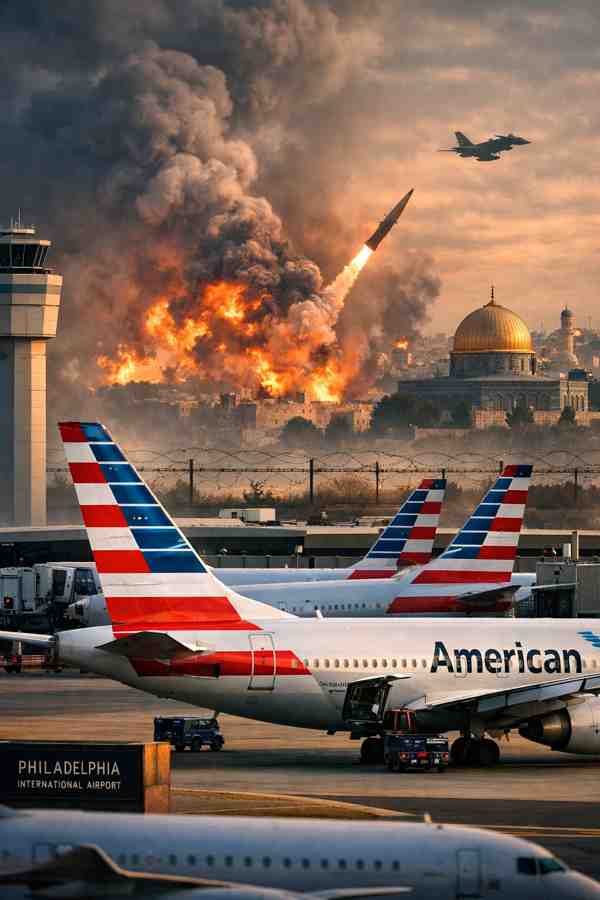
American Airlines is extending the suspension of a key Middle East route and delaying the relaunch of another as escalating geopolitical tensions continue to disrupt aviation operations across the region.
The airline confirmed that its service between Philadelphia International Airport and Doha Hamad International Airport will remain suspended until May 7, 2026. In addition, American Airlines postponed the restart of its New York John F. Kennedy International Airport to Tel Aviv Ben Gurion Airport route until April 23, 2026.
The changes highlight the growing operational challenges airlines face as military conflict and expanding airspace restrictions limit safe flight paths across the Middle East.
Philadelphia–Doha Service Remains Grounded
American Airlines operates a major long-haul connection linking Philadelphia with Doha, a key global aviation hub served in partnership with Qatar Airways.
The route has become strategically important for the carrier because it allows U.S. travelers to connect to destinations across the Middle East, Asia, and Africa through Doha’s extensive network.
However, continued military tensions and restricted airspace in the region have forced the airline to extend the suspension of the service.
American Airlines confirmed that the Philadelphia–Doha route will remain suspended until May 7, 2026.
Tel Aviv Route Restart Pushed Back
The airline has also delayed the relaunch of its service between New York’s John F. Kennedy International Airport and Tel Aviv’s Ben Gurion Airport.
The route has experienced several disruptions over the past year due to previous conflicts in the region. The latest delay reflects ongoing safety concerns and operational challenges affecting flights into Israel and neighboring airspace.
American Airlines now expects to resume the JFK–Tel Aviv service on April 23, 2026.
Options for Affected Travelers
American Airlines said customers affected by the suspensions will have flexibility when adjusting their travel plans.
Passengers may rebook their flights without paying change fees. Travelers can also cancel their tickets and receive refunds if the disruption alters their plans.
The airline said it is also coordinating with partner airlines to help passengers reach destinations in the Middle East through alternative routes when possible.
According to View from the Wing, the carrier noted that it is working closely with partner carriers to route travelers through European gateway cities when direct flights to the region are unavailable.
Widespread Airspace Restrictions
The flight suspensions come as the ongoing conflict involving Iran continues to restrict usable airspace across the Middle East.
European aviation safety authorities have temporarily limited airline operations across a wide area of the region. The affected countries include Bahrain, Iran, Iraq, Israel, Jordan, Kuwait, Oman, Qatar, Saudi Arabia, and the United Arab Emirates.
At the same time, the U.S. Federal Aviation Administration has banned flights within the Tehran and Baghdad flight information regions and issued additional advisories covering parts of the Persian Gulf and the Gulf of Oman.
These restrictions have significantly narrowed the available corridors for flights traveling between North America, Europe, and the Gulf region.
Airlines Forced to Reroute Flights
With large portions of Middle Eastern airspace closed or restricted, airlines have been forced to adopt longer and more complex routes.
Many flights now travel north through the Caucasus and Central Asia to avoid restricted zones. Others are being rerouted south through Egypt, Saudi Arabia, and Oman.
These detours increase flight times and fuel consumption, creating additional costs for airlines already facing operational uncertainty.
Broader Impact on the Aviation Industry
The conflict has triggered widespread disruption across the global aviation industry, with airlines canceling or rerouting thousands of flights.
Major aviation hubs such as Dubai, Doha, and Abu Dhabi have experienced operational interruptions during periods of heightened tensions.
Longer flight paths and fluctuating fuel prices are also placing financial pressure on carriers worldwide.
Energy markets initially reacted sharply to the conflict, sending oil prices higher before easing after signals emerged that the fighting might not last as long as initially feared.
For airlines, fuel remains one of the largest operating costs. Rising oil prices can significantly affect profitability, particularly for low-cost carriers that often lack strong fuel hedging strategies.
As geopolitical tensions continue to evolve, airlines are expected to monitor the situation closely and adjust flight schedules as necessary to maintain safety and operational reliability.
