


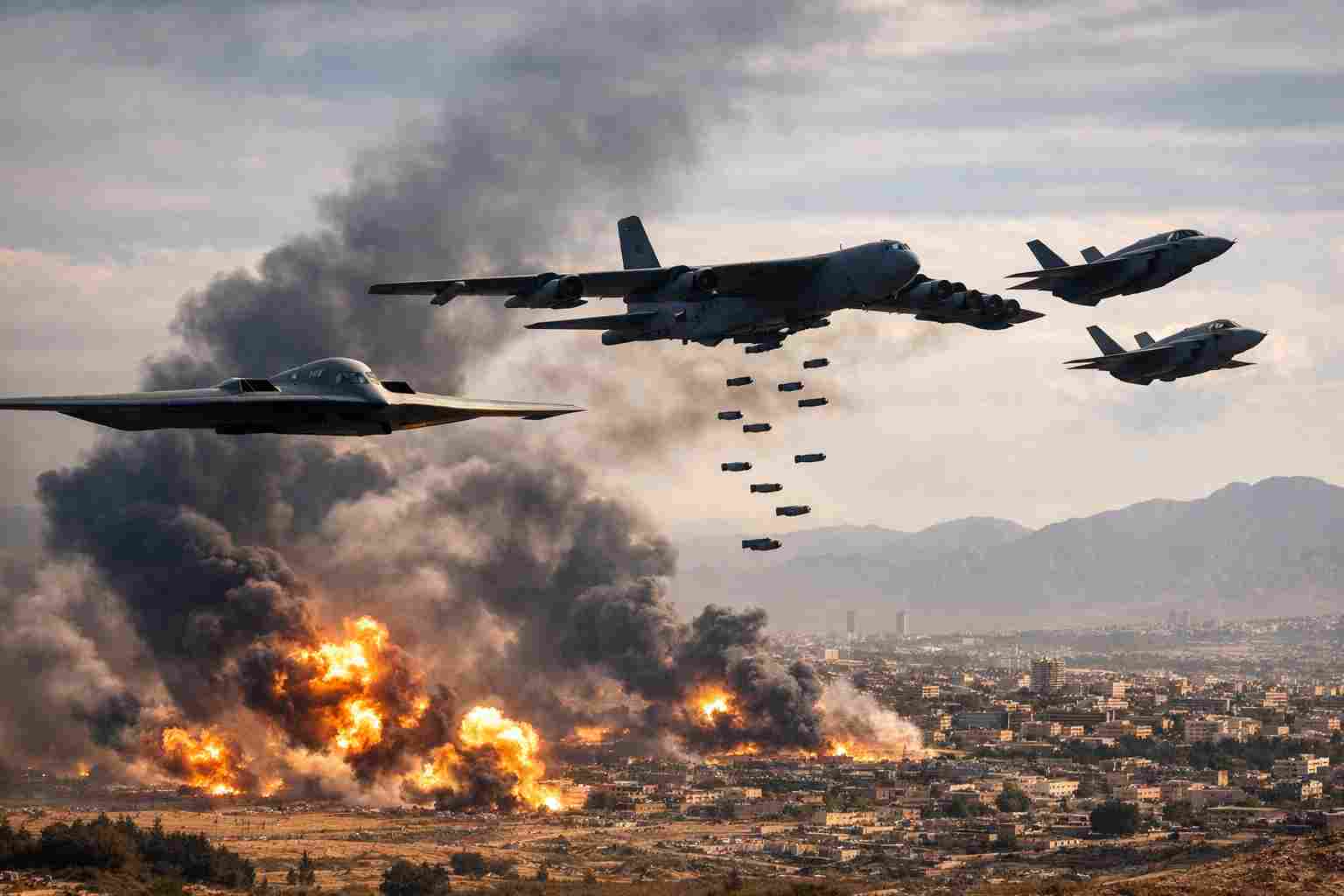
The United States has intensified its military campaign against Iran, expanding bomber strikes and deploying additional fighter aircraft as the conflict escalates. U.S. military leaders say the goal of the operation is not only to damage Iran’s current weapons systems but also to dismantle the infrastructure that enables Tehran to rebuild its missile capabilities in the future.
Officials from U.S. Central Command (CENTCOM) confirmed that the air war has entered a more aggressive stage, with coordinated strikes targeting missile facilities, launch sites, and military infrastructure across Iran. The latest operations include attacks near Tehran and are supported by forward operating bases in the Indian Ocean and the United Kingdom.
Bombers Strike Hundreds of Targets
In the 72 hours leading up to a briefing at CENTCOM headquarters in Tampa, U.S. bombers struck roughly 200 targets across Iran, according to military officials. Some strikes occurred only hours before the briefing itself.
CENTCOM commander Adm. Brad Cooper outlined the broader strategy behind the escalating campaign.
“We’re not just hitting what they have,” Cooper said. “We’re destroying their ability to rebuild.”
He emphasized that the operation is designed to cripple Iran’s weapons production network and prevent future missile development.
“And so as we transition to the next phase of this operation, we will dismantle Iran’s missile production capability for the future,” Cooper said.
Several types of strategic bombers have participated in the strikes. B-2 Spirit stealth bombers targeted deeply buried ballistic missile launch facilities using dozens of 2,000-pound bunker-busting bombs believed to be GBU-31 JDAMs. B-1B Lancer and B-52H Stratofortress aircraft also carried out missions against targets across Iran, including locations near the capital.
Defense analysts say the scale of these missions represents one of the largest coordinated strike waves since the conflict began.
Forward Bases Accelerate Operations
A key factor behind the surge in air operations has been expanded access to allied bases. The United Kingdom approved U.S. use of facilities at Diego Garcia in the Indian Ocean and RAF Fairford in England.
Operating from these forward locations dramatically shortens flight times compared with long-range missions launched from the continental United States. Military planners say the shorter distances allow bomber crews to conduct more frequent sorties while maintaining higher levels of readiness.
The additional bases also strengthen logistics networks and improve coordination among allied forces operating throughout the region.
Iranian Drone Carrier Targeted
U.S. forces also struck a large Iranian naval vessel believed to function as a drone carrier. Military officials described the ship as roughly comparable in size to a World War II aircraft carrier.
The vessel reportedly caught fire after the strike and sustained significant damage.
A post shared on social media described the scale of the attack.
“US forces aren’t holding back on the mission to sink the entire Iranian Navy. Today, an Iranian drone carrier, roughly the size of a WWII aircraft carrier, was struck and is now on fire.”
Military analysts say the destruction of the vessel could significantly limit Iran’s ability to conduct long-range drone operations across the region.
Missile Activity Drops Sharply
According to CENTCOM, the sustained air campaign has already had a measurable impact on Iran’s missile operations. Cooper said Iranian ballistic missile launches have dropped by roughly 90 percent since the opening phase of the conflict.
The reduction is believed to be the result of repeated strikes on launch sites and production facilities that support Iran’s missile program.
At the same time, Iranian officials have issued new warnings in response to the attacks. Tasnim News Agency, a semi-official Iranian outlet, reported that Tehran may target countries hosting communications infrastructure that broadcasts anti-Iranian content.
The report said Iran would take “appropriate action,” suggesting the possibility of further escalation involving communications or space-related systems.
CENTCOM confirmed that U.S. forces have also targeted facilities tied to Iran’s military space operations. Cooper said the attacks hit infrastructure comparable to the United States’ Space Command, which he said “degrades their ability to threaten Americans.”
Regional Alliances Strengthen
Iran’s retaliatory missile and drone strikes have affected multiple countries across the Gulf region, hitting targets in 12 different nations. According to Cooper, those attacks have shifted the regional political landscape.
“Those 12 countries are none too happy, and I look forward to working with all the partners who are willing to join us in this,” he said.
U.S. Defense Secretary Pete Hegseth said Iran’s actions have pushed several Gulf nations closer to Washington.
“If anything, what Iran is doing by targeting allied countries that would otherwise want to stay out of this, they’ve actually pulled them into the American orbit,” Hegseth said.
He added that multiple countries are now openly supporting U.S. operations.
“Now you’ve got UAE and Qatar and Bahrain and Saudi Arabia and Kuwait and others saying, ‘Hey, we’re with you. We’ll shoot with you. We’ll fly with you. We’ll defend with you. We’ll allow you more basing.’”
Many of these nations operate U.S.-made Patriot and THAAD missile defense systems, which have been increasingly used to intercept Iranian missiles and drones.
Integrated Air Defense Expands
As the coalition grows, regional air defense coordination has also intensified. The United Kingdom recently expanded its defensive role, with a Royal Air Force F-35B shooting down a drone over Jordan—marking the aircraft’s first operational air-to-air kill.
Other engagements have also been reported, including Qatar downing two Iranian Su-24 bombers and an Israeli F-35 destroying a Yak-130 trainer aircraft. The latter incident is notable as the first known air-to-air shootdown of a crewed aircraft by an F-35 fighter.
Cooper described the evolving network as “the most integrated air defense network in Middle East history,” underscoring how the conflict is reshaping military cooperation across the region.
