


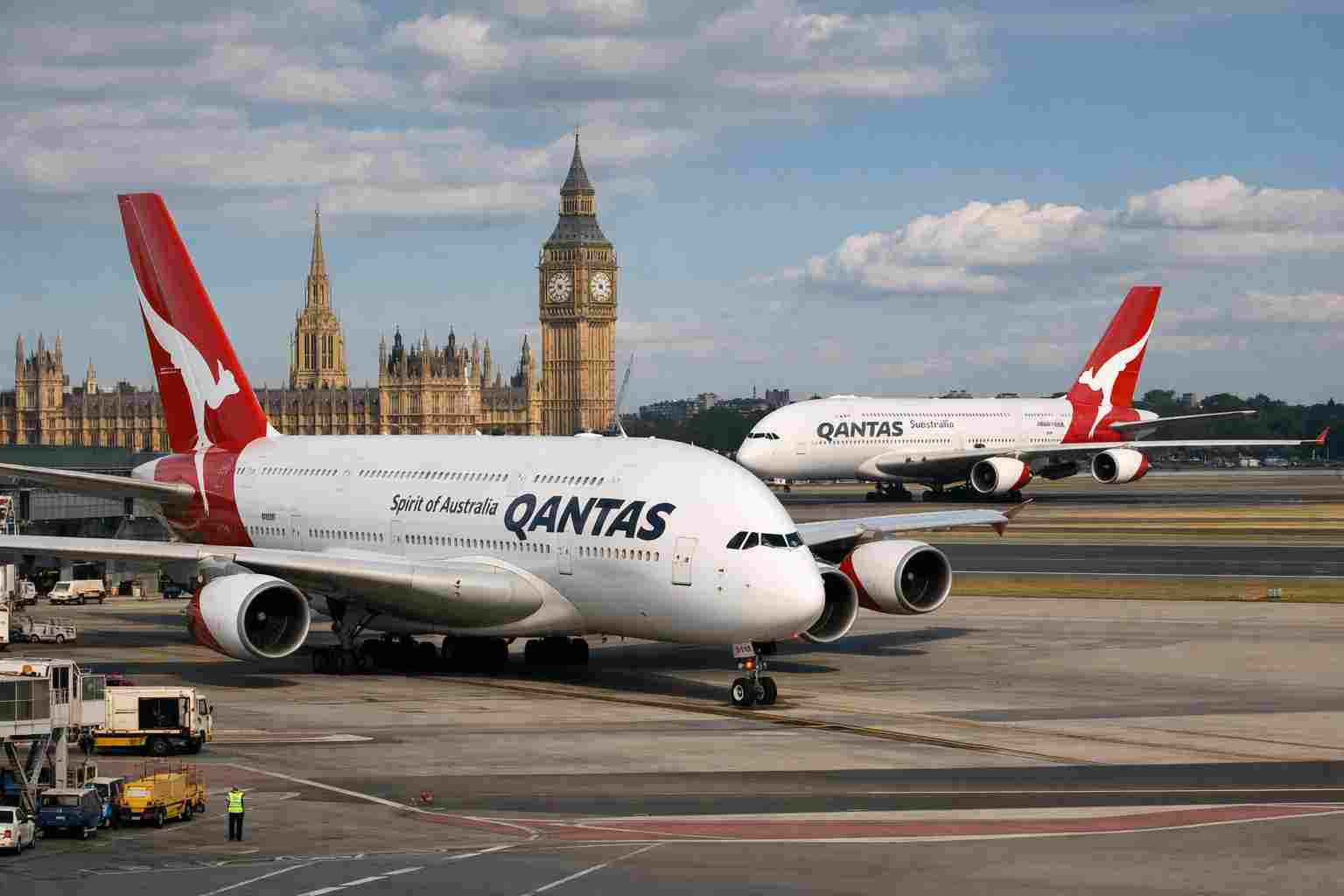
SYDNEY — Qantas Airways will briefly expand its long-haul capacity between Australia and the United Kingdom with an unusual one-off flight to London Heathrow Airport, temporarily doubling its flagship aircraft presence on the route.
The Australian carrier has scheduled an additional Airbus A380 service from Sydney Kingsford Smith Airport to London via Singapore Changi Airport on March 7. The special service will operate alongside the airline’s regular daily Sydney–Singapore–London flight but will only run in one direction, creating a rare operational twist for one of Qantas’ most prominent international routes.
The additional flight briefly recreates a scenario not seen in years — two Qantas A380 departures bound for London in a single evening.
Qantas Schedules Extra A380 Departure
The extra service will operate under flight number QF331 and is scheduled to depart Sydney at 10:15 p.m. on March 7. After leaving Australia, the aircraft will fly to Singapore, landing at 3:25 a.m. local time the following day.
From there, the aircraft will continue onward to London Heathrow later in the morning. The service includes a nearly four-hour layover at Singapore Changi Airport before departing for London at 7:20 a.m. local time.
The aircraft is expected to arrive in London around 2:00 p.m. on March 8.
The special operation will take place on the same night as Qantas’ standard QF1 service to London. The regular flight departs Sydney earlier in the day at 4:15 p.m., arriving in Singapore at 9:35 p.m. before continuing to Heathrow shortly after midnight.
With both flights scheduled on the same evening, the airline will temporarily double its A380 presence on the Sydney–London route.
Tickets for the additional flight were sold through Qantas’ normal booking channels. However, the airline prioritized passengers who needed to rebook travel during ongoing disruptions affecting travelers trying to return to Europe and other destinations.
One-Way Operation Creates Unusual Schedule
Despite the added capacity, the special flight will operate only in one direction.
There is no corresponding return flight — meaning there will be no QF332 service from London back to Sydney. As a result, the aircraft will not immediately return to Australia after reaching Heathrow.
Industry observers suggest the flight is likely being used to reposition the aircraft for scheduled maintenance in Europe or the Middle East.
Instead of operating the long flight without passengers, Qantas appears to have opened the sector for ticket sales to offset operating costs.
This strategy is occasionally used by airlines when aircraft must be relocated for major maintenance checks or fleet repositioning. By selling seats on the repositioning flight, airlines can generate revenue while moving aircraft where they are needed.
According to aviation publication Simple Flying, passengers also cannot book standalone tickets between Singapore and London on QF331. The restriction likely relates to international traffic rights that regulate so-called fifth-freedom flights between intermediate destinations
Long History of A380 Flights to London
Qantas has operated Airbus A380 flights to London Heathrow since January 2009, when the airline first deployed the double-decker aircraft on its Sydney–Singapore–London route.
The aircraft continues to play a central role in the airline’s long-haul network due to its large passenger capacity and ability to operate ultra-long routes with high demand.
In previous years, Qantas operated an additional A380 service to London from Melbourne. That route initially stopped in Singapore before later shifting to a Melbourne–Dubai–London schedule as part of the airline’s partnership with Emirates.
Those Melbourne A380 services continued until 2018 and marked the last period when Qantas regularly operated two daily A380 arrivals into Heathrow.
While the upcoming extra flight is only temporary, it briefly recreates that dual-arrival scenario for the airline’s London operations.
For passengers and aviation watchers alike, the one-off service highlights how airlines sometimes adapt schedules and fleet movements to meet operational needs while maximizing aircraft utilization.
