


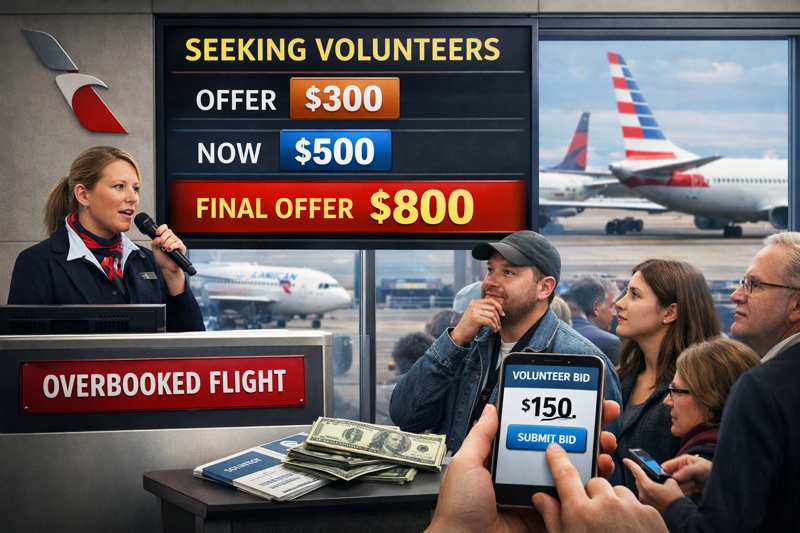
A leaked internal memo from American Airlines is shedding new light on how the carrier manages compensation when flights are oversold, revealing a structured system designed to encourage volunteers while keeping payouts under control.
The document outlines how gate agents raise compensation offers in stages and explains why the third announcement at the gate often represents the highest amount that can be offered without management approval. The guidance also clarifies how volunteers are identified through early offers, check-in bids, and gate announcements across major hubs such as Dallas–Fort Worth (DFW).
How Airlines Handle Oversold Flights
Overselling flights is a long-standing industry practice. Airlines routinely sell more tickets than available seats because some passengers typically fail to show up for departure.
However, when every ticketed passenger arrives for the flight, airlines must look for volunteers willing to give up their seat and take a later departure in exchange for compensation.
According to the memo, American Airlines begins managing this process well before passengers arrive at the boarding gate. Some travelers receive requests through the airline’s mobile app or during online check-in asking whether they would be willing to switch to another flight.
In certain situations, passengers may even be asked to move to a later flight with little or no compensation. If travelers accept these early requests, the airline can resolve oversold flights without raising compensation levels later in the boarding process.
Check-In Bids Help Identify Volunteers
During the check-in process, some passengers are given the opportunity to submit the minimum amount of compensation they would accept to give up their seat.
Travelers who enter lower bids are more likely to be selected if volunteers are needed. This approach helps the airline identify passengers willing to move to a different flight at the lowest possible cost.
The system allows American Airlines to gauge passenger willingness early and potentially resolve seat shortages before the situation escalates at the gate.
Gate Announcements Follow a Three-Offer Structure
If not enough volunteers come forward during the early stages, the process moves to the boarding gate.
Gate agents then begin announcing compensation offers to passengers waiting to board the flight. These offers usually increase in stages in an effort to encourage more travelers to volunteer.
According to the internal guidance, the third announcement typically represents the highest compensation amount gate agents can offer without obtaining approval from a manager or the day-of-departure leadership team.
In most situations, the airline stops raising compensation after this third offer unless additional authorization is granted. The structured approach helps ensure consistent procedures while preventing uncontrolled increases in payouts.
Policy Ensures All Volunteers Receive the Highest Offer
The memo also clarifies an important policy designed to protect passengers who volunteer early.
All passengers who give up their seats should ultimately receive the highest compensation amount announced at the gate. If someone accepts an earlier offer and the amount later increases, agents are instructed to adjust the payment so that every volunteer receives the final, highest offer.
This policy is intended to give passengers confidence that volunteering early will not permanently lock them into a lower compensation amount.
A Game-Theory Decision for Passengers
The voluntary bump process effectively becomes a strategic decision for passengers.
Each traveler must decide whether to accept an early offer or wait for a potentially higher payout. Accepting early guarantees compensation and a confirmed seat on a later flight, but waiting may result in a larger payment if others decline to volunteer.
In theory, passengers could collectively refuse early offers and force airlines to raise payouts significantly. In practice, such coordination rarely occurs, and someone typically accepts the offer before compensation climbs much higher.
This dynamic makes the process resemble a classic game-theory scenario in which individual decisions influence the final outcome.
Why American Airlines Records More Involuntary Bumps
American Airlines consistently reports more involuntary denied boarding incidents than other major U.S. carriers.
In some quarters, competitors such as Delta Air Lines report zero involuntary denied boardings. During similar periods, American Airlines has denied boarding to more than 7,000 passengers — a total that exceeds the combined numbers of several other airlines.
The difference largely reflects contrasting operational strategies. American Airlines tends to increase compensation gradually while carefully managing costs, whereas Delta often offers higher payouts more quickly to secure volunteers.
Delta’s Strategy Can Lead to Huge Payouts
Delta’s approach sometimes results in extremely large compensation payouts when flights are oversold.
In one documented case, a Delta flight distributed more than $43,000 in total compensation to volunteers who agreed to travel later. Another oversold flight resulted in more than $63,000 in payments.
In another widely reported example, a passenger received enough compensation from volunteering on a Delta flight to pay off a car loan.
These cases highlight how quickly payouts can escalate when airlines prioritize securing volunteers rather than forcing passengers off flights.
Balancing Cost Control and Operations
The American Airlines memo frames the updated guidance around three main operational goals: reducing involuntary denied boarding, managing compensation effectively, and controlling operational costs.
Gate agents are instructed to follow the structured compensation process and document each stage of the offer announcements.
For passengers, understanding this system explains why compensation usually increases gradually and why the third gate announcement often becomes the highest payout offered during an oversold flight situation.
