


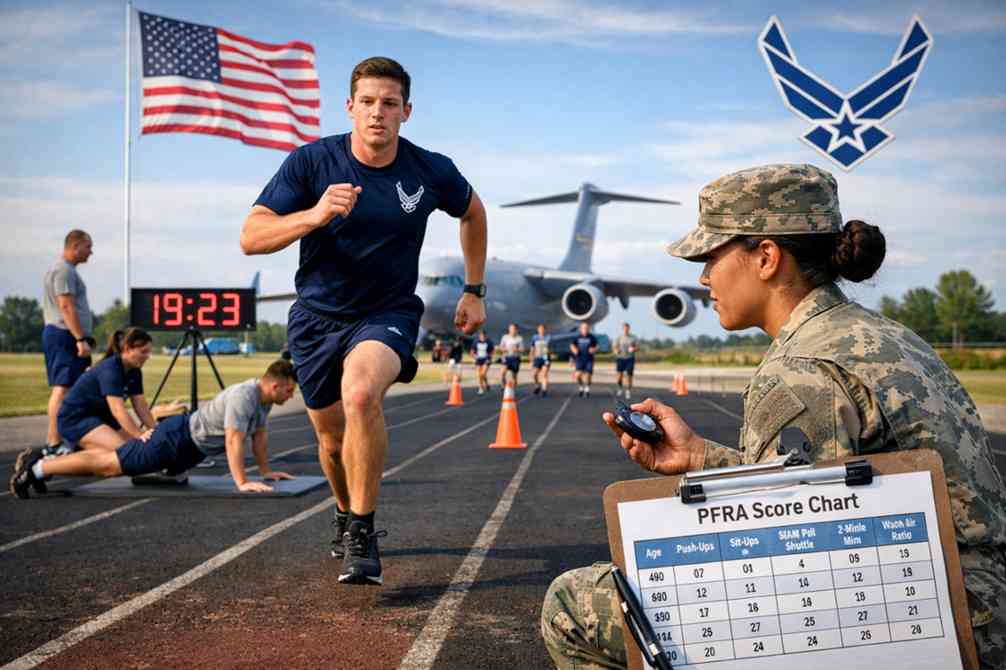
The U.S. Air Force has revised the scoring charts for its new Physical Fitness Readiness Assessment (PFRA), marking a significant step in the service’s effort to modernize physical fitness standards for the largest air force in the world. The updated standards took effect March 1, 2026, as the service begins a three-month diagnostic phase ahead of full implementation later this year.
Airmen will begin recording official scores under the revised standards starting July 1. Until then, the Air Force will use the diagnostic period to collect performance data and make any final adjustments to the test and scoring tables.
The service says the new framework is designed to support long-term readiness and career longevity by promoting sustainable fitness practices across an airman’s career. The PFRA is part of the broader Physical Fitness Readiness Program, which introduces updated scoring models and expanded exercise options.
Revised scoring tables and higher thresholds
The updated PFRA includes changes across all major testing components: aerobic capacity, muscular strength, core fitness and body composition. Airmen must complete the assessment twice per year, consistent with the Air Force’s current fitness testing schedule.
During the diagnostic phase, service members may choose to convert a practice score into an official result if they meet the required standards. The Air Force said the data gathered in the coming months could lead to further adjustments before the final scoring tables are locked in.
The revised charts introduce higher minimum thresholds for many categories compared with preliminary versions released in September. In several cases, airmen will need to complete more repetitions or achieve faster run times to earn the same number of points.
However, the changes are not universally stricter. Some categories reflect shifts in scoring weight rather than higher performance floors.
For example, males under age 25 must complete at least 33 situps to earn 2.5 points under the new chart. Under the earlier version, completing 39 situps earned 2.3 points. In another example, males aged 50 to 54 who complete the two-mile run in 22 minutes and 50 seconds now receive 35 points, compared with 29.5 points under the previous scoring model.
Aerobic testing options expand
The PFRA allows airmen to choose between two aerobic tests: the traditional two-mile run or the 20-meter High Aerobic Multi Shuttle Run, commonly referred to as HAMR.
For the two-mile run, minimum and maximum times vary by age and gender. Males under 25 must finish within 19 minutes and 45 seconds to pass the event, while the maximum performance score is achieved at 13 minutes and 25 seconds. For males aged 60 and over, minimum and maximum times are 24 minutes and 16 minutes 58 seconds, respectively.
Among female airmen under 25, the minimum time is 25 minutes and 23 seconds, with a maximum score awarded for completing the run in 15 minutes and 30 seconds. For females 60 and older, the minimum and maximum times are 29 minutes and 40 seconds and 18 minutes and 20 seconds.
The alternative HAMR test measures aerobic capacity through repeated 20-meter shuttle sprints paced by an audio signal that increases in speed over time. The event ends when an airman fails to reach the line before the signal three consecutive times.
Minimum shuttle counts for males range from 26 repetitions for those over 60 to 42 for those under 25 to earn 35 points. Achieving the maximum score of 50 points requires between 65 and 87 shuttles depending on age. For female airmen, minimum shuttle counts range from 11 for the oldest group to 21 for those under 25.
Multiple strength and core options
The updated PFRA also expands flexibility in strength testing. Airmen may perform either hand-release pushups within a two-minute period or standard pushups in one minute.
Minimum hand-release pushup requirements for males range from 11 repetitions for older airmen to 27 for younger members, while maximum scores require between 36 and more than 52 repetitions. Female minimums range from one to 17 repetitions, with maximum scores between 26 and 42.
Under the standard pushup option, male minimums range from 12 to 30 repetitions and maximums from 38 to 67. Female minimums range from three to 15 repetitions, with maximum scores between 28 and 50.
For core fitness, airmen can choose among three exercises: one minute of situps, two minutes of cross-leg reverse crunches, or a timed forearm plank.
Body composition component
The PFRA also includes a body composition element based on a waist-to-height ratio, replacing older tape measurement methods.
Airmen calculate the ratio by dividing waist circumference by height in inches. The resulting score places individuals into low-, moderate-, or high-risk categories.
For example, an airman measuring 69 inches tall with a 36-inch waist would have a ratio of 0.52, which falls into the moderate-risk band and earns 17 points. Body composition accounts for 20 percent of the overall PFRA score.
Expanded fitness support roles
Alongside the new testing framework, the Air Force is expanding support programs to help personnel meet the revised standards.
The service has introduced Master Fitness Leaders within the sustainment services career field, designated as 3F1. Selected airmen will attend a two-week training course focused on safe conditioning, reconditioning after injury, and adaptive fitness instruction.
Officials have not yet announced when the course will begin, but the program is expected to play a key role in helping units implement the new PFRA standards across the force.
