


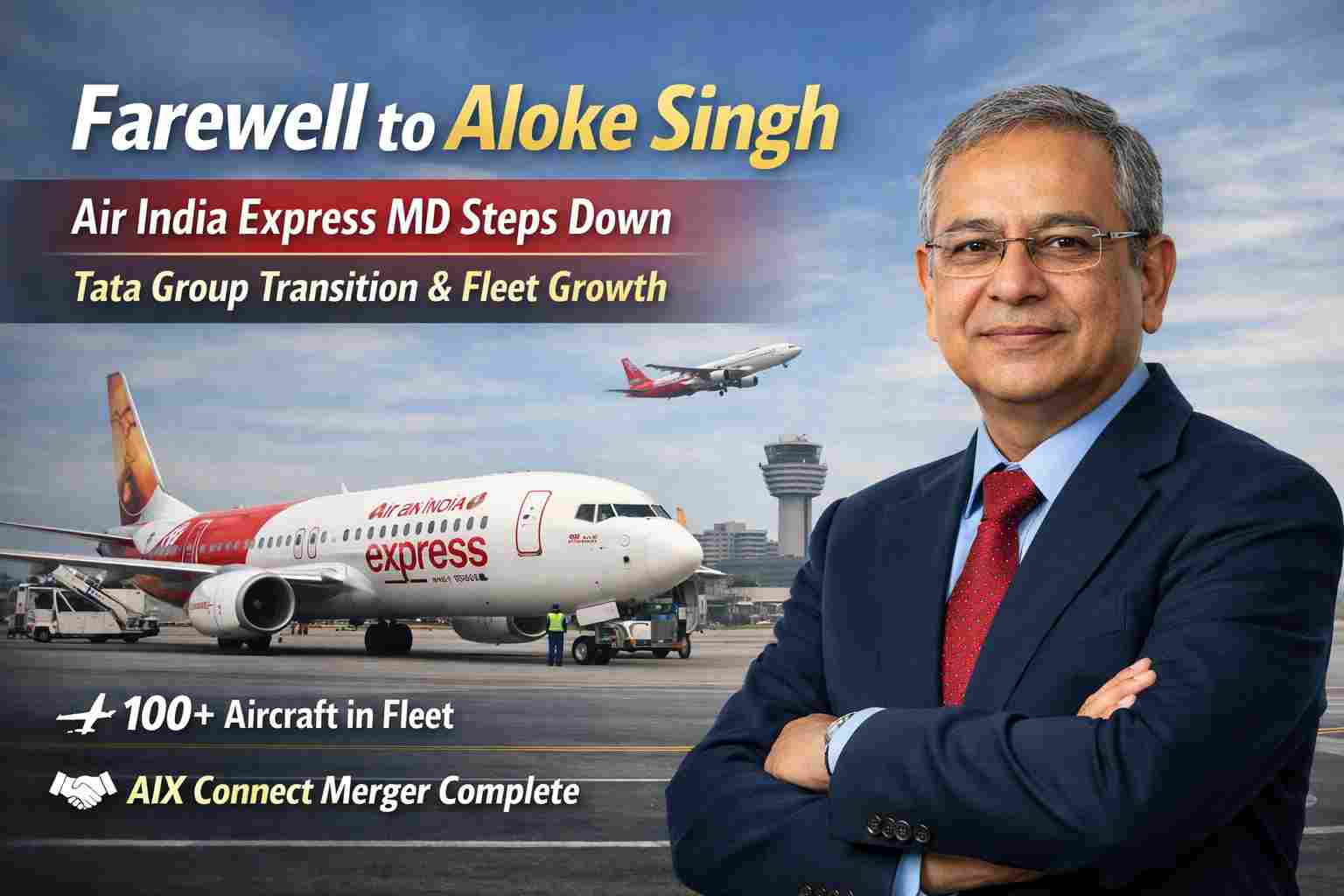
MUMBAI — Air India Express Managing Director Aloke Singh will step down on March 19, concluding a five-year tenure that spanned government ownership, privatization, and one of the most significant restructuring efforts in Indian aviation history.
Singh’s departure marks a transition point for the Tata Group-owned low-cost carrier, which has expanded its fleet fourfold, integrated a sister airline, and repositioned itself as India’s third-largest narrow-body operator during his leadership.
A Defining Five-Year Tenure
Singh joined the then government-owned airline as Chief Executive Officer on November 9, 2020, at a time when the aviation sector was grappling with pandemic-driven disruptions. He later assumed the role of Managing Director for a three-year term beginning March 19, 2023.
In a message to employees confirming his decision, Singh reflected on what he described as a transformative period for the airline.
In his farewell note to staff, Singh said his tenure at Air India Express would conclude on March 19. He expressed pride in the airline’s journey and credited employees for driving its operational and cultural transformation.
He described the past five years as a defining chapter in the airline’s history. Singh emphasized that the organization’s growth was built on resilience, teamwork, and professional excellence during complex operational shifts.
His leadership period is notable for spanning two distinct ownership structures — first under the Indian government and later under the Tata Group, which acquired Air India in January 2022. That transition ushered in sweeping reforms across the Air India Group, including fleet modernization, network rationalization, and operational consolidation.
Tata Group Transition and Strategic Realignment
The privatization of Air India marked a watershed moment for the Indian aviation industry. For Air India Express, it meant aligning more closely with the Tata Group’s broader strategy of building a competitive, cost-efficient aviation portfolio capable of competing in both domestic and international markets.
Singh’s exit represents one of the most significant leadership changes at the airline since the Tata takeover. During his tenure, Air India Express became central to the group’s low-cost operations, focusing on high-demand leisure routes and markets serving migrant workers across the Middle East and Southeast Asia.
His experience managing the airline through both public and private ownership positioned him as a critical bridge between two operational cultures and governance systems.
Fleet Expansion and AIX Integration
One of the most consequential developments during Singh’s tenure was the integration of AIX Connect, formerly known as AirAsia India.
The merger process concluded on October 1, 2024, following months of operational and brand alignment efforts. The integration brought fleet, systems, and workforce under a unified Air India Express brand.
During this period, the airline executed a fourfold fleet expansion. It now operates more than 100 aircraft and serves destinations across India and 14 international markets. The growth significantly expanded its domestic footprint while strengthening regional international connectivity.
The workforce also expanded substantially, with approximately 8,300 employees supporting operations. Singh oversaw the development of a unified brand identity, streamlined internal systems, optimized schedules, and enhanced network efficiency.
The fleet growth and consolidation repositioned Air India Express from a relatively niche operator into a scaled low-cost carrier with meaningful domestic and international presence.
Operational Continuity
Following Singh’s departure, Captain Hamish Maxwell, currently the Chief Operations Officer, will assume the role of Accountable Manager. The appointment is intended to ensure regulatory continuity and operational stability as the airline navigates its next growth phase.
The transition comes at a time when Air India Express is focused on consolidating its expanded network, integrating systems post-merger, and maintaining cost discipline amid industry-wide pressures on fuel prices and capacity.
Looking Ahead
As Air India Express enters its next chapter under Tata ownership, Singh leaves behind an airline markedly different from the one he joined in 2020. The carrier has expanded its fleet beyond 100 aircraft, unified two airline operations, and strengthened its role within the Air India Group’s broader restructuring plan.
While the company has not yet announced a long-term successor, industry observers will be watching closely to see how the airline sustains momentum in a highly competitive and fast-evolving aviation market.
For Air India Express, the leadership transition signals both the close of a transformative era and the beginning of a new strategic phase under Tata stewardship.
