


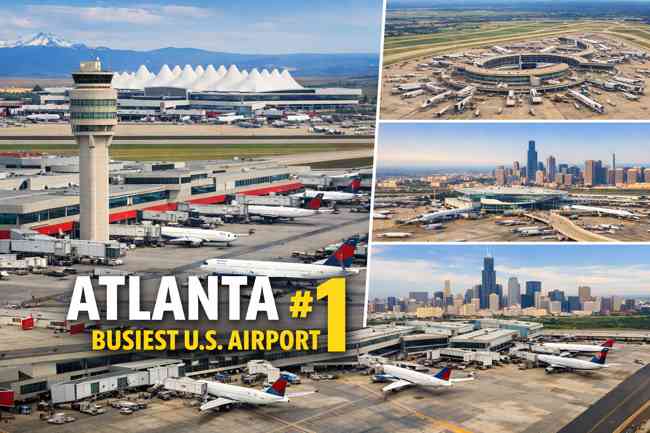
WASHINGTON — Hartsfield-Jackson Atlanta International Airport will remain the busiest airport in the United States in 2025, offering more than 63 million scheduled seats and widening its lead over major domestic rivals. The latest aviation capacity data highlights the continued dominance of large U.S. airline hubs and the strength of domestic travel demand.
Atlanta’s position at the top reflects its central role in airline networks, particularly as the primary hub for Delta Air Lines. The airport’s extensive domestic connectivity has allowed it to sustain steady growth even as global aviation patterns shift.
“The latest 2025 aviation capacity data confirms that Hartsfield-Jackson Atlanta International Airport (ATL) remains the busiest airport in the country, offering 63,100,437 scheduled seats this year. The Atlanta hub continues to dominate the domestic market, supported heavily by operations from Delta Air Lines (DL).”
Dallas/Fort Worth and Chicago O’Hare Follow Closely
Dallas Fort Worth International Airport ranks second with 51,215,128 scheduled seats, reinforcing its role as one of the nation’s most important connecting hubs. Its geographic location allows airlines to efficiently link passengers between East and West Coast destinations, as well as provide access to regional markets.
Chicago O’Hare International Airport placed third with 50,568,521 seats. The Chicago hub also recorded notable growth compared to the prior year.
“The rankings place Dallas Fort Worth International Airport (DFW) second with 51,215,128 seats, followed closely by O’Hare International Airport (ORD), which recorded 50,568,521 seats. These figures highlight the scale of airline capacity concentrated at major U.S. hubs.”
Chicago’s total represents an 8 percent increase over 2024 levels, reflecting airline expansion and continued recovery in travel demand.
Denver and Los Angeles Anchor Western Capacity
Denver International Airport ranked fourth with 49,485,982 scheduled seats, benefiting from expanding domestic and transcontinental routes. Its central location has made it an increasingly important hub for connecting traffic across North America.
Los Angeles International Airport rounded out the top five with 45,082,586 seats, maintaining its position as the primary West Coast gateway despite ongoing infrastructure changes and shifting airline strategies.
These airports play a critical role not only in passenger travel but also in supporting regional economies, airline employment, and cargo transport.
Domestic Travel Continues to Drive U.S. Aviation
The rankings highlight a defining feature of the U.S. aviation system: its heavy reliance on domestic travel.
“The data underscores the dominance of domestic travel in the United States aviation sector. Unlike global hubs that rely heavily on international transit traffic, U.S. airports generate the majority of their capacity from domestic networks.”
John F. Kennedy International Airport ranked sixth nationally with 38,572,589 seats, followed by Orlando International Airport with 34,805,618 seats. Both airports benefit from strong leisure and business travel demand, although their roles differ significantly. Kennedy serves as a major international gateway, while Orlando’s traffic is driven primarily by tourism.
Harry Reid International Airport in Las Vegas also posted strong numbers, with 34,348,589 seats scheduled this year. The airport’s performance reflects continued demand for leisure travel to major entertainment destinations.
Charlotte Douglas International Airport and Miami International Airport rounded out the top 10, offering 32,879,001 and 32,806,479 seats respectively. Both serve as major airline hubs, supporting domestic connections and key international routes.
“Notably, no U.S. airport ranks among the world’s top ten busiest international airports. This contrast highlights the scale and resilience of the domestic aviation market, which continues to anchor overall seat capacity.”
Global Competition Intensifies
While Atlanta remains the world’s busiest airport by total scheduled capacity, global competition is increasing.
“On a global scale, Atlanta retains the top position in total scheduled capacity for 2025. However, Dubai International Airport (DXB) is closing the gap with 62.4 million seats scheduled this year.”
Other major U.S. airports also continue to rank highly worldwide.
“Dallas/Fort Worth and Chicago O’Hare also rank among the top ten busiest airports worldwide in overall capacity. Denver appears in the global top ten as well, reflecting sustained growth in both network expansion and airline base development.”
Despite their overall size, U.S. airports lag global counterparts when it comes specifically to international traffic.
“The absence of U.S. airports in the top ten for international-only capacity reinforces a key industry trend.”
“American hubs depend primarily on extensive domestic connectivity, while airports in Europe and the Middle East rely more heavily on intercontinental transfer traffic.”
Domestic Strength Signals Industry Stability
The latest rankings reinforce the importance of domestic air travel to the U.S. aviation industry’s economic foundation. Large hub airports continue to benefit from airline consolidation, route optimization, and sustained passenger demand.
With millions of additional seats scheduled across major hubs, the data signals continued stability for airlines and airports alike. Atlanta’s commanding lead, along with strong performances from Dallas/Fort Worth, Chicago, and Denver, illustrates how domestic connectivity remains the cornerstone of the U.S. air travel system.
