


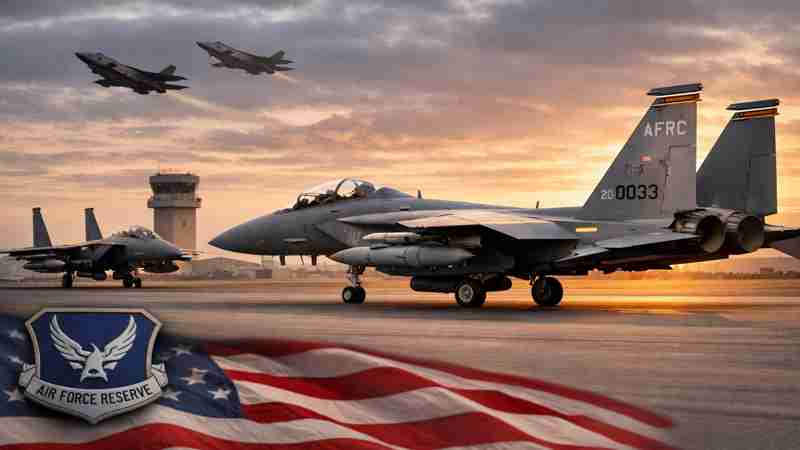
Reserve Seeks to Halt Long Pattern of Aircraft Losses
GEORGIA — The U.S. Air Force Reserve Command is pressing to acquire surplus F-15E Strike Eagles and new F-15EX Eagle II fighters as it faces the retirement of aging aircraft, a move leadership says is critical to preserving combat capability and controlling costs.
Lt. Gen. John P. Healy, chief of the Reserve Command, is advocating for the changes as part of broader service-wide modernization efforts. “The feasibility of transferring F-15E or allocating F-15EX aircraft depends on broader force structure decisions and procurement growth,” according to the proposal.
Speaking at the Air & Space Forces Association Warfare Symposium, Healy said the Reserve must align with the Air Force’s 10-year fighter plan while ensuring experienced personnel and operational readiness are not lost during fleet transitions.
The Reserve, headquartered at Robins Air Force Base, oversees a wide network of operational units, including flying wings, intelligence units, and cyber forces. Despite providing about 14% of the Air Force’s total capability, it consumes only about 4% of its manpower budget, a disparity Healy frequently highlights as evidence of efficiency.
Fighter Plan Creates Risk of Experience Drain
The Air Force’s long-term roadmap calls for nearly 1,400 combat-ready tactical aircraft by 2030, including expanded procurement of F-35s, F-15EX fighters, and future platforms.
However, several Reserve squadrons are scheduled to retire aircraft without guaranteed replacements, raising concerns that combat-experienced personnel could leave the service. Many Reserve units include pilots and crews with extensive operational experience, including recent combat deployments.
Healy has warned that retiring aircraft without recapitalization risks losing those skilled airmen. He acknowledged the aging nature of the fleet, noting that nearly 80% of Reserve aircraft are legacy systems, but argued modernization must happen in parallel with retirements.
Healy stated that the longstanding practice of divestment without recapitalization over the past 14 years must end.
Surplus Strike Eagles Could Provide Stopgap
One possible solution involves transferring existing F-15E Strike Eagles from active-duty units to Reserve squadrons.
The Air Force currently operates 218 F-15Es with two different engine variants. Older models powered by F100-PW-220 engines have been targeted for retirement by fiscal year 2028, freeing funding for newer systems.
Lawmakers, however, have expressed concern that retiring these aircraft too quickly could reduce overall combat capacity.
Another potential source of aircraft could come from Strike Eagle squadrons stationed at RAF Lakenheath in the United Kingdom. Those aircraft are expected to transition to F-35 fighters in the future, potentially freeing newer F-15Es for Reserve use.
Even older F-15Es could provide value in Reserve roles, preserving operational capability while allowing active-duty units to modernize.
F-15EX Procurement Offers Long-Term Opportunity
The newer F-15EX Eagle II fighter represents another key opportunity for the Reserve, though procurement levels remain uncertain.
Earlier plans called for at least 144 aircraft, but the fiscal year 2026 proposal increased the program’s total from 98 to 129 aircraft, including conversions from A-10 squadrons. Further expansion would likely be needed for Reserve units to receive the new jets.
Reserve squadrons currently flying A-10s, F-16s, or older F-15s could eventually transition to the F-15EX, depending on final force structure decisions.
Healy has also advocated for Reserve units losing F-16 aircraft to receive F-35 replacements to maintain advanced combat capability.
Cost Advantages Strengthen Reserve’s Case
A central argument for recapitalizing the Reserve is financial efficiency.
Operating costs for Reserve units are significantly lower than their active-duty counterparts. A Reserve F-16 squadron costs about $12 million less per year to operate, while Reserve F-15E squadrons save about $28 million annually. The newer F-15EX would still deliver estimated savings of $24 million per squadron.
These savings stem from the Reserve’s personnel model. Of roughly 67,000 personnel, only about 14,000 serve full-time, with the rest serving part-time but available for activation when needed.
This structure reduces overhead while maintaining readiness, allowing the Air Force to reinvest savings into modernization programs.
Healy argues that these efficiencies make recapitalizing the Reserve a strong business case as well as a strategic necessity.
Strategic Future Hinges on Procurement Decisions
Ultimately, whether the Reserve receives F-15E transfers or new F-15EX fighters will depend on broader Air Force procurement and force structure decisions.
Still, leadership believes the Reserve’s proven performance, combined with its cost advantages, strengthens its position.
Healy emphasized that the Reserve remains essential to the Air Force’s operational readiness and combat capability.
If approved, the aircraft transfers would mark a reversal from more than a decade of declining Reserve fighter inventory and help ensure the Reserve remains a key component of U.S. airpower.
The outcome will shape not only the Reserve’s future, but also the Air Force’s ability to balance modernization, cost efficiency, and combat readiness in the years ahead.
