


Demonstration Program Signals Push Toward Zero-Emission Aviation
WELLINGTON, New Zealand — Air New Zealand has completed more than 100 test flights of an all-electric aircraft, marking a significant step in the airline’s evaluation of zero-emission technology and its potential introduction into commercial service by 2028.
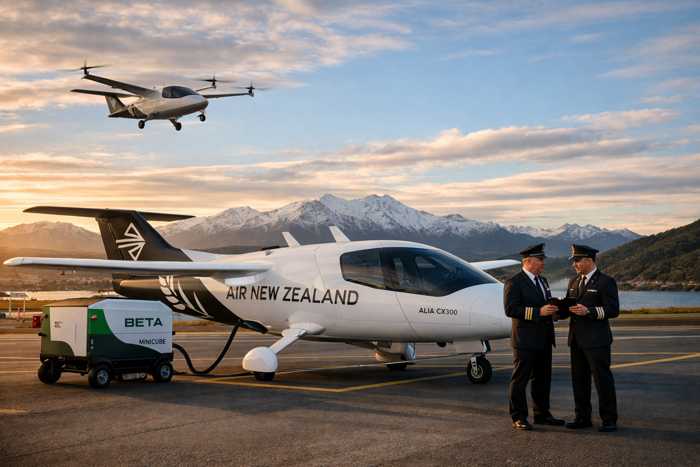
The demonstration involved the Alia CX300, an electric cargo aircraft developed by U.S.-based Beta Technologies. The aircraft conducted flights throughout New Zealand over several months, operating from Hamilton and Wellington and visiting 12 airports to simulate real-world cargo routes.
The airline confirmed the aircraft will depart from Tauranga and return to its Vermont-based manufacturer following the completion of the evaluation phase.
Air New Zealand said the trials were designed to assess operational performance, infrastructure readiness, and long-term feasibility as part of its broader sustainability strategy.
Real-World Testing Provides Operational Insights
The trial program focused on understanding how electric aircraft perform under varying weather conditions and operational scenarios typical of regional aviation.
According to company executives, the aircraft performed within its approved operational limits throughout the testing period, providing valuable operational data for the airline’s planning teams.
Pilots involved in the program included captains and first officers who typically operate Boeing 777 and 787 widebody aircraft. Their participation reflects the airline’s effort to evaluate how electric aircraft might integrate into existing flight operations.
They described the experience as both technically challenging and professionally rewarding, highlighting the collaborative approach required for emerging aviation technologies.
The flights simulated cargo transport missions, one of the most likely early use cases for electric aircraft due to shorter route distances and fewer passenger-related constraints.
Charging Infrastructure Emerges as Key Challenge
Air New Zealand said infrastructure readiness remains one of the most important factors in determining when electric aircraft can enter commercial service.
The airline worked closely with airport operators to test charging capabilities and electrical capacity requirements. Wellington Airport supported ground operations during the trial, while Marlborough Airport upgraded a transformer to meet the aircraft’s charging needs.
Both locations installed higher-capacity electrical outlets compatible with Beta Technologies’ Minicube mobile charging system.
The Minicube provides 65 kilowatts of charging power and can recharge the aircraft’s batteries in approximately 90 minutes. A future fixed charging system is expected to deliver up to 320 kilowatts, significantly more powerful than most electric vehicle fast chargers currently in operation.
Executives emphasized that electric aircraft must maintain sufficient energy reserves for safety, similar to conventional aircraft fuel requirements, making reliable and high-capacity charging infrastructure essential.
Certification and Commercial Timeline Still Uncertain
Before entering commercial service, the Alia CX300 must receive certification from the Federal Aviation Administration, a process that remains ongoing.
Air New Zealand’s Next Generation Aircraft Programme is evaluating whether the aircraft could be deployed on regional cargo routes as part of its future fleet.
The airline has identified 2028 as a potential entry-into-service timeline, based on current production and certification projections.
However, the company cautioned that no final decision has been made on whether the aircraft will become part of its long-term fleet.
Chief Executive Nikhil Ravishankar told lawmakers that it remains uncertain whether the Alia CX300 will ultimately form part of the airline’s long-term fleet solution, reported The New Zealand Herald.
Strategic Learning Phase for Future Investment
Air New Zealand described the demonstration program as a strategic learning initiative aimed at gathering data rather than committing to immediate fleet purchases.
The airline is studying how electric aviation could affect regional connectivity, operating costs, and emissions reduction goals.
Electric aircraft have the potential to reduce fuel costs, lower maintenance requirements, and eliminate direct carbon emissions, but their adoption will depend heavily on regulatory approval, technological maturity, and infrastructure investment.
By conducting cross-country flights and testing charging logistics, Air New Zealand has gained firsthand operational insights that will help guide future investment decisions.
The airline said the program also supports New Zealand’s broader ambition to remain at the forefront of sustainable aviation development.
While significant challenges remain, the completion of the trial flights represents an important milestone as the aviation industry explores alternatives to fossil fuel-powered aircraft and moves toward lower-emission transportation solutions.
