


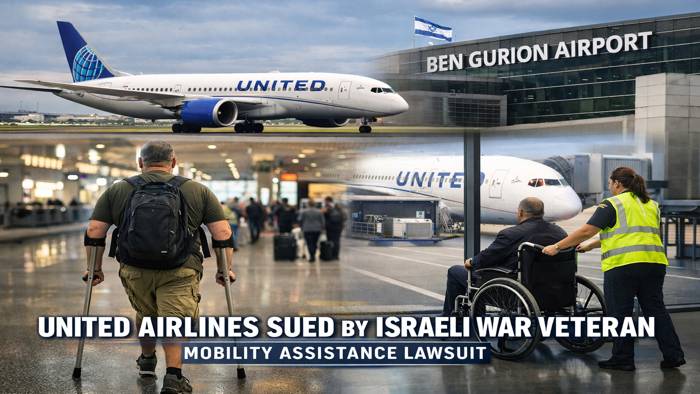
Lawsuit Filed in Illinois Raises Questions About Airline Liability
CHICAGO — United Airlines is facing a negligence lawsuit filed by an Israeli military veteran who lost his leg during the 2014 Gaza conflict and alleges the carrier failed to provide required mobility assistance during a return flight from Israel last year.
The lawsuit, filed in February 2026 in an Illinois district court, seeks damages under the Montreal Convention, the international treaty governing airline liability during international travel.
The plaintiff, identified in court filings as YK, now resides in Illinois and depends on a battery-powered mobility device due to catastrophic injuries suffered while serving as a reserve soldier in the Israel Defense Forces during the 2014 Gaza war.
Injury and Travel Background
During the conflict, YK sustained severe injuries that resulted in the amputation of one leg and multiple surgeries involving his hand and spine, leaving him permanently disabled.
In November 2025, he traveled from Chicago O’Hare International Airport to Ben Gurion Airport aboard United Airlines for a one-week visit. According to the complaint, the outbound trip proceeded without incident, and he was permitted to use his powered mobility device up to the departure gate.
However, the dispute centers on his return flight to the United States. The lawsuit alleges that airport staff required him to surrender his wheelchair at the check-in counter in Tel Aviv and that United failed to provide an alternative means of transportation to the aircraft.
According to the complaint, YK was forced to move through the airport on one leg to reach his departure gate.
The filing states that he suffered “significant physical pain, bodily injury, and aggravation of pre-existing medical conditions as a direct result of United’s conduct.”
Legal Focus on the Montreal Convention
The case hinges on Article 17 of the Montreal Convention, which holds airlines liable for passenger injuries sustained during international carriage, including the boarding and disembarking process.
While the treaty explicitly refers to injuries occurring during boarding, courts have long debated when that process officially begins. The complaint argues that United’s responsibility extended to providing safe and adequate mobility assistance during pre-boarding procedures within the terminal.
Legal precedent suggests courts may interpret airline responsibility broadly in some cases.
For example, a passenger named Andreas Wuchner was allowed to pursue legal action against British Airways after suffering a traumatic brain injury in a 2017 airport accident. He slipped on a puddle in a departure hall, and a judge ruled airline staff could have prevented the incident by addressing the hazard.
YK’s lawsuit could similarly test how U.S. courts define airline liability during the period before passengers physically board an aircraft.
History of Mobility-Related Controversies
United Airlines has faced scrutiny in recent years over its handling of disabled passengers and mobility equipment.
In 2023, the airline pledged improvements after federal investigators criticized its procedures following the death of disability rights activist Engracia Figueroa.
Figueroa died in 2021 after her customized wheelchair was damaged during a United flight. The airline provided a temporary manual wheelchair while attempting repairs, and she later developed an infection linked to a pressure ulcer, which contributed to her death.
United eventually agreed to replace her specialized wheelchair at a cost of $30,000, but the incident intensified calls for stricter protections and better training related to mobility assistance.
Broader Business and Operational Implications
The outcome of YK’s lawsuit could have significant operational and legal implications for airlines operating international routes, particularly regarding their reliance on third-party ground service providers.
Airlines typically coordinate with airport authorities and contractors to assist passengers with disabilities, but courts may examine whether carriers retain ultimate responsibility for ensuring assistance is properly delivered.
A ruling in favor of the plaintiff could push airlines to implement tighter oversight of accessibility services at foreign airports and potentially increase legal exposure under international treaties.
The case also highlights ongoing industry challenges in balancing operational efficiency with compliance obligations and passenger safety.
United Airlines has not publicly commented on the lawsuit, and the case remains pending in federal court.
As litigation proceeds, aviation industry observers say the decision could help clarify the boundaries of airline liability during the pre-boarding phase — an issue with far-reaching consequences for carriers, passengers, and airport operators worldwide.
