


Record Production and Allied Demand Drive Regional Airpower Growth
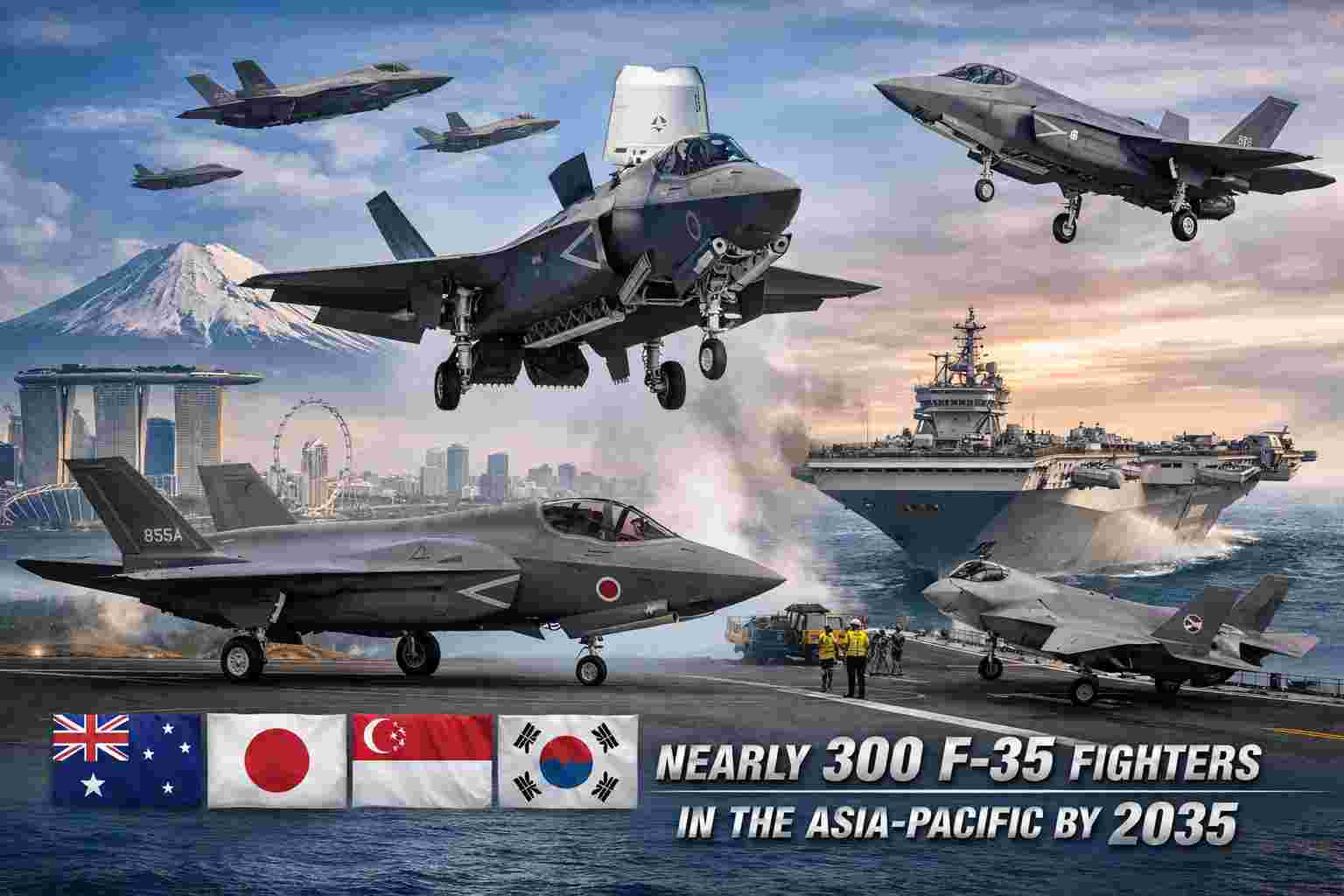
SINGAPORE — Lockheed Martin expects the collective fifth-generation fighter fleet operated by U.S. allies in the Asia-Pacific to approach 300 aircraft by 2035, underscoring the accelerating pace of defense modernization in one of the world’s most strategically contested regions.
Speaking at the Singapore Airshow at Singapore Changi Airport, a senior Lockheed Martin executive said the forecast reflects both record production levels for the F-35 Lightning II program and deepening operational cooperation among allied nations. The projection comes as deliveries of the aircraft reach historic highs and regional security concerns continue to intensify.
Executives emphasized that the growth trajectory is not simply a function of new orders, but also of sustained industrial output and long-term commitments from partner nations seeking advanced air combat capabilities.
F-35 Production Reaches Historic Highs
Lockheed Martin delivered 191 F-35 aircraft worldwide last year, marking the highest annual output in the program’s history. For the current year, the company expects to deliver approximately 156 jets, a pace executives described as a sustainable production balance following the recent surge.
The company said strong allied demand has helped maintain steady output despite ongoing global supply chain pressures. Asia-Pacific customers have emerged as a central pillar of that demand, driven by the region’s strategic geography, evolving threat environment, and emphasis on interoperability with U.S. forces.
The F-35’s combination of stealth design, advanced sensors, integrated avionics, and secure data-sharing capabilities allows participating air forces to operate as a single, networked force. Lockheed Martin executives said this multi-domain integration — across air, sea, and land — is a key factor behind sustained interest in the platform.
Asia-Pacific Operators Form the Core Fleet
Four U.S. allies currently anchor F-35 operations in the Asia-Pacific: Australia, Japan, Singapore, and South Korea. Together, they represent the backbone of fifth-generation airpower in the region and regularly participate in multinational training and operational exercises.
Japan and Singapore have ordered both the F-35A conventional takeoff and landing variant and the F-35B short takeoff and vertical landing variant. The F-35B provides additional operational flexibility, enabling operations from amphibious ships and shorter or austere runways.
Japan is expected to become the world’s second-largest F-35 operator after the United States, reflecting a significant expansion of its air combat capabilities. Australia has completed deliveries of 72 aircraft and declared full operational capability, while South Korea currently operates 40 F-35As and has signaled interest in additional purchases, according to regional media reports.
Security Environment Shapes Demand
Lockheed Martin executives directly linked the expanding F-35 fleet to the increasingly complex security environment in the Asia-Pacific. China’s rapid development and deployment of advanced fighter aircraft over the past decade has reshaped regional airpower dynamics and heightened the focus on next-generation capabilities.
Fifth-generation fighters offer substantial advantages over older platforms, including enhanced survivability, superior situational awareness, and the ability to share real-time data across forces. These attributes are critical for maintaining air superiority and executing joint missions in high-end conflict scenarios.
The company stressed that the strategic value of the F-35 lies not only in the number of aircraft delivered, but also in the level of interoperability achieved among allied forces.
Sustainment and Interoperability Take Center Stage
As fleets mature, Lockheed Martin said sustainment and readiness are becoming central priorities. Japan is converting its final assembly and check-out facility into a maintenance, repair, and overhaul hub, strengthening regional support infrastructure for allied F-35 operators.
Regular multinational exercises are designed to ensure pilots, maintainers, and command-and-control systems can operate seamlessly in contested environments. Executives noted that this emphasis on integration enhances deterrence by demonstrating collective operational capability rather than isolated national strength.
Lockheed Martin described the F-35 as the only fifth-generation fighter currently available on the global export market, adding that partnerships in the Asia-Pacific continue to deepen as allied nations focus on resilience, readiness, and collective defense.
Bottom Line
Record F-35 deliveries are rapidly reshaping the balance of airpower across the Asia-Pacific, with U.S. allies on track to field nearly 300 aircraft by 2035. As Australia, Japan, Singapore, and South Korea expand and refine their fifth-generation capabilities, the emphasis is shifting from acquisition to long-term sustainment and joint operations.
With interoperability now matching fleet size in strategic importance, the F-35 has emerged as a central pillar of allied deterrence and air superiority in an increasingly contested regional security environment.
