


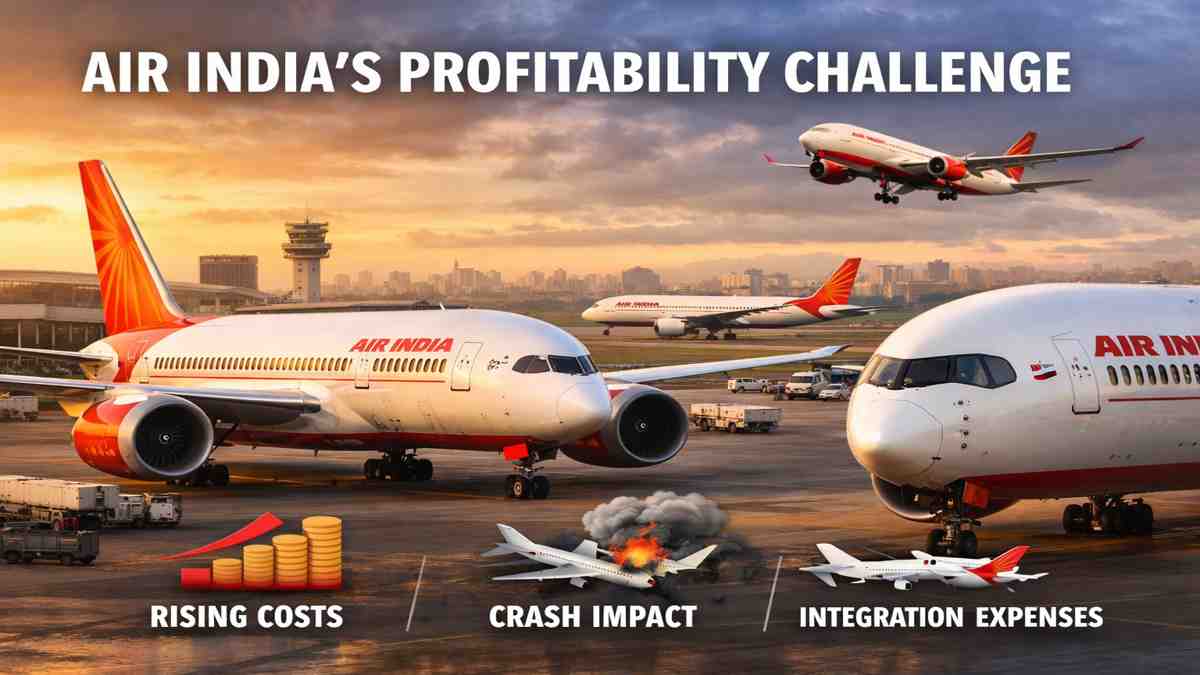
GURUGRAM — Tata Group-owned Air India is resetting expectations for its long-awaited financial turnaround, with profitability now likely several years later than initially planned. Rising operational costs, prolonged airspace restrictions, fallout from a fatal crash, and the expense of integrating multiple airline units are weighing on the carrier’s recovery, according to people familiar with the matter.
The full-service airline, jointly owned by Tata Group and Singapore Airlines, now expects to reach break-even and post profits only after three to four more years. That timeline effectively shifts the target beyond the original five-year window outlined under its post-privatization transformation plan, pushing potential profitability toward fiscal 2029 or 2030.
Vihaan.AI Roadmap Faces Delays
Air India launched its five-year Vihaan.AI transformation program in September 2022 following its return to Tata Group ownership. The plan set milestones across fleet renewal, network expansion, service upgrades, market share growth, and a return to profitability within five years.
Sources now indicate that those targets are being recalibrated. Escalating costs, operational disruptions, integration expenses, and uncertainty in global demand have slowed progress. Air India, Tata Sons, and Singapore Airlines have not issued formal public comments on the revised timeline.
Mounting Losses Highlight Restructuring Phase
Official data shared in India’s Parliament shows that Air India and Air India Express together posted a loss before tax of Rs 9,568.4 crore for the fiscal year ended March 31, 2025. Air India recorded a loss before tax of Rs 3,890.2 crore, while Air India Express reported a loss before tax of Rs 5,678.2 crore, despite having been profitable in earlier years.
According to industry sources, combined group losses could exceed Rs 15,000 crore in the fiscal year ending March 31, 2026, if current cost pressures persist. Given Air India’s multi-billion-dollar annual revenue base, analysts view these losses as reflective of a deep restructuring cycle rather than a short-term dip.
Pakistan Airspace Restrictions Add Billions in Costs
A key operational challenge has come from Pakistan’s airspace restrictions, which have forced Air India to reroute several westbound flights to Europe and North America. These longer routes increase flight time, fuel consumption, crew duty hours, and aircraft utilization.
Air India CEO and Managing Director Campbell Wilson stated earlier that the estimated financial impact from these restrictions alone is about Rs 4,000 crore. Beyond direct costs, the longer routings reduce scheduling flexibility and push up per-flight operating expenses on long-haul sectors.
Dreamliner Crash Compounds Financial Pressure
On June 12, 2025, an Air India Boeing 787-8 Dreamliner operating from Ahmedabad to London Gatwick crashed shortly after takeoff, resulting in 260 fatalities, including 241 passengers and crew. The tragedy has had significant financial and operational consequences.
While aviation insurance typically covers aircraft hull losses and third-party liability, airlines still face deductibles, uninsured expenses, legal processes, compensation payments, technical inspections, and indirect revenue losses stemming from schedule disruptions and capacity adjustments.
Integration of Group Airlines Continues
Air India’s turnaround also involves consolidating its low-cost operations. Air India Express and AIX Connect, formerly AirAsia India, are being merged into a single low-cost platform. The integration is designed to eliminate duplication, improve scale efficiencies, and streamline fleet and crew deployment.
In the near term, however, integration costs, system harmonization, and brand transition expenses are adding pressure to the group’s financials, even as management positions the merger as essential for long-term cost reduction.
Fleet Renewal Anchors Long-Term Strategy
Fleet modernization remains central to Air India’s recovery plan. The group currently operates about 190 aircraft and has placed orders for more than 570 jets from Airbus and Boeing, spanning narrowbody and widebody types.
These include Airbus A320neo family aircraft for domestic and regional routes, alongside Airbus A350 and Boeing 787 and 777 variants for long-haul expansion. The airline has already inducted its first Boeing 787-9 after privatization. New-generation aircraft offer improved fuel efficiency and lower maintenance costs, supporting margin improvement over time.
Market Share Ambitions Remain Intact
Under Vihaan.AI, Air India is targeting at least a 30 percent share of India’s domestic market and a stronger foothold in international long-haul travel. The domestic market is currently dominated by IndiGo, with the Air India group holding a significantly smaller combined share.
Network growth is focused on strengthening hubs in Delhi and Mumbai, with expanded capacity planned for North America, Europe, and key Asia-Pacific routes. Despite near-term headwinds, management continues to position scale, fleet renewal, and hub development as the foundation for sustainable profitability later this decade.
