


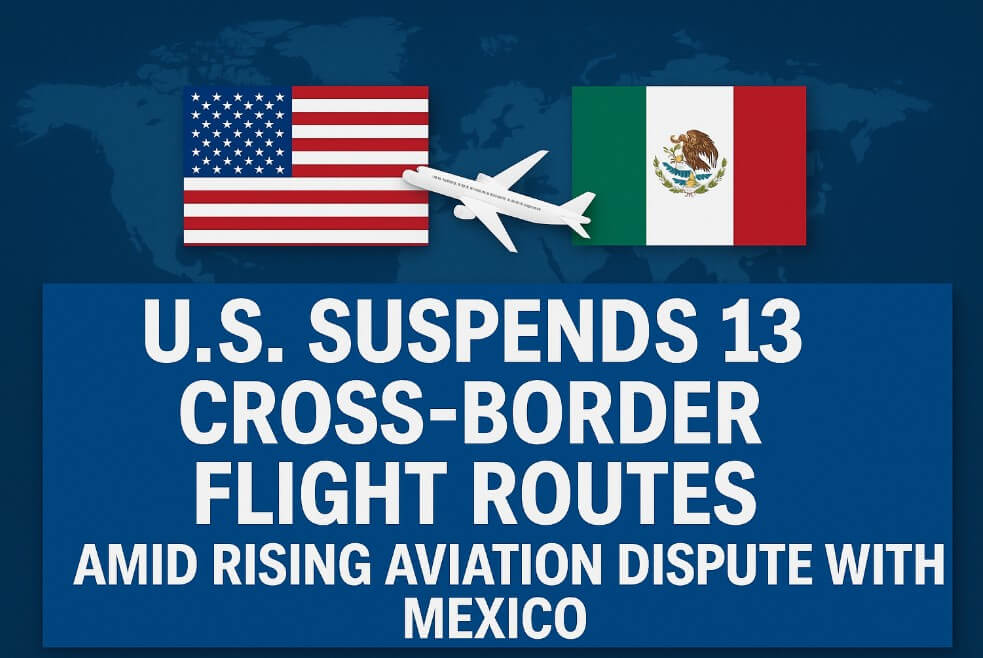
WASHINGTON, D.C. — The U.S. Department of Transportation (DOT) has ordered the suspension of 13 commercial flight routes between the United States and Mexico, escalating a years-long dispute over air competition and compliance with the countries’ 2015 Open Skies Agreement.
The decision, announced Friday, affects major Mexican carriers including Aeroméxico, Volaris, and Viva Aerobus, and will ground multiple routes linking U.S. cities to Mexico City’s Benito Juárez International Airport (MEX) and the newer Felipe Ángeles International Airport (NLU). The DOT cited “unfair aviation practices” and violations of competition laws as the basis for the move, which takes effect November 7, 2025.
The order also bans all Mexican airline operations between Felipe Ángeles International Airport and any U.S. destination, effectively closing that cross-border corridor. The suspension could impact thousands of travelers and disrupt one of North America’s busiest aviation markets.
DOT Targets Competitive Imbalance
The action marks the most significant shift in U.S.–Mexico air policy since the Open Skies Agreement, which was designed to allow airlines to freely determine routes, capacity, and pricing without government interference. In recent years, however, U.S. officials have accused Mexico of undermining the deal by restricting airport access for American carriers.
At the center of the dispute is the allocation of flight slots at Mexico City’s congested airports. U.S. regulators argue that Mexico has unfairly favored domestic airlines, including through preferential slot assignments at MEX and NLU. The DOT described these practices as “anti-competitive and inconsistent with the spirit of Open Skies.”
The agency specifically called out Aeroméxico’s partnership with Delta Air Lines, labeling the arrangement “legalized collusion” that gives the two carriers a dominant 60 percent share of U.S.–Mexico City passenger traffic. “Restoring open competition takes priority over individual airline losses,” the DOT said in its ruling.
Legal Challenge and Industry Pushback
Delta and Aeroméxico have appealed the decision, asking the U.S. Court of Appeals to delay the order while they seek judicial review. The airlines warned that abruptly dissolving their joint venture would cause “significant financial harm” and reduce transborder connectivity.
Their partnership, launched under the Open Skies framework, has been a cornerstone of cross-border travel for nearly a decade, linking major U.S. hubs such as Atlanta, Los Angeles, and New York to Mexico’s primary business and leisure destinations.
The legal standoff follows years of growing friction. In 2022, several U.S. airlines accused Mexico of breaching Open Skies after losing flight slots at Benito Juárez International Airport. That same year, the U.S. downgraded Mexico’s aviation safety rating, citing deficiencies in regulatory oversight. Although the rating was restored in 2023, tensions over access and compliance persisted.
Impact on Passengers and Markets
Travelers booked on the affected routes will be eligible for full refunds or rebooking, the DOT confirmed. The suspended routes include several popular links to U.S. airports in Houston, Los Angeles, Miami, Dallas/Fort Worth, and New York.
Viva Aerobus, which faces the most extensive cancellations, acknowledged that “the suspension will impact thousands of passengers” and called for “constructive dialogue” between the two governments to resolve the dispute and “limit disruption.”
While major U.S. airlines such as American Airlines, United Airlines, and Delta Air Lines will continue operating most of their Mexico City services, analysts warn that reduced competition could push fares higher and limit seat availability during the busy holiday and spring travel seasons.
Political and Diplomatic Fallout
Mexican President Claudia Sheinbaum sharply criticized the U.S. decision, warning that it could “strain bilateral travel and trade.” She announced plans to meet with domestic airline executives and seek talks with the U.S. Secretary of State to reach a “fair resolution.”
Industry analysts say the dispute could become a broader test of U.S.–Mexico economic cooperation, particularly as cross-border air travel remains a key pillar of tourism and commerce. The United States is Mexico’s largest aviation partner, accounting for more than two-thirds of its international passenger traffic.
Unless the DOT revises its directive or the two governments reach a new understanding, airlines may be forced to reroute flights through Benito Juárez International Airport or reduce frequencies altogether.
The Canceled Routes
The order suspends 13 routes, including:
-
Aeroméxico (AM): Mexico City (MEX)–San Juan (SJU); Mexico City (NLU)–Houston (IAH); Mexico City (NLU)–McAllen (MFE).
-
Volaris (Y4): Mexico City (MEX)–Newark (EWR).
-
Viva Aerobus (VB): Mexico City (NLU)–Austin (AUS); JFK (NYC); Chicago O’Hare (ORD); Dallas/Fort Worth (DFW); Denver (DEN); Los Angeles (LAX); Miami (MIA); Orlando (MCO).
-
General Suspension: All Mexican carrier flights between Felipe Ángeles International Airport and any U.S. destination.
Outlook
Both governments have expressed willingness to resume discussions, but no formal timeline has been announced. For now, travelers are urged to verify bookings directly with their airlines and monitor official updates from the DOT and Mexico’s civil aviation authority.
The coming months will reveal whether the skies between the U.S. and Mexico can reopen under truly “open” terms—or whether a broader aviation rift is taking shape in the hemisphere’s busiest travel corridor.
